What's inside
As an Amazon Associate I earn from qualifying purchases. This post may contain affiliate links at no extra cost to you.
What we cover
Best Screwdriver Magnetizers: Top Picks for Strong, Reliable Hold
For most home and shop users, choose a compact permanent-magnet block with separate magnetizing and demagnetizing slots; the Wiha Magnetizer/Demagnetizer is a dependable all-around pick, while a magnetic screw-holding guide is the better choice when overhead work demands more than a magnetized tip alone. A magnetizer can help a screwdriver pick up and retain screws, but hold varies with the shaft’s material and shape, the screw’s size, and how much vibration or side force the job involves.
Top picks by job
Best all-around: Wiha Magnetizer/Demagnetizer
Wiha’s small handheld block combines magnetizing and demagnetizing functions in one tool. It suits common steel-shaft screwdrivers and is easy to keep in a tool bag. Its main limitation is the same one shared by most compact blocks: the opening must accommodate the shaft, and a magnetized tip is not a substitute for a screw guide when working above your head.
As an Amazon Associate we earn from qualifying purchases at no extra cost to you.


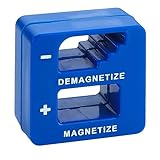
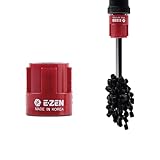
Best simple alternative: Klein Tools Screwdriver Magnetizer/Demagnetizer
Klein Tools also makes a compact magnetizer/demagnetizer for screwdriver shafts. It is a sensible choice if you already buy Klein hand tools or want a straightforward, no-battery accessory. Compare the opening against your largest shaft before buying; broad or unusually shaped shafts may not pass through the working slot as smoothly as standard round and hex shafts.
Best for overhead fastening: a magnetic screw-holding guide
For a screw that must stay aligned while you start it overhead, consider a magnetic screw-holding attachment or a screwdriver with a dedicated screw-holding feature. These products physically support or surround the screw, which can be more reliable than relying on residual magnetism alone. Check that the guide matches the driver bit and screw head you use; a guide intended for one profile may obstruct another.
Best for a mixed toolkit: two magnetizers or a magnetizer plus a holder
If several people share tools, or you move between electronics, cabinetry, and rough construction, keep one magnetizer at the bench and another in the field kit. For frequent overhead work, pair one with a screw guide. A demagnetizer is useful when magnetism attracts filings or interferes with delicate assembly, but it does not restore a worn or damaged screwdriver tip.
Comparison at a glance
Dimensions and weights vary by version and market. The figures below are practical buying targets, not claimed manufacturer specifications; confirm the exact model’s dimensions before ordering, especially for large shafts.
| Option | Approx. size | Approx. weight | Magnetizing | Demagnetizing | Best use |
|---|---|---|---|---|---|
| Wiha Magnetizer/Demagnetizer | About 50–60 × 30–40 × 20–25 mm | About 25–50 g | Yes; pass a compatible steel shaft through the marked slot | Yes; use the designated demagnetizing path | General workshop and home-tool use |
| Klein Tools Screwdriver Magnetizer/Demagnetizer | About 50–65 × 30–45 × 20–25 mm | About 25–55 g | Yes; compact permanent-magnet design | Yes; separate area or path | Basic hand-tool kits |
| Magnetic screw-holding guide | Often about 30–100 mm long | Often about 10–40 g | Not necessarily; some are magnetic, some retain mechanically | Usually no | Starting screws overhead or in awkward positions |
| Magnetized screwdriver with no accessory | Depends on driver | No added weight | May retain magnetism from prior use | No controlled demagnetizing function | Light, occasional fastening |
These approximate ranges help with storage and handling, but they do not predict magnetic strength. Compact blocks rarely publish a directly comparable holding-force rating, and screw retention depends heavily on the driver tip and fastener. Treat a claimed ability to “hold screws” as a starting point, not a guarantee for every overhead task.
What matters more than the strongest magnet
- Shaft compatibility: Most blocks work with common steel shafts, but the shaft must fit the slot. Check the largest shaft diameter or width you expect to use. A wide insulated handle may not pass through even if the metal shaft itself would.
- Driver material: Magnetizers work on ferromagnetic materials such as many steel tools. They will not make a nonmagnetic shaft reliably magnetic. Some stainless steels respond weakly or not at all, depending on their composition.
- Tip condition and screw fit: A worn or poorly matched tip can slip out of the screw recess. Magnetism helps retain the fastener; it does not correct the wrong bit size or profile.
- Demagnetizing control: A dedicated demagnetizing area is useful when screws or metal chips keep sticking during precision work. Follow the tool’s markings rather than repeatedly dragging the shaft through whichever opening is closest.
- Overhead security: A magnetized tip is useful for positioning and starting a screw, but gravity, impact, and vibration can still dislodge it. A screw-holding guide is the more appropriate choice when dropping a fastener would be costly or unsafe.
Choose by situation
| Your situation | Best fit | Why |
|---|---|---|
| Occasional repairs, lowest cost | Basic magnetizer/demagnetizer block | Inexpensive, compact, and usually adequate for ordinary steel drivers |
| Frequent workshop use | Wiha or Klein block, kept at the bench | Easy to access and offers both magnetizing and demagnetizing |
| Large or specialty shafts | A model whose slot is confirmed to fit, or a compatible magnetic holder | Prevents buying a block that cannot accept the tool |
| Repeated overhead fastening | Screw-holding guide or purpose-built screw-holding driver | Provides more support than magnetism alone |
| Precision assembly where stray metal is a nuisance | Block with a clearly marked demagnetizing function | Lets you reduce unwanted attraction when needed |
How to magnetize a driver for better screw retention
- Check the shaft. Make sure it is steel and fits through the magnetizing slot. Wipe off oily residue and filings so debris does not collect in the block.
- Follow the marked direction. Move the shaft through the magnetizing channel as the manufacturer directs. If the instructions specify several passes, use that number rather than assuming more is better.
- Test with the actual fastener. Pick up the screw and hold the driver horizontally, then at the angle you expect to use. A small screw may stay attached when a heavier one will not.
- For overhead work, add support. Seat the screw fully on the bit and use a screw guide or a controlled starting method. Keep your free hand clear of the driver path.
- Demagnetize when needed. Use the designated area with the manufacturer’s recommended motion. Test again afterward; the result depends on the shaft and the block, so do not assume every driver will become completely nonmagnetic.
Ownership notes: what wears and what goes wrong
Permanent-magnet blocks have no battery or routine consumable. Their practical weak points are physical damage, a cracked housing, and metal filings collecting around the slots. Brush away debris periodically; avoid dropping the block or storing it where chips can pack into the channels. If a shaft no longer fits smoothly, clean both shaft and slot rather than forcing it through.
The most common disappointment is expecting a magnetizer to turn every screwdriver into a secure overhead screw holder. It cannot overcome a loose-fitting bit, a heavily worn tip, a nonresponsive shaft, or a fastener that is too heavy for the magnetic contact. For routine bench and cabinet work, a compact block is a low-cost, useful accessory. For repeated ceiling work, buy for screw retention first and treat magnetization as a helpful extra.