What's inside
- The best budget rotary hammer depends on the holes you need to drill: for frequent anchor holes, choose the Bosch 11255VSR; for light chiseling, the corded DEWALT D25263K is the stronger all-round pick; for occasional DIY, the lighter Bosch GBH 2-26 is easier to handle.
- Choose by the job, not just the impact number
- Quick decision matrix
- What the specifications mean in practice
- Set up for clean, reliable anchor holes
- Ownership costs and wear points
- Bottom line
- The best budget rotary hammer depends on the holes you need to drill: for frequent anchor holes, choose the Bosch 11255VSR; for light chiseling, the corded DEWALT D25263K is the stronger all-round pick; for occasional DIY, the lighter Bosch GBH 2-26 is easier to handle.
- Choose by the job, not just the impact number
- Quick decision matrix
- What the specifications mean in practice
- Set up for clean, reliable anchor holes
- Ownership costs and wear points
- Bottom line
As an Amazon Associate I earn from qualifying purchases. This post may contain affiliate links at no extra cost to you.
What we cover
- The best budget rotary hammer depends on the holes you need to drill: for frequent anchor holes, choose the Bosch 11255VSR; for light chiseling, the corded DEWALT D25263K is the stronger all-round pick; for occasional DIY, the lighter Bosch GBH 2-26 is easier to handle.
- Choose by the job, not just the impact number
- Quick decision matrix
- What the specifications mean in practice
- Set up for clean, reliable anchor holes
- Ownership costs and wear points
- Bottom line
The best budget rotary hammer depends on the holes you need to drill: for frequent anchor holes, choose the Bosch 11255VSR; for light chiseling, the corded DEWALT D25263K is the stronger all-round pick; for occasional DIY, the lighter Bosch GBH 2-26 is easier to handle.
These are corded SDS-Plus tools, a practical budget category for concrete and masonry work. Their published specifications provide useful comparisons, but they do not predict drilling speed in every situation: bit sharpness, concrete hardness, hole depth, and operator pressure all matter. Prices vary by region and promotion, so treat the ranges below as general market guidance, not fixed quotes.
| Model | Impact energy | Published no-load speed | Concrete capacity | Modes | Approx. tool weight | Typical price range |
|---|---|---|---|---|---|---|
| Bosch 11255VSR | 2.0 ft-lb | 0–1,300 rpm | Up to 1 in. | 3: rotary hammer, rotation only, hammer only | 6.7 lb | $150–$220 |
| DEWALT D25263K | 3.0 J (2.2 ft-lb) | 0–1,150 rpm | Up to 1 in. | 3: rotary hammer, rotation only, hammer only | 6.8 lb | $200–$300 |
| Bosch GBH 2-26 | 2.7 J (2.0 ft-lb) | 0–900 rpm | Up to 1 in. | 3: rotary hammer, rotation only, hammer only | About 6 lb | $150–$250 |
| Makita HR2475 | 2.7 J (2.0 ft-lb) | 0–1,100 rpm | Up to 1 in. | 3: rotary hammer, rotation only, hammer only | 6.6 lb | $180–$260 |
Figures are manufacturer-published specifications for common North American versions; package contents and listed weights can differ by market. Check the exact model suffix and manual before buying.
As an Amazon Associate we earn from qualifying purchases at no extra cost to you.

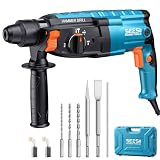


Choose by the job, not just the impact number
Best for everyday anchor holes: Bosch 11255VSR
The 11255VSR is a sensible value choice for repeated small- and medium-diameter holes for concrete screws, sleeves, or other masonry anchors. Its three modes cover hammer drilling, ordinary rotary drilling, and light hammer-only work. Bosch lists vibration control, useful when a job involves a run of holes rather than one or two. Its 1-inch capacity is a maximum capability, not a promise that large holes will be quick; most anchor work is more comfortable with smaller SDS-Plus bits.
Best budget pick when light chipping matters: DEWALT D25263K
At 3.0 joules, the D25263K has the highest stated impact energy in this group. That gives it an edge for breaking loose tile, removing small amounts of mortar, or trimming a shallow channel with a suitable SDS-Plus chisel. Its active vibration control is a useful feature for those jobs. The trade-off is price: it may cost more than an entry-level hammer, and its higher impact figure does not automatically mean faster drilling in every concrete mix.
Best for occasional DIY and a lighter feel: Bosch GBH 2-26
The GBH 2-26 offers three modes in a compact package and is a good fit for occasional holes around the home, such as fixing a bracket to a concrete wall. It weighs about 6 pounds, though accessories and the cord add to what you handle. Compared with the DEWALT, its lower listed impact energy makes it less compelling for chipping, but it is still suited to routine SDS-Plus drilling when paired with a sharp, appropriate bit.
Best alternative for a familiar, simple three-mode tool: Makita HR2475
The HR2475 combines a 2.7-joule rating with three modes and a published 1-inch concrete capacity. It is worth considering when its price or local service availability is better than the alternatives. Like the other tools here, its rotation-only setting is for wood or metal with the correct chuck and bit arrangement—not for ordinary SDS-Plus masonry drilling.
Quick decision matrix
| Your situation | Best fit | Why |
|---|---|---|
| A few anchor holes each year; limited storage | Bosch GBH 2-26 | Compact corded format and three useful modes without paying extra for a chipping-focused tool. |
| Regular anchor installation in concrete | Bosch 11255VSR | Good balance of drilling capability, modes, and vibration-control features. |
| Anchor holes plus occasional tile or mortar removal | DEWALT D25263K | Highest listed impact energy here and a hammer-only mode for light chipping. |
| Price or local parts and service are the priority | Compare Makita HR2475 with Bosch GBH 2-26 | Both offer three modes; choose based on the actual package, warranty, and local support. |
What the specifications mean in practice
Impact energy is a useful clue for comparing hammers, especially if you plan to chip as well as drill. It is not a direct measure of holes per minute: manufacturers may use different rating methods, and the bit and material affect results. No-load speed is the tool’s rotation speed without drilling load; it does not tell you how quickly a bit will cut under pressure. For anchor holes, use a sharp masonry bit matched to the anchor’s required diameter and depth.
All four models use SDS-Plus accessories. That system makes bit changes convenient, but it also means standard smooth-shank drill bits do not fit directly. A separate chuck adapter may be needed for non-SDS bits, and adapters are not a substitute for a proper hammer-drill setup in masonry.
Set up for clean, reliable anchor holes
- Confirm the hole specification. Match bit diameter and embedment depth to the anchor maker’s instructions; a hole that is oversized or too shallow can compromise the intended fit.
- Check what is behind the surface. Locate wiring, plumbing, and other concealed services before drilling, and follow site requirements for dust control and protective equipment.
- Use hammer-drill mode for concrete. Start square to the surface, hold the side handle, and let the bit do the cutting. Excessive pushing can slow drilling and increase fatigue.
- Clear dust from deep holes. Withdraw the bit periodically. Remove dust using a method suitable for the anchor and job; some anchors require a specific cleaning procedure.
- Use hammer-only mode only for light work. These SDS-Plus hammers can manage small chipping tasks, but they are not substitutes for larger demolition hammers when removing thick slabs or extensive concrete.
Ownership costs and wear points
The tool’s price is only part of the budget. SDS-Plus bits are consumables: drilling into aggregate can blunt or damage cutting edges, and a worn bit often makes a modest hammer feel weak. Keep bits clean, inspect them for damage, and use the right diameter and length rather than forcing an undersized tool to make a large opening. For repeat holes, a dust-extraction attachment or compatible shroud may add cost but can make cleanup easier.
After use, unplug the tool, brush dust from vents and the chuck area, and follow the manual’s instructions for SDS-Plus bit lubrication. Avoid storing the hammer with concrete dust packed around the chuck, and do not use a bit that has become bent, cracked, or unusually hot. Vibration control can reduce transmitted vibration, but it does not eliminate exposure; take breaks and follow the manufacturer’s safety guidance.
Bottom line
For a lower-cost rotary hammer mainly used for anchor holes, start with the Bosch 11255VSR or the lighter-feeling Bosch GBH 2-26, depending on price and availability. If you also need to remove tile or chip small areas of masonry, the DEWALT D25263K’s higher published impact energy and vibration-control system make the extra cost easier to justify. The Makita HR2475 is a credible alternative when its local price, warranty, or service support is the strongest fit.