What's inside
As an Amazon Associate I earn from qualifying purchases. This post may contain affiliate links at no extra cost to you.
The best magnetic drill press for beginners is a compact, two-speed annular-cutter drill with a positive-locking magnetic base, an interlock that prevents operation unless the magnet is engaged, and enough capacity for the steel you actually drill—not the largest machine you can afford.
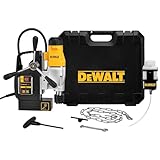
For most first-time users, the Hougen HMD2MT is the easiest conventional choice because it is relatively light and has simple controls. Choose the DEWALT DWE1622K when you want more power and a larger drilling range in a corded machine. For work away from an outlet, the Milwaukee M18 FUEL 2787-20 is the most convenient cordless option, provided you budget for batteries and chargers.
As an Amazon Associate we earn from qualifying purchases at no extra cost to you.


What we cover
Best magnetic drill presses for beginners at a glance
| Model or type | Best for | Approx. weight | Typical drilling capacity | Power and control | Beginner trade-off |
|---|---|---|---|---|---|
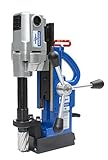
| Hougen HMD2MT | First-time users and overhead portability | About 29.5 lb | Up to 1-1/2 in annular cutters; about 5/8 in twist drills | Corded, two-speed, manual feed | Less reserve power for very large cutters or thick work |
| DEWALT DWE1622K | Frequent shop or fabrication use | About 47 lb | Up to 1-1/2 in annular cutters | Corded, two-speed, electronic overload protection | Heavier to position and carry |
| Milwaukee M18 FUEL 2787-20 | Remote work and locations without mains power | About 63 lb with a high-capacity battery, depending on configuration | Up to 1-1/2 in annular cutters; up to 2 in twist-drill capacity in manufacturer specifications | Cordless, two-speed, electronic safety controls | Battery, charger, and runtime add cost and weight |
| Compact 3/4-in-class mag drill | Thin stock, small holes, and occasional work | About 20–30 lb | Approximately 3/4 in annular cutters | Usually single-speed or basic two-speed operation | Less versatile when your projects grow |
Weights and capacities can vary with chuck, arbor, battery, and regional configuration. Check the current manufacturer specification sheet before ordering, especially if the machine will be used on a lift, scaffold, or overhead.
Which beginner mag drill fits your situation?
| Your situation | Most sensible choice | Why |
|---|---|---|
| Budget-conscious, fewer than 20 holes per month | Compact corded 3/4-in-class model | You avoid battery costs and pay for only the capacity you need. |
| You need a dependable first machine for general steelwork | Hougen HMD2MT | Its lower weight makes setup less tiring and reduces the temptation to skip secure positioning. |
| You drill thick plate or use large cutters every week | DEWALT DWE1622K | Its larger motor and two-speed range provide more working margin for repeated fabrication. |
| You work outdoors, on machinery, or far from outlets | Milwaukee M18 FUEL 2787-20 | Cordless operation simplifies placement, but spare batteries become part of the system. |
| You mostly drill thin sheet or irregular surfaces | A smaller mag drill plus a temporary flat steel fixture | A larger magnet does not solve poor contact; a flat, stable interface matters more. |
What beginners should compare before buying
Controls that prevent expensive mistakes
Look for separate, clearly marked controls for the magnet, spindle, and speed. A reversing switch is useful for tapping, but it is not essential for ordinary annular cutting. A two-speed gearbox is more valuable: the lower range suits large cutters and harder material, while the higher range suits smaller cutters.
Useful safety features include a motor-start interlock, magnet confirmation, overload protection, restart protection after a power interruption, and a visible warning light. These features do not make an unsafe setup safe, but they reduce the chance of starting with the magnet switched off or restarting unexpectedly.
Magnet size and holding force
A magnetic base works best on clean, flat, reasonably thick ferrous steel. Paint, scale, rust, chips, air gaps, and curved surfaces reduce the effective holding force. Published holding-force figures are normally measured on thick, clean plate under ideal conditions; they should not be treated as a guarantee on a rusty beam.
For beginners, a base with a wide contact area and positive locking controls is preferable to a very small ultralight design. Before drilling, scrape away paint and scale, wipe the base and workpiece, and confirm that the entire magnet sits flat. Never rely on the magnet alone when drilling overhead or near an edge: use a safety strap or chain attached to a suitable structure.
Weight versus capacity
A 30-pound drill is easier to carry onto a ladder or position above shoulder height than a 50-pound machine. However, the lighter tool may have less torque, a smaller annular-cutter limit, or a less substantial base. Buy for the largest hole you routinely make, not the largest hole listed in a catalog.
A useful rule is to leave capacity margin. If your regular work calls for 1-inch cutters, a 1-1/2-inch-rated drill is a more comfortable choice than a 1-inch maximum machine. The extra margin helps when the steel is thick, the cutter is worn, or the setup is less than ideal.
Thin and uneven steel: the limitation most listings skip
Thin sheet can be difficult because the magnetic circuit needs enough steel beneath the magnet. On a very thin workpiece, the magnet may hold, but with substantially less force than its rating suggests. The sheet can also flex, allowing vibration that makes the cutter grab.
Uneven steel creates a similar problem. A beam flange with heavy scale, a curved tank, a seam, or a small contact patch can leave an air gap under part of the base. Do not “test” this by starting the motor. Instead:
- Clean a flat area larger than the magnetic base.
- Measure the material thickness and compare it with the drill manufacturer’s minimum recommended thickness.
- Use a flat sacrificial steel plate only when it can be securely clamped or welded in place and the arrangement is structurally sound.
- On thin sheet, clamp the sheet to a rigid backing plate to prevent flexing.
- Use a safety chain and keep your body out of the cutter’s line of movement.
- Stop if the base rocks, slides, chatters, or loses contact.
A sacrificial plate can improve flatness and spread the magnetic field, but it is not a substitute for adequate thickness or a secure mechanical attachment. On nonmagnetic stainless steel, aluminum, or painted structures, a standard permanent-magnet drill may not hold at all; use clamping, a vacuum system designed for the surface, or another approved drilling method.
Basic setup procedure for a first hole
- Mark and inspect the location. Check the reverse side for cables, pipes, voids, and structural hazards.
- Select the cutter. Annular cutters remove only a ring of material, so they generally drill faster and require less motor power than a full-size twist drill of the same diameter.
- Clean the contact surfaces. Remove chips, scale, oil, and loose paint from both the magnet and the steel.
- Position the drill. Align the pilot pin with the mark, then engage the magnet. Try to rock the machine by hand; any movement means the setup needs correction.
- Fit coolant or cutting lubricant. Use the cutter maker’s recommended fluid. For vertical or overhead work, apply lubricant carefully rather than allowing it to run into the motor.
- Start slowly. Let the pilot pin establish the center before applying steady feed pressure. Do not force a dull cutter.
- Clear the slug safely. The metal plug can be hot and may eject when the cutter exits. Wear eye protection and wait for the spindle to stop.
Ownership costs and maintenance
The cutter is usually the first consumable to wear, not the motor. Budget for replacement annular cutters, pilot pins, cutting fluid, and occasional arbor parts. A simple cost calculation helps: if a $900 drill, $300 in cutters and accessories, and $100 in maintenance produce 400 holes over several years, the equipment cost is about $3.25 per hole before labor. A cheaper drill that cuts slowly or damages cutters can cost more over time.
After each use, brush chips from the base and arbor, wipe away coolant, and inspect the power cord or battery contacts. Keep the magnet face flat and free of burrs. Check cutter teeth for missing segments, lubricate the arbor as specified, and verify that handles and safety straps are not damaged. Store the drill with the magnet switched off and the cutter removed.
Final recommendation
For the broadest beginner appeal, choose the Hougen HMD2MT if portability and uncomplicated operation matter most. Choose the DEWALT DWE1622K for heavier, repeated shop work, or the Milwaukee M18 FUEL 2787-20 when cordless access outweighs battery cost and weight. Whatever you buy, secure mounting, clean contact surfaces, correct cutter speed, and respect for thin or uneven steel matter more than a headline capacity number.