What's inside
As an Amazon Associate I earn from qualifying purchases. This post may contain affiliate links at no extra cost to you.
What we cover
Best Cordless Core Drills for Concrete and Masonry
The best cordless core drill for most concrete and masonry work is a dedicated 18V/20V-class rig with a roughly 6-inch wet-drilling capacity, a compatible water feed, and at least two high-capacity batteries. For larger penetrations or repeated holes in reinforced concrete, a 36V-class system is the more realistic choice; for occasional small holes, a compact drill with a core-bit adapter may cost less, but it is not a substitute for a purpose-built core drill.
There is no single cordless model that suits every job. The practical choice depends on the largest hole you need, whether you can supply water, how many holes you expect per charge, and whether you can safely support the tool. Manufacturers often publish capacity and battery-platform figures, but rarely promise a hole count: concrete hardness, aggregate, reinforcement, bit condition, and operator technique all change runtime.
As an Amazon Associate we earn from qualifying purchases at no extra cost to you.


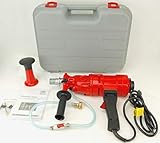

Compare the main cordless options
The figures below describe common product classes rather than guaranteed performance from one model. Exact limits vary by manufacturer and configuration; check the manual for the drill, battery, stand, and core bit you plan to use.
| Drill class | Typical rated capacity | Approx. tool weight | Battery and realistic workload | Wet drilling |
|---|---|---|---|---|
| Compact 18V/20V drill with core-bit adapter | About 1–3 in. with approved bits | About 5–9 lb, without battery | One 5 Ah battery may manage several small holes in light masonry; large or reinforced holes can drain it quickly. | Usually not intended for continuous wet core drilling. Confirm the tool’s water protection and bit requirements. |
| Dedicated 18V/20V core drill | Commonly up to about 6 in. | About 10–18 lb, without battery | A 5–8 Ah pack is a sensible starting point. Expect fewer holes as diameter, depth, and reinforcement increase. | Some models support wet drilling with an approved water feed; others are dry-drilling only. |
| 36V-class dedicated core drill | Often about 6–8 in., model and material dependent | About 15–25 lb, without battery | Higher-capacity packs suit sustained work. A second charged battery can matter more than a small difference in advertised voltage. | Available on wet-capable models; use only the manufacturer-approved water-management setup. |
| Corded rig (comparison point) | Often larger than cordless options | Varies; stand and motor add substantial bulk | No battery limit, making it better for long runs of large holes where power access is available. | Wet drilling is common on dedicated rigs, subject to the model’s instructions. |
Weight figures are approximate tool-only ranges, not complete working weights. Add the battery, bit, water-feed parts, and—where used—the stand. A drill that feels manageable at bench height can become tiring or hard to control overhead. For bigger diameters, a securely anchored stand is usually safer and more consistent than trying to hold the drill by hand.
Choose by the job, not just the maximum diameter
For a few small holes in brick or block
A compact drill and an approved small-diameter core bit can be the economical option for light, occasional work. Check the manufacturer’s permitted bit size and operating method: ordinary hammer drills and impact drivers are not automatically suitable for core bits. If the bit binds, the drill twists, or the material is reinforced concrete, stop and move to a properly rated core-drilling setup.
For regular holes up to about 6 inches
A dedicated 18V/20V core drill is the practical middle ground for plumbing, ventilation, and service penetrations. Look for a model with a clear capacity rating for the material, a clutch or overload protection, and a stand-compatible connection if you will drill large holes. Wet capability is valuable in concrete because water cools the bit and helps control dust, but it adds hoses, slurry, and cleanup.
For large holes, reinforced concrete, or repeated work
Choose a higher-capacity 36V-class drill or a corded rig according to the manufacturer’s stated limits and job conditions. The extra capacity is useful only if the bit, stand, anchoring method, and battery system are also up to the task. If holes are deep, numerous, or regularly encounter rebar, plan for spare batteries—or consider corded equipment where access and site rules permit.
Estimate how much work one charge will handle
Battery capacity alone cannot produce a reliable hole count. A 5 Ah pack stores more energy than a 2 Ah pack on the same voltage platform, but a wide bit cutting dense, reinforced concrete consumes energy far faster than a small bit in soft block. A useful planning method is to treat a battery as a work allowance, then confirm it on a representative hole before committing to a full day’s schedule.
Example planning calculation: suppose a crew needs 12 holes, each 4 inches in diameter and 6 inches deep, in ordinary concrete. If a trial hole consumes about one-quarter of a fully charged pack under those site conditions, plan on roughly three packs for the holes, plus reserve for starts, binding, and tougher aggregate. This is a planning estimate—not a promised runtime. If the first hole uses half a pack, the job needs a battery change plan or a different tool setup.
- Record the battery’s charge before and after one representative hole.
- Repeat the check if hole diameter, depth, concrete, or bit changes substantially.
- Budget extra capacity for reinforcement, worn bits, and interrupted work.
- Bring a spare charged pack when stopping to recharge would disrupt the job.
Wet drilling, dust, and bit life
Wet drilling can reduce airborne dust and manage heat at the cutting edge, but it is not just a matter of pointing a hose at the hole. Use only a drill designed for the method, with the approved water feed and electrical precautions. Control slurry so it does not spread across finished surfaces or enter drains. Where wet drilling is unavailable or unsuitable, use a compatible dust-control system and follow the tool and bit maker’s instructions.
Core bits are consumables. Abrasive aggregate and reinforcement can wear or damage the cutting segments; pushing too hard can overheat the bit, slow progress, and increase battery draw. Keep the bit aligned, clear cuttings as directed, and stop if vibration or binding changes suddenly. Before drilling, check what lies behind the surface and whether the opening could intersect wiring, plumbing, post-tensioning, or structural reinforcement; get qualified guidance where the location or structure is uncertain.
Quick decision matrix
| Your situation | Best fit | What to prioritize |
|---|---|---|
| Homeowner, occasional small holes, limited storage | Compact drill with a manufacturer-approved core-bit setup | Low weight, compatibility, and modest upfront cost |
| Tradesperson, frequent service holes up to roughly 6 in. | Dedicated 18V/20V core drill | Wet capability if needed, stand compatibility, and a spare high-capacity battery |
| Large penetrations or repeated reinforced-concrete work | 36V-class drill or corded rig | Rated capacity, stable stand setup, battery rotation, and bit availability |
| Uncertain site conditions or a one-off structural opening | Pause and consult a qualified drilling contractor or structural professional | Safe location, reinforcement and service checks, and suitable equipment |
Ownership costs and the choice that lasts
The purchase price is only part of the cost. Core bits, batteries, a charger, a stand, anchors, water-feed equipment, and dust or slurry control can materially change the total. General market pricing varies widely by country, battery kit, and included accessories; compare complete setups rather than bare-tool prices. If you already own batteries from a compatible platform, that can improve value, but verify that the pack is approved for the drill’s power demands.
For most buyers searching for the best cordless core drill, a dedicated 18V/20V model is the balanced choice for moderate holes and occasional-to-regular use. Move up to 36V when diameter, reinforcement, or workload demands it, and choose a corded rig when uninterrupted high-volume drilling matters more than portability. The best match is the lightest setup that safely meets the hole size and workload—not simply the drill with the biggest advertised capacity.