What's inside
As an Amazon Associate I earn from qualifying purchases. This post may contain affiliate links at no extra cost to you.
What we cover
Best Battery-Powered Backpack Sprayers for 2026
The best battery powered backpack sprayers for most property owners are the Milwaukee M18 Switch Tank for adjustable pressure and a broad cordless-tool ecosystem, the STIHL SGA 85 for commercial-grade construction, the DEWALT 20V MAX 4-gallon sprayer for familiar controls and battery compatibility, and the Ryobi 18V ONE+ 4-gallon model for lower-cost routine spraying.
Choosing among them is less about maximum pressure than matching the tank, battery platform, harness, nozzle system, and chemical-handling requirements to the work. A sprayer for spot-treating weeds has different priorities from one used to apply fertilizer across several acres.
As an Amazon Associate we earn from qualifying purchases at no extra cost to you.
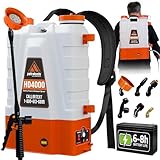


Head-to-head comparison
| Sprayer | Tank capacity | Pressure range | Battery and runtime | Charging time | Best suited to |
|---|---|---|---|---|---|
| Milwaukee M18 Switch Tank | 4 gal | 0–120 psi | M18 18V; roughly 12 tanks with a 12.0Ah battery under light-to-moderate spraying | About 60–120 minutes, depending on charger and battery | Frequent users who need pressure control and interchangeable tanks |
| STIHL SGA 85 | 4.5 gal | Up to about 87 psi | AP battery; commonly rated for several hours of intermittent operation | About 45–100 minutes with compatible AP chargers | Professional grounds maintenance and demanding daily use |
| DEWALT 20V MAX 4-Gallon | 4 gal | Up to about 60 psi | 20V MAX; approximately 10–12 tanks with a high-capacity battery, depending on pressure and nozzle | About 60–90 minutes with a fast charger | Users already invested in DEWALT batteries |
| Ryobi 18V ONE+ 4-Gallon | 4 gal | Up to about 45 psi | 18V ONE+; commonly several tanks with a 4.0Ah battery | About 90 minutes with a standard charger | Home gardens, lawns, and occasional property maintenance |
Runtime varies substantially with nozzle size, pressure setting, liquid viscosity, temperature, battery age, and how often the pump is allowed to cycle. Treat these figures as planning ranges rather than guaranteed coverage.
Our picks by user and job
Best overall: Milwaukee M18 Switch Tank
The M18 Switch Tank is the strongest all-around choice when one sprayer must handle herbicide, fertilizer, and other compatible liquids. Its removable 4-gallon tank and interchangeable tank assemblies are useful because they reduce cross-contamination between products. The pressure control reaches a higher level than many consumer models, while the adjustable dial makes it possible to use lower pressure for close-range spot treatment.
The main ownership advantage is not just battery runtime. A separate tank assembly can be dedicated to a particular chemical, which is easier to manage than repeatedly trying to clean one tank perfectly. The trade-off is cost: purchasing multiple tanks can make this system considerably more expensive than a basic backpack sprayer.
Best for professional durability: STIHL SGA 85
The STIHL SGA 85 is designed around STIHL’s AP battery system and is a better fit for landscape contractors, municipalities, and owners who use a sprayer frequently. Its 4.5-gallon tank provides slightly more capacity than the common 4-gallon class, and its adjustable pressure is suitable for both broad-area application and controlled spraying.
Its harness and frame are important benefits during long work sessions. Professional models generally put more attention into pump protection, hose routing, control placement, and replaceable service parts. The higher initial price is difficult to justify for a few applications each year, but it can make sense when downtime, operator fatigue, and serviceability matter.
Best for DEWALT battery owners: DEWALT 20V MAX 4-Gallon
The DEWALT model is a practical choice when the rest of your cordless equipment already uses 20V MAX batteries. A 4-gallon tank is a useful compromise: large enough for meaningful coverage without making the filled sprayer excessively bulky. Its pressure range is appropriate for common lawn and landscape applications, although it does not provide as much adjustment as the Milwaukee system.
Inspect the supplied wand and nozzle arrangement before buying. Some users will prefer a simple adjustable cone nozzle, while others need a flat-fan nozzle for more uniform band spraying. Replacement nozzles from standard agricultural spray ranges may be available, but thread and seal dimensions must match.
Best budget choice: Ryobi 18V ONE+ 4-Gallon
The Ryobi 18V ONE+ sprayer is aimed at homeowners who already have compatible batteries or need occasional spraying without investing in a professional platform. Its pressure is adequate for weeds, lawn products, fence treatments, and garden applications where high reach is not essential.
It is not the best choice for continuous commercial work. Lower-cost sprayers commonly have less robust straps, switches, seals, and wand fittings, so careful rinsing and storage are especially important. Buying a second battery is usually more useful than selecting the largest available battery if the sprayer is used only intermittently.
What to compare before buying
Tank capacity and real carrying weight
Water weighs about 8.3 pounds per gallon. A full 4-gallon sprayer therefore carries approximately 33 pounds of liquid before adding the tank, battery, wand, and harness. A 4.5-gallon unit carries about 37 pounds of liquid. That extra half-gallon may reduce refills, but it also increases shoulder and lower-back load.
For small gardens, a 2-gallon or 3-gallon battery sprayer may be more comfortable. Choose 4 gallons when the work area is large enough that frequent refilling would be disruptive. Do not fill to the maximum simply because capacity is available.
Pressure and nozzle control
Pressure is only useful when it suits the nozzle. A flat-fan nozzle needs consistent pressure for an even pattern; an adjustable cone nozzle is more flexible for spot treatment but can produce larger droplets or a less uniform application. High pressure can increase drift, waste battery power, and place more stress on seals.
Look for a variable pressure dial or electronic control rather than a pump that is simply on or off. A lockable trigger, clearly marked pressure setting, and replaceable nozzle are also more valuable than a headline maximum-pressure figure.
Battery runtime and charging
For intermittent spraying, a battery between 4.0Ah and 6.0Ah is usually a reasonable balance between runtime and pack weight. Larger packs can extend operating time but add weight to the tool and may take longer to charge. If you use the sprayer away from a power source, buy a spare battery before buying a second charger.
As a planning example, suppose a sprayer uses 0.35 gallons per minute and a 4-gallon tank. Continuous spraying time is:
4 ÷ 0.35 = about 11.4 minutes of trigger-on time.
If the operator sprays only half the time while walking, turning, or repositioning, that tank can support roughly 23 minutes of elapsed work. Battery runtime must exceed this figure, but liquid capacity may run out before the battery does. This is why a claimed battery runtime measured in hours does not automatically mean several hours of active spraying.
Harness comfort and fit
Prioritize padded shoulder straps, a wide waist belt, a chest strap, and a frame that keeps the tank close to your back. The waist belt should carry part of the load rather than leaving the shoulders to support the entire filled unit. Adjust the harness with an empty tank, then fine-tune it after filling.
Users of different heights should check whether the wand can be reached without twisting. A comfortable harness cannot compensate for a hose that is too short or a control that requires frequent shoulder movement.
Chemical resistance
Most backpack sprayer tanks are made from polyethylene or a similar plastic, but the pump, hose, seals, wand, and nozzle may use different materials. Compatibility with one herbicide does not prove compatibility with solvents, concentrated fertilizers, oils, disinfectants, or other formulations.
Read the sprayer manual and the chemical label before use. Avoid storing mixed solution in the tank unless both instructions specifically permit it. When changing products, use the cleaning procedure recommended for that product; some residues require more than a water rinse.
Decision matrix
| Your situation | Most sensible choice | Why |
|---|---|---|
| Occasional garden use and an existing 18V ONE+ battery | Ryobi 4-gallon class | Lower platform cost and sufficient pressure for routine work |
| Frequent use with several compatible cordless tools | Milwaukee M18 Switch Tank or DEWALT 20V MAX | Spare batteries and chargers are already useful elsewhere |
| Daily professional spraying | STIHL SGA 85 | More service-oriented construction and a professional harness |
| Different chemicals requiring strict separation | Milwaukee Switch Tank with dedicated tank assemblies | Reduces the chance of carrying residue between products |
| Limited storage or reduced carrying strength | Smaller 2- or 3-gallon battery sprayer | Less filled weight is more important than fewer refills |
Cleaning and maintenance that affect service life
- Empty unused liquid according to the product label rather than pouring it onto soil or into a drain.
- Rinse the tank with clean water, then run the rinse water through the pump, hose, wand, and nozzle.
- Remove and clean the nozzle and filter separately. A partially blocked filter makes the pump work harder and changes the spray pattern.
- Inspect the hose, wand connections, tank cap, and seals for swelling, cracking, or leaks.
- Remove the battery before storage, dry the sprayer, and store it away from freezing temperatures and direct sunlight.
The parts most likely to wear first are nozzle inserts, small filters, O-rings, hose ends, and pump diaphragms. Do not clear a blocked nozzle with a pin, which can permanently enlarge the orifice. Use a soft brush or replace the inexpensive insert.
Bottom line
Choose the Milwaukee M18 Switch Tank when pressure adjustment and chemical separation are priorities. Choose the STIHL SGA 85 for demanding professional use, the DEWALT 20V MAX model when you already own that battery platform, and the Ryobi 18V ONE+ model for economical occasional spraying. Whichever model you select, size it by filled weight, verify chemical compatibility, and treat nozzle control and harness fit as seriously as tank capacity.