What's inside
As an Amazon Associate I earn from qualifying purchases. This post may contain affiliate links at no extra cost to you.
What we cover
Best Professional Studio Monitor Speakers
The best professional studio monitor speakers are the ones whose bass extension and cabinet size suit your room, with the right inputs, acoustic controls, and nearfield accuracy for the way you work. In a small untreated room, a compact 5-inch monitor can produce more reliable decisions than a powerful 8-inch model that excites room modes; in a larger, treated room, a 6.5- or 8-inch monitor can provide more useful low-end information.
Quick picks by room and working situation
| Situation | Best-fit type or model | Why it fits | Typical market range per pair |
|---|---|---|---|
| Small room, desk listening, roughly 2–3 m listening distance | Genelec 8030C or Neumann KH 120 II | Compact nearfield dispersion and controlled bass reduce room overload | About $1,000–$1,700 |
| Small-to-medium treated room, music production and mixing | Kali Audio LP-6 2nd Wave or ADAM Audio A7V | More low-frequency reach and useful rear-panel or software-based correction | About $500–$1,600 |
| Medium room where bass decisions matter | Neumann KH 150 | Deeper extension, DSP room alignment, and strong output without immediately requiring a subwoofer | About $2,500–$3,500 |
| Budget-conscious home studio | Yamaha HS5 or HS8, chosen by room size | Simple analog connectivity and familiar midrange presentation; widely supported by setup advice | About $400–$800 |
| High-end immersive or critical mixing setup | Genelec 8341A or equivalent coaxial three-way monitor | Precise imaging and controlled directivity, usually with calibration support | About $5,000–$7,000 |
How monitor size should match the room
Woofer size is not a quality ranking. It is mainly a compromise between maximum output, bass extension, cabinet dimensions, and how strongly the speaker interacts with the room.
As an Amazon Associate we earn from qualifying purchases at no extra cost to you.

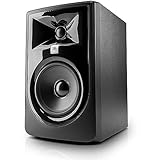
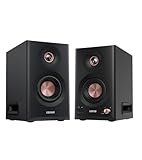
- 5-inch monitors: usually the safest choice for a compact bedroom, editing suite, or desk placed close to a wall. They can be accurate nearfields, but the lowest octave may be reduced.
- 6- to 6.5-inch monitors: a versatile middle ground for a treated small-to-medium room. They offer more kick-drum and bass-guitar information without being as demanding as many 8-inch speakers.
- 7- to 8-inch monitors: appropriate when the room is large enough to support greater bass output and the listening position is not immediately against a wall. They need careful placement and bass trapping more than smaller monitors.
- Three-way or coaxial systems: useful for critical mixing, mastering, and immersive work when the budget, room treatment, and calibration process justify them.
A practical starting point is a listening distance of approximately 0.9–1.5 metres for compact nearfields. Larger monitors often benefit from more space, but distance alone does not fix room modes. If bass changes dramatically when you move your head or walk around the room, acoustic treatment and placement are more important than buying a larger speaker.
Head-to-head specifications
| Model | Driver format | Published frequency range | Inputs and controls | Approx. weight per speaker | Placement implication |
|---|---|---|---|---|---|
| Genelec 8030C | 5-inch two-way | 47 Hz–25 kHz | Balanced XLR; rear level and bass/treble shelving | 5.0 kg | Compact and wall-friendly, but does not reproduce deep sub-bass |
| Neumann KH 120 II | 5.25-inch two-way | 44 Hz–21 kHz | Balanced XLR; DSP alignment and network control | Approx. 6.4 kg | Strong nearfield option; still needs symmetry and boundary management |
| Kali Audio LP-6 2nd Wave | 6.5-inch two-way | 39 Hz–25 kHz | Balanced XLR/TRS and unbalanced RCA; boundary EQ presets | Approx. 7.8 kg | Good value, but rear-panel clearance and room response need attention |
| ADAM Audio A7V | 7-inch two-way | 41 Hz–42 kHz | Balanced XLR and unbalanced RCA; DSP voicing via rear controls or software | Approx. 8.7 kg | Detailed top end and strong output; avoid placing it in a cramped corner |
| Yamaha HS8 | 8-inch two-way | 38 Hz–30 kHz | Balanced XLR/TRS; room-control and high-trim switches | 10.2 kg | Useful low end in a suitable room, but often excessive for a small untreated space |
| Neumann KH 150 | 6.5-inch two-way | 39 Hz–21 kHz | Balanced XLR; DSP alignment and network control | Approx. 8.2 kg | Deep bass and output require disciplined placement and treatment |
Frequency figures are manufacturer specifications and are not directly equivalent to a full-room response. A speaker rated to 38 Hz will not necessarily produce dependable 38 Hz decisions in a poorly positioned room. Look for the tolerance attached to the specification, such as a -3 dB or -6 dB limit, and consider whether the manufacturer gives a maximum SPL figure under a defined measurement condition.
Inputs and acoustic controls that matter
Balanced XLR is the preferred connection for long cable runs and electrically noisy environments. A balanced TRS input is equally practical for many interfaces. RCA is convenient in a multimedia setup, but it offers less protection from hum over longer runs.
Basic rear-panel switches for bass roll-off, midrange level, and treble level are useful when a monitor sits near a wall or on a desk. They cannot replace acoustic treatment, but they can reduce predictable boundary buildup. A monitor with onboard DSP can go further by applying delay, level, and equalisation corrections. Systems such as Neumann’s network-controlled monitors and Genelec’s calibration ecosystem are particularly attractive when several speakers must be aligned consistently.
Do not select a monitor because it has the most controls. Select controls that match your room and workflow. If you will never measure the room or use calibration software, a well-designed analog monitor with clear boundary switches may be the more dependable purchase.
Nearfield setup: a repeatable starting procedure
- Make the layout symmetrical. Put the left and right monitors the same distance from the side walls, with the desk centred on the room’s width where possible. Symmetry improves the reliability of the stereo image.
- Form an equilateral triangle. The distance between the monitors should approximately equal the distance from each monitor to your head. Aim both tweeters at the listening position unless the manufacturer recommends otherwise.
- Raise the tweeters to ear height. Use rigid stands or stable isolation platforms. Soft, unstable surfaces can allow movement and blur the low-mid presentation.
- Keep a sensible wall distance. Do not place a rear-ported monitor directly against the wall. Follow the manufacturer’s clearance guidance, then use the boundary control only after placement is sensible.
- Set levels before judging tone. Match the monitor levels and leave headroom in the audio interface. Louder often sounds more impressive, even when it is less accurate.
- Check with familiar references. Use several commercial tracks at moderate volume, then verify bass on headphones or another system. If your mix repeatedly has too much or too little low end, measure the room before changing monitors.
Ownership realities and common mistakes
The first things that usually suffer are not the drivers but the cabinet finish, input sockets, power switches, and cables. Keep drinks away from rear panels, avoid repeatedly pulling heavy cables sideways, and allow ventilation around powered monitors. Dust can be removed with a soft, dry brush or cloth; do not press a vacuum nozzle against the tweeter or use liquid on the grille.
Powered monitors also contain amplifiers, so a surge-protected power setup and a sensible shutdown routine are worthwhile. Never connect or disconnect loudspeaker cables while the system is powered at high level. If a monitor develops hiss, intermittent output, or a rattling sound, swap the cable and the interface channel before assuming the driver has failed.
A subwoofer is not automatically an upgrade. It adds another crossover, another room source, and another placement problem. Add one only after the main monitors and listening position are working reliably, and calibrate the crossover and level rather than turning the subwoofer up until it sounds exciting.
Bottom line
For the smallest rooms, choose a controlled 5-inch nearfield such as the Genelec 8030C or Neumann KH 120 II. For a treated room needing more bass without immediately moving to a large system, the Kali LP-6 2nd Wave is a value-focused option, while the ADAM A7V adds more output and DSP voicing. Choose the Yamaha HS8 only when the room can accommodate its low-frequency energy. For high-end work, the Neumann KH 150 and Genelec 8341A make sense when accurate placement, treatment, and calibration are part of the budget—not afterthoughts.