What's inside
As an Amazon Associate I earn from qualifying purchases. This post may contain affiliate links at no extra cost to you.
Brick drilling does not always require the biggest hammer drill on the shelf. For small holes for screws or lightweight wall anchors, a compact cordless drill with a hammer setting may be easier to control and less tiring. For larger holes, repeated work, or hard brick, a rotary hammer is usually faster—but its stronger blows can make a poor choice for delicate masonry and a less comfortable one for long sessions.
The right tool depends on hole diameter, brick hardness, and how many holes you need. Vibration also depends on technique and the bit: a blunt masonry bit, excessive pressure, or a drill held at an angle can make even a good tool unpleasant.
As an Amazon Associate we earn from qualifying purchases at no extra cost to you.



What we cover
Choose a drill for the hole, not the label
A standard hammer drill combines rotation with short, rapid impacts. It suits common anchor holes around 1/4 to 3/8 inch in brick. A rotary hammer uses a piston mechanism to deliver stronger blows, usually with less effort from the user. It makes sense for larger holes, multiple holes, or tough, dense masonry.
For occasional work, a cordless hammer drill is often the practical choice. Look for a side handle, variable speed, and a clutch or adjustable settings. The side handle gives you a better brace and control; it does not eliminate vibration, but it helps keep the tool from twisting if the bit binds.
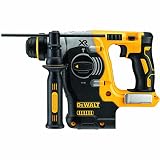
If the job involves several holes above 1/2 inch, a cordless SDS-Plus rotary hammer is worth considering. It is heavier and typically uses SDS bits rather than round-shank bits. For just two or three small anchor holes, that added cost and bulk are hard to justify.
Hammer drill or rotary hammer?
| Tool type | Good fit for brick | Trade-off |
|---|---|---|
| Regular drill, no hammer mode | Very soft brick and tiny pilot holes, if the drill and bit can manage | Slow; forcing it can overheat the bit and motor |
| Cordless hammer drill | Small and medium anchor holes, occasional household work | Can require firm pressure and take longer in hard brick |
| SDS-Plus rotary hammer | Repeated holes, larger diameters, or dense brick | Heavier, louder, and easier to overdo on fragile masonry |
Published impact rate or torque alone does not tell you how comfortable a drill will feel. Compare weight with the battery installed, grip and handle layout, and whether the tool has a usable low-speed trigger. If you can, hold the drill before buying. A heavy battery can shift the balance and tire your wrist, especially when drilling overhead.
Use the right bit and settings
Use a masonry bit sized to the anchor instructions, not a guessed diameter. A common plastic wall plug may call for a 1/4-inch hole, while other anchors require a different size. Check the packaging: an oversized hole can leave the anchor spinning, and an undersized hole can make insertion difficult or split weak brick.
For a hammer drill, use a carbide-tipped masonry bit with a round shank. For an SDS-Plus rotary hammer, use an SDS-Plus bit. Do not put an ordinary round-shank bit in an SDS chuck without the correct adapter; adapters add length and can wobble. Replace bits that are chipped, visibly worn, or taking much longer than a fresh bit. A dull bit encourages extra pressure and heat, both of which increase fatigue.
Start slowly to keep the bit from skating, then let the hammer action do the work. Keep the drill square to the wall and use steady, moderate pressure. Pushing hard does not make the impacts more effective; it can bog the motor, flex the bit, or cause the tip to wander. If the drill has speed settings, choose a controlled setting you can hold steadily rather than pulling the trigger fully from the start.
Reduce vibration and avoid common failures
Hold the main grip firmly but do not clamp down until your hand goes numb. With a side handle, keep both hands on the tool and stand so you can resist a sudden twist. Take short breaks during repeated drilling. Gloves can help with comfort, but they do not correct an awkward grip or make a vibrating tool safe to use for an unlimited stretch.
Brick can crack or crumble, particularly near an edge, a mortar joint, or an existing damaged spot. Whenever the installation allows, drill into the brick rather than the mortar; mortar is softer and may not hold an anchor securely. Keep holes several inches from edges where practical, and follow the anchor maker’s spacing guidance. On old, soft, or hollow masonry, test in an inconspicuous spot and use a light touch. A rotary hammer can punch through weak material too aggressively.
Before drilling, check for wires and pipes with an appropriate detector, and avoid locations directly above or below outlets and plumbing fixtures unless you know what is behind the wall. Wear eye protection and hearing protection. Brick dust is irritating: use dust collection or a suitable mask, and clear the hole before fitting an anchor so loose grit does not interfere with seating.
Where to save and where not to
For a few small holes in ordinary brick, an entry-level hammer drill is often enough. You do not need a high-end rotary hammer just because the wall is masonry. A solid masonry bit and correct anchor size can matter more than extra tool power. If you already own a regular drill, a hammer-drill option and masonry bit set may seem like a low-cost route, but check compatibility and expect slower progress than with a purpose-built hammer drill.
Spend more when the work is frequent, the holes are large, or the brick is consistently hard. In that case, prioritize a comfortable side handle, controllable speed, and a battery platform you already own. If a hole is taking unusually long, the bit is wandering, or the masonry starts breaking out, stop and reassess rather than applying more force. Switching to a sharp bit, changing the hole location, or choosing a smaller pilot hole can solve the problem without adding vibration or damage.