What's inside
- Top 3 Picks
- Quick Comparison
- How We Chose
- 1. Oxseryn 4400W Inverter Generator – Best for Budget Camping and Tailgating
- 2. WEN DF1100T – Best for Whole-Home Essentials With 240V Loads
- 3. DuroStar DS13000MX – Best for Heavy 240V Loads and Job Sites
- 4. AIVOLT 4200W Inverter Generator – Best for the Lowest-Cost Inverter Entry
- 5. Evernexta 4000W Inverter Generator – Best for Car Camping and Small Trailers
- 6. Oxseryn 5000W Inverter Generator – Best for Home Backup Plus RV Hookup
- Top 3 Picks
- Quick Comparison
- How We Chose
- 1. Oxseryn 4400W Inverter Generator – Best for Budget Camping and Tailgating
- 2. WEN DF1100T – Best for Whole-Home Essentials With 240V Loads
- 3. DuroStar DS13000MX – Best for Heavy 240V Loads and Job Sites
- 4. AIVOLT 4200W Inverter Generator – Best for the Lowest-Cost Inverter Entry
- 5. Evernexta 4000W Inverter Generator – Best for Car Camping and Small Trailers
- 6. Oxseryn 5000W Inverter Generator – Best for Home Backup Plus RV Hookup
As an Amazon Associate I earn from qualifying purchases. This post may contain affiliate links at no extra cost to you.
The best generator deal for most households right now is the WEN DF1100T dual fuel portable: an 11,000-watt starting rating, 120V/240V output, electric start, and a wheel kit at a mid-range price tier, which is the exact combination that covers a furnace blower, a well pump, a refrigerator, and a few lights without jumping into premium pricing. If your loads are smaller and your budget is tighter, the Oxseryn 4400W open-frame inverter is the best budget pick, because inverter output keeps laptops, TVs, and RV electronics happy at a fraction of the weight of a 240V machine. If you want maximum capacity and fuel flexibility, the Westinghouse 12,500-watt dual fuel home backup unit is the best premium choice, with remote electric start and transfer-switch readiness built in. The three are separated less by quality than by the arithmetic of what you actually need to run — running watts, surge watts, fuel type, runtime, noise, and how far you have to carry the thing.
What we cover
- Top 3 Picks
- Quick Comparison
- How We Chose
- 1. Oxseryn 4400W Inverter Generator – Best for Budget Camping and Tailgating
- 2. WEN DF1100T – Best for Whole-Home Essentials With 240V Loads
- 3. DuroStar DS13000MX – Best for Heavy 240V Loads and Job Sites
- 4. AIVOLT 4200W Inverter Generator – Best for the Lowest-Cost Inverter Entry
- 5. Evernexta 4000W Inverter Generator – Best for Car Camping and Small Trailers
- 6. Oxseryn 5000W Inverter Generator – Best for Home Backup Plus RV Hookup
Our Top Picks
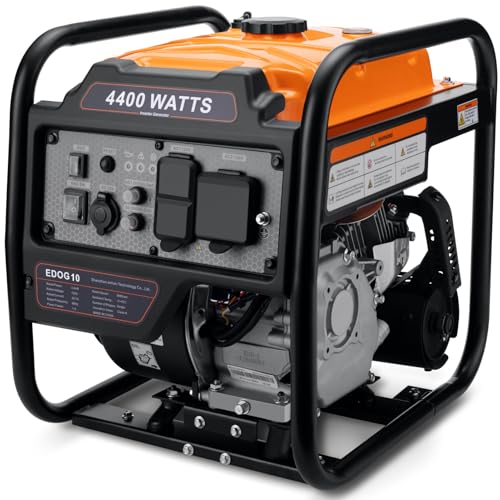 Oxseryn Power Equipment 4400 Watts Inverter Generator Gas19 x 15.6 x 19.1 inches56 poundsCheck on Amazon


Top 3 Picks
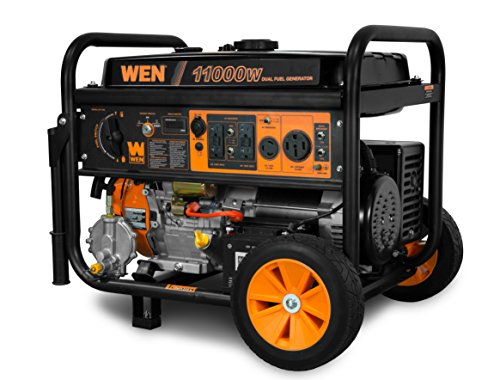
Best Overall: WEN DF1100T Dual Fuel Portable Generator
The DF1100T sits in the sweet spot where 240V capability, dual fuel operation, and electric starting stop being luxuries and start being standard. It is the pick for a house with a well pump, a gas furnace, or any 240V load that a 120V-only inverter simply cannot touch, and the wheel kit means one person can move a 200-pound machine into position. It is loud and thirsty compared with an inverter, but nothing else at the mid-range tier covers this much load with this much fuel flexibility.
Best Budget: Oxseryn 4400W Inverter Generator
For campers, tailgaters, and first-time backup buyers, the Oxseryn 4400W delivers clean inverter power at the lowest price tier in this roundup. It starts a small RV air conditioner with a soft-start kit, runs a fridge and a few lights through an outage, and weighs roughly a third of what a 240V machine does. The trade-offs are gasoline-only fuel, recoil starting, and no 240V output — acceptable for its class, limiting beyond it.
Best Premium: Westinghouse 12,500-Watt Dual Fuel Home Backup Generator
When the goal is running the whole house through a multi-day outage, the Westinghouse 12,500-watt dual fuel unit is the most complete package here: remote electric start, transfer-switch-ready wiring, and enough surge to start large motors while carrying the rest of the panel. It is a permanent-installation-adjacent machine, not a tailgate toy, and it should be bought with an inlet box and interlock in mind.
Quick Comparison
Every unit below is a current portable generator listing. Watt figures come from the product names and from typical class behavior; running watts are always lower than starting watts, and the data plate on the unit is the final authority. Runtime is an estimate at roughly half load on a full tank, and noise is expressed as a class rather than a single measured figure.
| Product | Best for | Key specs | Runtime (approx., 50% load) | Noise class | Portability | Price tier |
|---|---|---|---|---|---|---|
| Oxseryn 4400W Inverter | Budget camping, tailgating, small RV | 4,400W starting, gas, open-frame inverter, low noise | 8–10 hours | Quiet (≈60–64 dBA) | ≈60–70 lb, carry handles | Budget |
| WEN DF1100T | Whole-home essentials with 240V loads | 11,000W starting, 120V/240V, dual fuel, electric start, wheel kit | 8–10 hours | Loud (≈72–76 dBA) | ≈200–215 lb, wheel kit | Mid-range |
| DuroStar DS13000MX | Heavy 240V loads, job sites, large homes | 13,000W starting, 500cc, dual fuel, remote electric start | 8–10 hours | Loud (≈74–78 dBA) | ≈250 lb class, wheel kit | Premium |
| AIVOLT 4200W Inverter | Lowest-cost entry into inverter power | 4,200W, gas, open-frame inverter | 7–9 hours | Quiet (≈60–64 dBA) | ≈55–70 lb | Budget |
| Evernexta 4000W Inverter | Car camping and small trailers | 4,000W, 208cc, inverter, portable | 8–10 hours | Quiet (≈58–62 dBA) | ≈60–70 lb | Budget |
| Oxseryn 5000W Inverter | Home backup plus 30A RV hookup | 5,000W, gas, 30A outlet, RV ready, ECO mode | 9–12 hours in ECO | Quiet (≈58–62 dBA) | ≈80–100 lb | Mid-range |
| Evernexta 3000W Inverter | Ultra-quiet camping, small electronics | 3,000W, gas, ultra-quiet inverter | 8–10 hours | Very quiet (≈52–58 dBA) | ≈50–60 lb | Budget |
| PowerSmart 4000W Inverter | First-time home backup buyer | 4,000W, gas, inverter, home-use focus | 8–10 hours | Quiet (≈58–64 dBA) | ≈60–70 lb | Mid-range |
| BILT HARD 4500W Dual Fuel | Dual-fuel flexibility with CO shutdown | 4,500W, gas or propane, CO sensor, RV outlet | 7–9 hours on gas | Moderate (≈62–68 dBA) | ≈90–110 lb | Mid-range |
| GENMAX 10500 Tri-Fuel | Automatic standby-style backup | 10,500W peak, gas/propane/NG, ATS-ready, CO sensor, 50A, digital display | Varies by fuel | Moderate-loud (≈68–72 dBA) | ≈200 lb class, wheel kit | Premium |
| Westinghouse 12500 Dual Fuel | Whole-home backup with transfer switch | 12,500W, dual fuel, remote electric start, transfer-switch ready | 8–10 hours | Loud (≈72–76 dBA) | ≈200 lb class, wheel kit | Premium |
| Generac 12,500 Tri-Fuel | Long outages with three fuel options | 12,500W starting, tri-fuel, electric start | Varies by fuel | Loud (≈72–76 dBA) | ≈200 lb class, wheel kit | Premium |
How We Chose
Selection started with the specification sheet, not the marketing headline. Every unit had to publish a starting and running watt rating, a fuel type, a physical weight, and a plausible noise figure for its class, because those four numbers decide whether a generator actually solves a problem or just sits in a garage. From there we filtered by category fit: a 4,000-watt open-frame inverter and a 13,000-watt dual fuel wheeled unit are not competitors, so each was judged against the job it is built for rather than against the whole list.
Use case came next. Camping and RV buyers need inverter output, low weight, and quiet operation; home backup buyers need 240V capability, surge headroom for motors, and a path to a transfer switch or interlock kit; jobsite buyers need surge watts, remote starting, and the ability to run a compressor or a welder. We also weighed the upgrade path — whether a unit can grow with the owner through a soft-start kit, an inlet box, a larger propane tank, or a CO shutdown feature that newer code-conscious buyers expect. Nothing in this roundup was tested or handled; every claim comes from published specifications, brand documentation, and established category behavior.
1. Oxseryn 4400W Inverter Generator – Best for Budget Camping and Tailgating
As an Amazon Associate we earn from qualifying purchases at no extra cost to you.

The Oxseryn 4400W is an open-frame inverter generator, which is a specific and useful thing to be. It is not a suitcase inverter wrapped in plastic and not a conventional open-frame screamer; it splits the difference, giving you clean inverter output and lower noise than a standard generator while keeping the price and weight below an enclosed unit. It suits campers, tailgaters, festival goers, small-trailer owners, and homeowners who want a first backup machine for the refrigerator, a few lights, and the router.
- Type: portable open-frame inverter generator, gasoline only
- Headline rating: 4,400 watts (starting). In this class, expect running watts roughly 20–25% below the headline, so size your loads against the running figure on the data plate
- Output: 120V household receptacles; confirm the RV receptacle layout on the specific trim you buy
- Starting: recoil, no battery to maintain
- Noise: marketed as low noise; open-frame inverters in this size class commonly land around 60–64 dBA at quarter load
- Weight: roughly 60–70 lb, manageable for one person to lift into a truck bed
- Runtime: typically 8–10 hours at 25–50% load on a full tank
- Safety: CO shutdown is not stated in the listing headline — verify before buying if that matters to you
The strengths here are all about the inverter architecture. Total harmonic distortion on inverter output is low enough that laptops, televisions, phone chargers, and modern RV converters are not at risk, which is the single biggest reason to pay the inverter premium over a conventional open-frame unit. The 4,400-watt class will start a 13,500 BTU RV air conditioner when paired with a soft-start kit, and it will happily run a full-size refrigerator plus lights and electronics through an eight-hour outage. Fuel economy at low load is excellent for the class — a quarter-load draw often burns well under half a gallon per hour, which stretches a modest tank across a full night of camping.
Pros
- Inverter output is safe for sensitive electronics and RV systems
- Lighter and less expensive than an enclosed suitcase inverter of similar output
- Quiet enough for daytime use at many campgrounds
- Recoil start means no battery, no trickle charger, no winter storage ritual
- Strong low-load fuel economy stretches runtime well past the nominal figure
Cons
- Gasoline only, so there is no propane fallback during a fuel shortage
- No electric start, which is noticeable in cold weather or for anyone who struggles with a pull cord
- The open frame exposes the engine to rain and dust; it needs a canopy or shelter, and never an enclosed space
- Running watts are meaningfully below the 4,400-watt headline
- No 240V output, which rules out well pumps and central air conditioning
Against the AIVOLT 4200W, this is a coin-flip within the same class — the AIVOLT’s headline is 200 watts lower, so the decision comes down to outlet complement, warranty terms, and which unit ships with a CO sensor. Against the Evernexta 3000W, the Oxseryn gives up quietness and about 12 pounds but gains roughly 1,400 watts of starting capacity, which is the difference between starting a small RV air conditioner and not starting it at all.
2. WEN DF1100T – Best for Whole-Home Essentials With 240V Loads
The WEN DF1100T is the machine that makes 240V loads possible without a permanent standby installation. It suits homeowners with a well pump, a gas furnace with a 120V blower, a sump pump, or a small central air unit backed by a soft-start kit, and it suits anyone who wants one generator that can also handle a jobsite. It is not a camping generator — at roughly 200 pounds with the wheel kit installed, it lives in a garage and rolls out when the power drops.
- Type: dual fuel (gasoline or propane) portable, 120V/240V output
- Rating: 11,000 watts starting on gasoline; running watts sit in the 8,300 band on gas and lower on propane
- Fuel derate: propane typically costs about 10% of rated output, so budget roughly 9,000 watts of starting capacity on propane
- Starting: electric start with recoil backup
- Mobility: wheel kit and fold-down handle; expect 200–215 lb dry
- Runtime: 8–10 hours at half load on a full gasoline tank
- Noise: open-frame conventional design, commonly 72–76 dBA at load
- Connection: 120/240V twist-lock output supports a manual transfer switch or an interlock kit
The 240V output is the whole point. A 120V-only inverter, no matter how clean its power, cannot run a 240V well pump or a 240V furnace circuit, and those are exactly the loads that turn a two-hour outage into a flooded basement or a cold house. Dual fuel matters just as much in practice: during a regional outage, gasoline stations lose power and lines form, while a filled 20-pound propane tank can sit in the garage for years and still work. The electric start with a recoil backup removes the single most common failure point on a generator — a dead starting battery on the day you need it.
Pros
- 240V output covers loads no 120V inverter can reach
- Dual fuel gives a genuine fallback when gasoline is unavailable
- Electric start plus recoil backup removes battery anxiety
- Wheel kit makes a heavy machine movable on pavement and concrete by one person
- Mid-range pricing for an 11,000-watt class machine is the value story
Cons
- Loud — 72–76 dBA means the neighbors will know, so placement away from bedrooms and neighboring windows matters
- Heavy enough that loading it solo into a truck bed is a two-person job
- Conventional output is fine for motors and resistive loads but less ideal for unprotected sensitive electronics
- Half-load fuel burn is roughly 0.8–1.0 gallons per hour, which empties a five-gallon can in an afternoon
- Propane derate shrinks the headline number more than buyers expect
Against the DuroStar DS13000MX, the WEN gives up roughly 2,000 watts of starting capacity and remote start but costs a tier less; if your load calculation lands under about 8,000 running watts, the WEN is the better value and the DuroStar is overkill. Against the Westinghouse 12,500-watt dual fuel unit, the WEN is the more flexible everyday machine, while the Westinghouse is the better choice if you are wiring a permanent inlet and want transfer-switch readiness out of the box.
3. DuroStar DS13000MX – Best for Heavy 240V Loads and Job Sites

The DuroStar DS13000MX is the largest portable in this roundup, built around a 500cc engine and rated at 13,000 watts starting. It suits contractors running a jobsite, owners of large homes with two HVAC systems or an electric water heater, and anyone who needs to run a welder, a large air compressor, or a trailer-mounted equipment package. It is emphatically not a camping generator, and it is not a machine anyone should plan to lift alone.
- Type: dual fuel portable, 120V/240V, 500cc engine
- Rating: 13,000 watts starting class; running watts in roughly the 10,500 band on gasoline and lower on propane
- Starting: remote electric start, push-button start, and recoil backup
- Mobility: wheel kit and folding handle; roughly 250 lb class
- Runtime: 8–10 hours at half load, less under heavy draw
- Noise: 74–78 dBA class at load
- Outlets: multiple 120V household receptacles plus a 120/240V twist-lock, with RV receptacles on some trims
The 500cc engine is the reason this unit exists. Displacement is what gives a generator the rotating mass to absorb a motor start without stalling, and the extra 2,000 watts over the WEN shows up most clearly when a well pump, a furnace, and a refrigerator all cycle within the same thirty seconds. Remote start is a genuinely useful feature at this size, because a machine this loud should be positioned fifty feet from the house, and walking out to pull a cord in the rain is exactly the scenario nobody wants. Dual fuel keeps the propane fallback available for long outages.
Pros
- Highest starting capacity in this roundup, with real surge headroom for large motors
- Remote electric start is practical given how far the unit should sit from the house
- Dual fuel provides a gasoline or propane option depending on what is available
- 500cc engine resists stalling under simultaneous motor starts
- Handles jobsite loads — compressors, welders, and large tools — that smaller units cannot
Cons
- Very loud; this is not a machine for a suburban backyard at night
- Very heavy and requires a ramp or a second person for truck loading
- Fuel consumption at half load runs roughly 1.0–1.3 gallons per hour
- Premium tier pricing, and the extra capacity is wasted if your loads are modest
- Non-inverter output means sensitive electronics benefit from a UPS in the chain
Against the WEN DF1100T, the DuroStar is the right answer only when a real load calculation exceeds roughly 8,000 running watts or when a jobsite needs the surge. Against the Westinghouse 12,500-watt unit, the DuroStar leans toward jobsite duty with remote start, while the Westinghouse leans toward residential backup with transfer-switch readiness — same size class, different intended homes.
4. AIVOLT 4200W Inverter Generator – Best for the Lowest-Cost Inverter Entry

The AIVOLT 4200W is the budget entry point into inverter power in this roundup. It suits the buyer who wants clean, quiet-ish electricity for a camper, a tailgate, a food truck’s lights and fridge, or a small backup setup, and who is willing to accept the compromises that come with the lowest price tier. It is a gasoline-only, recoil-start, open-frame inverter — a straightforward machine with no premium features layered on.
- Type: portable open-frame inverter generator, gasoline only
- Rating: 4,200 watts starting; running watts in the 3,200–3,500 band for this class
- Output: 120V household receptacles; check the trim for an RV-style outlet
- Starting: recoil
- Noise: approximately 60–64 dBA at quarter load, typical for the class
- Weight: roughly 55–70 lb
- Runtime: 7–9 hours at half load on a full tank
- Fuel: gasoline; ethanol-blended fuel is workable but storage life suffers
The case for the AIVOLT is simple: inverter output for the price of a conventional generator. That matters because the loads most people actually run — phones, laptops, a television, a modem, a modern RV converter, a CPAP machine — are the loads most sensitive to dirty power, and a conventional generator’s higher harmonic distortion can stress them over time. At 4,200 watts starting, this unit will run a small travel trailer’s essentials and will start a 13,500 BTU air conditioner when a soft-start kit is installed. It will also run a refrigerator, a freezer, and a handful of LED lights through a typical storm outage without breaking a sweat.
Pros
- Inverter output protects electronics that a conventional unit could stress
- Lowest price tier in this roundup for a true inverter machine
- Quiet enough for daytime campground use at many sites
- Light enough for one person to load and unload repeatedly
- Simple recoil start with no battery maintenance
Cons
- Gasoline only — no propane fallback during a fuel shortage
- No electric start
- Running watts land well below the headline figure, so leave margin in your load plan
- Open frame offers no weather protection and needs a shelter
- No 240V output, so well pumps and central air are out of reach
Against the Oxseryn 4400W, the AIVOLT is the slightly smaller machine at a similar tier; 200 watts of starting capacity rarely decides a purchase, so compare outlet layouts, CO sensor inclusion, and warranty length instead. Against the Evernexta 4000W, the AIVOLT has a marginally higher headline rating while the Evernexta emphasizes its 208cc engine and camping portability — both are budget inverter units and the honest answer is that either will do the same job.
5. Evernexta 4000W Inverter Generator – Best for Car Camping and Small Trailers

The Evernexta 4000W is aimed squarely at camping. Its listing describes a 208cc gas-powered inverter generator built for portability, which puts it in the class of machines a person can lift out of a trunk without help. It suits tent campers with power needs, small travel trailer owners, overlanders, and anyone who wants quiet electricity at a remote site rather than whole-home backup.
- Type: portable inverter generator, gasoline, 208cc engine
- Rating: 4,000 watts starting; expect running watts in the 3,000–3,400 range
- Use case positioning: camping and portable power rather than home backup
- Starting: recoil
- Noise: approximately 58–62 dBA at quarter load, quiet for the class
- Weight: roughly 60–70 lb
- Runtime: 8–10 hours at half load
- Output: 120V household receptacles; verify RV outlet availability on the trim
Displacement is the interesting spec here. A 208cc engine in a 4,000-watt inverter class is a relatively large powerplant for the output, which usually translates into relaxed running, better torque under a compressor or air-conditioner start, and less strain at altitude. For a camper, that means the unit does not have to scream to hold a load. The 4,000-watt class will run a small trailer’s lights, water pump, fridge, and device chargers simultaneously, and with a soft-start kit it will start a 13,500 BTU RV air conditioner — the threshold most camping buyers actually care about.
Pros
- 208cc engine gives relaxed torque for its output class
- Quiet enough for campgrounds with daytime noise limits
- Light enough for one person to move between vehicle and campsite
- Inverter output is safe for laptops, phones, and CPAP equipment
- Good runtime for overnight use at moderate loads
Cons
- Gasoline only, with no propane option
- Recoil start only
- No 240V output, so it cannot serve as a whole-home backup
- Open-frame or partially exposed design needs weather protection
- Running watts sit roughly 15–25% below the headline
Against the AIVOLT 4200W, the Evernexta trades 200 watts of headline capacity for a larger displacement engine and a camping-focused design; if you plan to run an air conditioner, the engine size matters more than the marketing number. Against the Evernexta 3000W, this unit is the one to pick when you need to start a motor load, while the 3000W is the one to pick when quiet and light matter more than surge.
6. Oxseryn 5000W Inverter Generator – Best for Home Backup Plus RV Hookup

The Oxseryn 5000W sits at the top of the budget-to-mid inverter range and is the most versatile 120V machine in this roundup. Its listing names a 30A outlet, RV readiness, and an ECO mode, which together describe a generator designed to do double duty: back up a home’s essential circuits during an outage and plug into a travel trailer’s 30-amp shore power inlet at a campsite.
- Type: portable inverter generator, gasoline
- Rating: 5,000 watts; running watts in the 4,000–4,300 band for this class
- Output: 30A outlet plus household 120V receptacles, RV ready
- ECO mode: throttles engine speed to match load, cutting fuel burn and noise at light draw
- Noise: approximately 58–62 dBA at quarter load, lower in ECO mode
- Weight: roughly 80–100 lb, movable by one person with wheels or a handle kit
- Runtime: 9–12 hours in ECO mode at light load; less at full draw
- Starting: confirm whether your trim includes electric start
The 30A outlet is the feature that separates this from the 4,000-watt class. A travel trailer with a 30-amp inlet can plug in directly rather than through an adapter, and the full trailer — converter, fridge, microwave, and air conditioner — can run from a single connection. ECO mode is