What's inside
As an Amazon Associate I earn from qualifying purchases. This post may contain affiliate links at no extra cost to you.
Assembling cabinets and shelving does not require the most powerful drill in the store. It requires a tool that starts smoothly, fits into tight spaces, drives screws without stripping them, and does not break particleboard when the clutch is set incorrectly. For most flat-pack furniture, a compact 12-volt cordless drill is the best starting point. A 18- or 20-volt drill makes more sense for repeated installation, large cabinets, or drilling into studs and masonry.
As an Amazon Associate we earn from qualifying purchases at no extra cost to you.



What we cover
What to look for in a cordless drill
Prioritize control over maximum torque. A two-speed gearbox is useful: the low range, usually around 0 to 400 or 500 rpm, gives better control for driving screws; the high range, often up to 1,500 or 2,000 rpm, is for drilling holes. A variable-speed trigger lets you ease a screw into a hinge or shelf bracket instead of slamming it in at full speed.
A clutch with at least 15 settings is more important than an impressive torque number. The clutch slips when the screw reaches a selected resistance. This helps prevent stripped screw heads, crushed cabinet edges, and screws driven through thin back panels. Start at a low setting and increase it only when the screw does not seat fully.
Look for a compact body, a comfortable grip, and a built-in LED. A tool under roughly 7 inches from the chuck to the back is easier to use inside a cabinet. A keyless 3/8-inch chuck is adequate for furniture work; a 1/2-inch chuck is useful if you also drill larger holes or work with construction lumber.
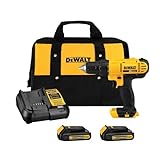
If you are buying a first tool for flat-pack projects, compare 12-volt cordless drill kits. They generally weigh less than 3 pounds with a battery and are less tiring during a long assembly session.
Which drill type fits the job?
| Tool type | Best use | Main advantage | Limitation |
|---|---|---|---|
| Compact 12-volt drill | Flat-pack cabinets, shelves, hinges, drawer hardware | Light, controllable, easy to fit in cabinets | Less runtime and power for large holes or masonry |
| 18- or 20-volt drill/driver | Frequent installations, studs, thick wood, larger fasteners | More power and longer runtime | Heavier and easier to overtighten screws |
| Hammer drill | Anchors in brick, block, or concrete | Hammering action speeds masonry drilling | Usually unnecessary for cabinet assembly |
| Impact driver | Long screws, structural fastening, repeated driving | High driving force with less wrist twist | No clutch on many models; noisy and easy to damage furniture |
For ordinary cabinet assembly, choose a drill/driver rather than an impact driver. An impact driver can drive screws quickly, but its pulsing force makes it harder to stop at the right depth. It can strip a cam-lock screw, crack a narrow cabinet stile, or pull a screw through soft particleboard. An impact driver becomes useful when attaching cabinets to wall studs with long screws, especially if you are installing several units.
Battery size and runtime
Battery capacity is measured in amp-hours (Ah). A 2.0-Ah battery is usually enough for a furniture project, while a 4.0- or 5.0-Ah pack provides more runtime but adds noticeable weight. For cabinet assembly, two small batteries are often more convenient than one large battery: one can charge while the other is in use.
Expect a fully charged compact battery to handle dozens, and sometimes well over 100, small screws depending on material, clutch setting, and bit condition. Drilling repeated holes, driving into hardwood, or using a hole saw consumes power much faster. Battery capacity does not fix a poor clutch or dull bit, so do not buy solely on the highest Ah rating.
Stay within one battery platform if you expect to add a light, sander, or impact driver later. The battery ecosystem can cost more than the first tool. A cheaper drill is fine for assembling one bookcase, but a better-supported platform is usually worth considering if you will install furniture regularly.
Bits, settings, and technique
Use a sharp No. 2 Phillips bit for common furniture screws, but check the fastener first. Many European cabinet screws use Pozidriv heads, which look similar to Phillips but fit poorly with the wrong bit. A mismatched bit cams out and damages the recess. For wood screws, add a set of brad-point drill bits and a countersink bit. Brad points make cleaner holes and wander less than general-purpose twist bits.
For a screw into particleboard or MDF, drill a pilot hole slightly smaller than the screw’s solid shaft. For example, a 3/32-inch or 1/8-inch pilot is often suitable for small 3- to 4-millimeter screws, but follow the screw diameter and test on scrap. A pilot hole reduces splitting and lowers the force needed to drive the screw. Do not assume a self-drilling screw eliminates the need for care; it can still bulge or break out the back of a panel.
Set the drill to low gear and start the screw slowly. Keep the bit straight and stop when the head is flush. If the clutch clicks before the screw is seated, raise the setting one step at a time. If the screw spins without tightening, the hole may be stripped; move to a slightly larger screw only if the hardware and panel thickness allow it. A damaged particleboard hole may need a wood plug, epoxy repair, or a different fastening location.
Drilling and anchoring shelves safely
Furniture assembly and wall mounting are different jobs. For shelves or cabinets fixed to drywall, locate studs whenever possible. A stud-mounted screw provides far more holding strength than a hollow-wall anchor. Use a stud finder, confirm the location with a small pilot hole, and avoid electrical or plumbing routes near outlets, switches, and plumbing fixtures.
When a stud is unavailable, match the anchor to the load. Light-duty plastic expansion anchors are suitable for small items, not heavily loaded shelves. Self-drilling drywall anchors are convenient but can loosen under repeated loading. Toggle bolts generally hold better in hollow drywall, provided there is enough space behind the wall and the bracket hole is large enough.
For brick or concrete, use a masonry bit and a cordless hammer drill. A standard drill may work for a few small holes, but it is slower and can overheat. Use the anchor manufacturer’s specified bit diameter and depth. Blow or vacuum dust from the hole before inserting the anchor; packed dust can prevent the anchor from seating fully.
A sensible buying choice
Buy a compact 12-volt drill for occasional assembly and light shelf work. Step up to an 18- or 20-volt drill/driver if you also drill studs, install many cabinets, or want one tool for general household repairs. Add an impact driver only when long screws and repeated structural fastening justify it. Spend part of the budget on quality driver bits, a small drill-bit set, and the correct wall anchors. Those accessories, plus a conservative clutch setting, prevent more furniture damage than extra peak torque.