What's inside
As an Amazon Associate I earn from qualifying purchases. This post may contain affiliate links at no extra cost to you.
Lag bolts and construction hardware are hard on ordinary chrome sockets. An impact driver can deliver several hundred inch-pounds of torque, and its hammering action produces sharp shock loads that can crack brittle chrome vanadium steel. The right socket is not simply one that fits the hex head. It must also match the driver’s square-drive size, reach, clearance, and the fastener’s expected load.
As an Amazon Associate we earn from qualifying purchases at no extra cost to you.


What we cover
What to buy first
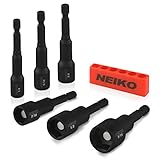
For most cordless impact drivers, the best starting point is a set of impact driver socket sets with a 1/4-inch hex shank. These sockets connect directly to the quick-change chuck and commonly cover 1/4-inch through 9/16-inch hex sizes, with metric sizes from roughly 8 to 15 mm.
That range handles many deck screws with hex heads, structural screws, carriage-bolt nuts, small lag bolts, and general construction hardware. Look for sockets marked “impact rated,” with a black oxide or phosphate finish and a retaining groove or ball detent compatible with a 1/4-inch chuck. A short socket is usually more rigid and less likely to wobble than a long extension.
If you already own a ratchet or a larger impact wrench, buy 3/8-inch-drive impact sockets instead, using a 1/4-inch hex-to-square adapter only when necessary. A 3/8-inch-drive socket set gives you a stronger connection and more size options, but it is bulkier on a compact impact driver.
Socket types and where they work
| Socket type | Best use | Main limitation |
|---|---|---|
| 1/4-inch hex-shank socket | Direct use in an impact driver; deck and framing hardware | Less durable than a full square-drive socket under extreme torque |
| 3/8-inch-drive impact socket | General construction, automotive-style nuts, larger lag bolts | Needs an adapter or impact wrench |
| Deep impact socket | Long exposed threads, nuts on threaded rod, recessed hardware | More clearance required; can flex more at full reach |
| Shallow impact socket | Flush nuts and tight spaces | May bottom out before gripping a long nut or bolt |
| Universal impact socket | Limited-access fasteners and slight angle changes | More expensive and less positive engagement than a six-point socket |
Choose six-point sockets for lag bolts and structural nuts. They grip the flat sides of the hex instead of the corners, reducing rounding. Twelve-point sockets are useful when access is restricted, but they spread the load over smaller contact areas and are a poor first choice for a stubborn or partially damaged fastener.
Fit, sizes, and depth
Measure the fastener head or nut across the flats, not from corner to corner. Common SAE construction sizes include 1/4, 5/16, 3/8, 7/16, 1/2, 9/16, and 5/8 inch. Common metric hardware includes 8, 10, 12, 13, 14, 15, and 17 mm. Do not substitute a near-fitting metric socket for SAE hardware, or vice versa. A 13 mm socket is close to 1/2 inch, but “close” is enough to round a tight nut.
A deep socket is valuable when a lag bolt passes through a bracket or washer and leaves a long section of thread above the nut. For driving lag bolts directly, shallow sockets often give better control because the socket stays closer to the driver. Check the socket’s internal depth before assuming it will reach the fastener.
Magnetic nut setters can be convenient for hex-head screws, especially overhead, but they are not a replacement for sockets on heavy lag bolts. Magnets can lose their grip from vibration, and a nut setter with a shallow pocket may hold only the tip of a tall hex head. For repeated structural fastening, use a proper six-point impact socket.
Adapters, torque, and common failures
A 1/4-inch hex-to-3/8-inch square adapter is practical for occasional use, but it creates another failure point. The adapter’s pin or detent can shear, the square anvil can twist, and the extra length increases leverage and wobble. Use an adapter for moderate work, not as a permanent substitute for a dedicated impact socket setup.
Do not use chrome hand-tool sockets on an impact driver. Chrome sockets are often heat-treated for hand tools and can fracture under impact loading. The failure may be a visible split, or small chips that break away at the mouth. Wear safety glasses, particularly when using inexpensive sockets or working above shoulder height.
Socket markings also matter. A socket that physically fits may still be unsuitable if its wall is too thin for the application. Thin-wall designs help in tight spaces but can crack sooner on high-torque fasteners. For framing and structural hardware, favor a slightly thicker standard-wall impact socket unless clearance is genuinely limited.
Using sockets on lag bolts
Socket choice cannot compensate for poor installation. Drill a pilot hole sized for the lag bolt’s unthreaded shank and threaded portion. In softwood, a pilot hole around the root diameter is typical; in hardwood, the pilot may need to be closer to the thread’s minor diameter and slightly deeper. Follow the fastener manufacturer’s guidance when available.
Keep the driver square to the bolt. A tilted socket loads one side of the hex and can round the head, especially with a long extension. Run the impact driver at a lower speed as the washer or head approaches the work surface. Stop when the washer is seated. Continued hammering can crush wood fibers, strip the head, or snap the lag bolt.
For large lags, such as 1/2-inch hardware, a high-torque impact driver may be marginal depending on wood species, embedment depth, and corrosion. A compact driver may install a 1/4-inch or 5/16-inch lag comfortably but stall on a long 1/2-inch fastener. Pre-drilling, wax or approved lubricant, and a slower final drive reduce heat and resistance. Never rely on impact noise as a torque measurement.
When a cheaper set is fine
A low-cost impact socket set is reasonable for occasional shelving, a small deck repair, or assembling outdoor structures if the sizes are accurate and the sockets are clearly labeled impact-rated. Replace any socket that develops a crack, spreads at the opening, or no longer holds tightly in the chuck.
Spend more on a set when you install structural screws daily, work with stainless or heavily corroded hardware, or need dependable fit across many sizes. Premium sets generally offer better heat treatment, clearer markings, stronger detents, and tighter dimensional control. Those benefits reduce downtime, but they do not eliminate the need for the correct pilot hole or controlled driving technique.