What's inside
As an Amazon Associate I earn from qualifying purchases. This post may contain affiliate links at no extra cost to you.
Small furniture assembly is a light-duty job, but the wrong drill can still split a panel, strip a screw head or make a simple project harder than it needs to be. A compact 12-volt drill is usually the best fit: it has enough power for pilot holes and screws, weighs less than most 18-volt tools, and is easier to control around particleboard and softwood parts.
You do not need a hammer drill or impact driver for ordinary flat-pack furniture. Spend first on a comfortable drill with a variable-speed trigger, a clutch and a small set of well-fitting bits. If you already own a larger drill, it can do the job too—use a low speed and a light touch.
As an Amazon Associate we earn from qualifying purchases at no extra cost to you.


What we cover
What to look for in a furniture drill
Prioritize control over maximum torque. A clutch lets you set a limit on how firmly the drill drives a screw; when resistance reaches that setting, the clutch slips instead of continuing to tighten. Start low and increase the setting only if the screw stops before its head is seated. Clutch numbers are not standardized, so a setting on one drill does not correspond reliably to the same setting on another.
A variable-speed trigger is useful for starting screws slowly. That helps keep the bit seated in the screw head, especially with short screws or screws going into a narrow edge. A two-speed gearbox adds another kind of control: the low range is generally better for driving screws, while the high range is for drilling holes. Follow the tool’s manual, since speed ranges vary.
Look for a 3/8-inch chuck, which accepts common drill bits and is plenty for furniture work, and a battery around 1.5–2.0 Ah if one is offered. A smaller battery keeps the tool light; it may need recharging sooner, but a typical home assembly job rarely uses much capacity. For repeated projects, a second battery is more useful than a high-capacity pack that makes the drill heavier.
Which drill type makes sense?
A compact 12-volt drill is the practical choice for occasional assembly and small repairs. A basic 18- or 20-volt drill makes sense if you also plan to drill into framing, build projects from lumber or use larger bits. It is more capable, but its extra weight and torque are not advantages when you are trying to fasten small furniture parts gently.
A hammer drill is designed to add a pulsing hammer action when drilling masonry. It is unnecessary for assembling furniture, and that action should be switched off for wood, metal and fasteners. An impact driver delivers rotational impacts to drive fasteners; it can handle tougher fastening, but its abrupt force makes it easier to overdrive small furniture screws. Unless you have other jobs for one, neither tool is a sensible first purchase for flat-pack assembly.
| Tool | Best use | Furniture trade-off |
|---|---|---|
| Compact 12V drill | Flat-pack furniture, pilot holes, light repairs | Light and controllable; less suited to large holes or extended heavy work |
| 18/20V drill | Furniture plus general home projects | More versatile, but often heavier and easier to overpower small screws |
| Impact driver | Driving many long or large fasteners | Fast, but forceful; poor control is a risk on delicate panels |
| Hammer drill | Drilling masonry | Unneeded for furniture assembly |
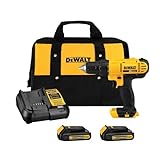
For most buyers, a 12V cordless drill-driver kit is the best starting point. If you already have compatible batteries in a tool brand’s 18- or 20-volt platform, buying a bare drill may cost less than switching systems. Compare the included charger, battery and case before comparing kit prices.
Bits, setup and safe fastening
Many furniture kits use Phillips, Pozidriv, hex or Torx fasteners. They can look similar at a glance, but a mismatched bit may slip and chew up the screw head. Check the instruction sheet and test the bit in the screw before driving. The bit should fit snugly, with little side-to-side movement. A small bit set covering common furniture screw types is usually more useful than a large assortment of drill bits.
Use the manual’s specified bit size for any pilot hole. If it gives no guidance, test on scrap of similar material rather than guessing on a visible panel. For a pilot hole in solid wood, the bit should generally be close to the screw’s core diameter—the shaft excluding the threads. Particleboard behaves differently and can crumble or lose holding strength if a hole is too large, so follow the furniture maker’s instructions where possible.
Clamp or hold pieces steady before drilling, keep the bit perpendicular, and avoid drilling through the far side of a panel. A depth stop or a strip of tape on the bit can serve as a visual depth guide, but it is not a substitute for care. Wear eye protection when drilling, and keep fingers clear of the bit and moving joints.
Common mistakes and how to avoid them
The most frequent mistake is using the drill at full speed from the first squeeze. Start slowly, keep the bit aligned, and ease off as the screw head approaches the surface. If the screw continues turning without getting tighter, stop: the hole may be stripped. More power will not repair it. Do not keep driving a screw once it is seated; crushing the surface or sinking the head below it can weaken the joint.
Another failure is overtightening cam locks or connector bolts. They are designed to hold parts in a particular position, not to be forced until the drill stalls. Assemble parts in the sequence shown, bring fasteners snug by hand or at a low clutch setting, and check that the panels remain square. If a joint will not close, look for a misaligned connector or reversed panel rather than applying more torque.
A sensible buying choice
For one bookcase, desk or set of chairs, a basic compact cordless drill-driver with a clutch is enough. Choose a larger 18- or 20-volt drill kit if you expect regular woodworking or home-repair use, not simply because the voltage is higher. For occasional assembly, an inexpensive drill is fine as long as its trigger is controllable, its clutch works and you have the correct bit. The careful setup matters more than extra power.