What's inside
As an Amazon Associate I earn from qualifying purchases. This post may contain affiliate links at no extra cost to you.
A cordless drill is only as useful as its chuck. If the jaws do not grip a small bit evenly, the bit slips, wobbles, or falls out when you start drilling. This is especially common with bits under 1/8 inch, long pilot bits, and smooth-shank bits used for wall anchors or small screws.
For most users, the best upgrade is a good 3/8-inch or 1/2-inch keyless chuck with jaws that close tightly and run concentrically. A keyed chuck can grip even harder, but it is slower to use. Impact drivers require a different solution: their 1/4-inch hex collets accept hex-shank bits, not ordinary round-shank drill bits.
As an Amazon Associate we earn from qualifying purchases at no extra cost to you.


What we cover
What Makes a Chuck Good for Small Bits?
Small bits expose chuck weaknesses that larger bits can hide. A chuck may hold a 1/2-inch bit adequately while allowing a 1/16-inch bit to sit off-center. The result is a hole that is larger than the bit, a wandering pilot hole, or a bit that breaks as it flexes.
Look for three jaws that meet evenly, a smooth tightening sleeve, and a published minimum capacity of 1/32 inch or smaller. Many common chucks range from 1/16 to 1/2 inch, which is fine for general drilling but may not grip the smallest bits securely. A 0 to 3/8-inch chuck is often better suited to precision work if you rarely drill large holes.
Runout matters, too. Runout is the amount the bit wobbles as it spins. Under about 0.004 inch is a useful target for a replacement chuck, although manufacturers do not always publish a number. A small amount of visible movement at the bit tip is normal; a dramatic circular sweep indicates a problem with the chuck, arbor, or bit.
The Best Chuck Types
| Chuck type | Best use | Small-bit grip | Main trade-off |
|---|---|---|---|
| Quality keyless | General cordless drilling | Good | Can loosen under vibration if poorly tightened |
| Keyed | Heavy drilling and maximum grip | Very good | Requires a chuck key and is slower |
| Precision keyless | Pilot holes, electronics, light woodworking | Excellent | Usually costs more and has lower capacity |
| 1/4-inch hex collet | Impact drivers and hex-shank accessories | Good with matching bits | Does not accept ordinary round-shank bits |
A 3/8-inch keyless drill chuck is the sensible choice for most cordless drills. It is compact, light, and covers common bit sizes up to 3/8 inch. Choose one with a metal sleeve if you regularly drill masonry, metal, or hardwood; plastic sleeves are lighter and cheaper but can crack or become difficult to turn after dust and wear.
A keyed chuck is preferable when bits repeatedly slip. The key lets you tighten each jaw position with more torque than hand-tightening can provide. It is also useful with hole saws, large twist bits, and masonry bits. The downside is practical rather than technical: you must keep track of the key, and changing bits takes longer. For occasional household drilling, the extra grip may not justify the inconvenience.
For very small bits, consider a precision mini drill chuck only if it matches your drill’s connection. Many are intended for rotary tools or small drill presses, not a full-size cordless drill. They may use a threaded mount, Morse taper, or a tiny shaft rather than the standard threaded arbor found on many drill chucks.
Check Compatibility Before Buying
Do not assume every replacement chuck fits every cordless drill. Remove the battery, open the existing jaws fully, and look inside for the retaining screw. The chuck may attach with a 1/2-20 UNF thread, 3/8-24 thread, or a taper. The retaining screw is often left-hand threaded, so it loosens clockwise.
Measure the old chuck’s capacity and identify whether the drill has a threaded arbor or a tapered spindle. A replacement chuck with the wrong thread may seem to start but will not seat correctly. It can wobble, damage the spindle, or unscrew during reverse operation. If the drill uses a proprietary quick-change system, a standard chuck may not be a direct replacement.
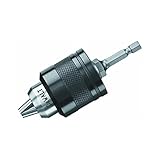
A 1/4-inch hex chuck adapter can add round-bit capability to an impact driver, but it is a compromise. The adapter adds length and runout, and the impact mechanism can loosen ordinary keyed or keyless attachments. Use it for light drilling in wood or plastic, not demanding masonry work or large holes.
How to Hold Small Bits Securely
Open the jaws only far enough to insert the bit. Push the bit straight into the center, then tighten the chuck while lightly rotating the bit by hand. On a keyless chuck, tighten firmly at two or three positions around the sleeve if the design allows it. This helps center the jaws instead of leaving one side loose.
Before drilling, run the tool at low speed and watch the tip. If it wobbles, reseat the bit. A bent bit will wobble even in a good chuck, so test with another bit before blaming the tool. Do not hold a tiny bit with pliers while tightening; the jaws can mark it and the bit may still be off-center.
For a pilot hole, start slowly with light pressure. High speed and heavy pressure heat small bits quickly, especially in steel. Let the bit cut rather than forcing it. When drilling wall anchors, use the anchor manufacturer’s stated bit diameter—often 1/4 inch, 5/16 inch, or 3/8 inch—and stop when the hole reaches the specified depth. A sloppy hole can leave the anchor spinning instead of gripping.
When the Cheaper Chuck Is Fine
A budget keyless chuck is adequate for occasional holes in softwood, drywall, plastic, and light-duty fastening. If the bit is 1/8 inch or larger and the work does not involve vibration, you may notice little difference from a premium chuck.
Spend more when you drill small holes often, work in metal, use long bits, or need repeatable hole placement. In those situations, better jaw alignment and lower runout save broken bits and rework. Keep the chuck clean, avoid using it as a hammering surface, and replace it when the jaws no longer meet evenly or the bit slips despite firm tightening.