What's inside
As an Amazon Associate I earn from qualifying purchases. This post may contain affiliate links at no extra cost to you.
Heavy artwork puts more stress on drywall than its static weight suggests. A 30-pound framed picture can pull away from the wall as someone bumps it, or as the frame hangs slightly forward on its wire. The best anchor depends on the actual load, the wall thickness, and whether you can place the fastener in a stud.
As an Amazon Associate we earn from qualifying purchases at no extra cost to you.

What we cover
Start With the Wall and the Load
First weigh the artwork, including the frame, glass, backing, and hanging hardware. Add a safety margin: choose hardware rated for at least twice the real weight. A 25-pound frame should not be hung from an anchor rated for exactly 25 pounds, especially if it will be moved often or hangs over a bed, sofa, or walkway.
Use a stud whenever the layout allows it. A wood stud provides far more reliable holding power than any drywall anchor. A stud finder helps locate one, but confirm the location with a small drill bit or by measuring from a nearby corner. Standard studs are usually spaced 16 inches on center, though 24-inch spacing and irregular framing are common.
For a stud-mounted installation, drive a suitable screw directly into the center of the stud. A 2 1/2- to 3-inch screw is often appropriate for a thick picture hanger or French cleat, allowing for the cleat and drywall while leaving roughly 1 1/2 inches of thread in the wood. Do not use an excessively long screw without checking for pipes and wiring.
Best Drywall Anchors by Use
| Anchor type | Best use | Practical load range | Main drawback |
|---|---|---|---|
| Picture hook | Light to medium frames | 10–50 lb, depending on the product | Limited capacity and a small hanging point |
| Self-drilling threaded anchor | Quick installation for lighter frames | Up to about 50 lb in ideal conditions | Can strip or pull out in weak drywall |
| Plastic expansion anchor | Light-duty, inexpensive installations | Usually 10–25 lb | Not a good choice for truly heavy artwork |
| Toggle bolt | Heavy loads where no stud is available | Often 50–100 lb per anchor, product-dependent | Requires a large hole and access behind the wall |
| Strap toggle | Heavy frames and repeated loading | Often 50–100 lb or more per anchor | More expensive; the strap can be damaged during installation |
Best Choice for Heavy Artwork
For a heavy frame on open drywall, a metal strap toggle is usually the best all-around choice. It spreads the load over a broad area behind the drywall instead of relying on threads cut into the gypsum. A pair of properly installed toggles can support a substantial frame, but use the manufacturer’s rating for your exact drywall thickness rather than assuming the highest advertised number.
Traditional spring toggles also work well, particularly in 1/2-inch drywall. They are inexpensive and strong, but the wings fall behind the wall when you remove the bolt. That makes them inconvenient if the artwork is repositioned. The hole also needs to be large enough for the folded toggle to pass through.
For a more secure and cleaner installation, use a heavy-duty strap toggle anchor. These are a good choice for French cleats, wide brackets, and frames supported at two or more points.
When Cheaper Anchors Are Fine
A basic plastic expansion anchor is sufficient for a small canvas or lightweight frame under about 10 pounds. It is also reasonable for a temporary installation where failure would not cause damage. Drill the specified hole, tap the anchor flush, and use the correct screw diameter. If the anchor spins while tightening, remove it and replace it; a spinning anchor is not gripping the drywall.
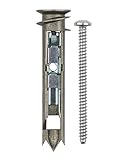
Self-drilling threaded anchors are faster because they do not require a separate pilot hole. They are convenient for medium-weight artwork, especially when the frame has two hanging points. However, their coarse threads can tear up the drywall if you overtighten them. They are also a poor choice in damaged, soft, or repeatedly patched drywall.
Shop for heavy-duty drywall anchors for picture hanging rather than relying only on a package’s maximum weight claim. Look for ratings that specify drywall thickness and whether the rating applies to one anchor or a pair.
Installation Tools and Technique
A cordless drill with a sharp drill bit makes the job cleaner. For plastic anchors, use the bit size printed on the package. For toggles, drill the exact required hole; a hole that is too large reduces the bearing area, while a hole that is too small can bend the toggle or damage the drywall.
Use a standard drill mode, not hammer mode. Hammer drilling can enlarge the hole and crush the gypsum around it. A small cordless drill driver is generally preferable to an impact driver because it gives better control. An impact driver can easily over-tighten an anchor, crack the drywall, or strip the screw head.
Mark both mounting points with a level. Keep anchors at least 1 1/2 inches from the edge of a drywall sheet or a previous hole when possible. After installing the anchor, tighten the screw until the bracket is firm, then stop. Continued tightening does not increase holding power once the bracket is seated.
Avoid Common Failure Modes
Do not hang a heavy frame from a single screw driven only into drywall unless the anchor is specifically rated for the load and the frame cannot swing. Two anchors reduce tilting and distribute the force. For very wide or valuable artwork, a French cleat attached to a stud, or to several properly spaced toggles, is safer than two small picture hooks.
Watch for bowed drywall, loose paper, and old anchor holes. These conditions can make a listed 75-pound capacity meaningless. If the artwork is valuable, mounted over people, or weighs more than roughly 50 pounds, locate studs or use a cleat with multiple structural attachment points. When the wall cannot support the load confidently, move the artwork or open the wall to add blocking rather than gambling on a stronger-looking anchor.
For locating studs before drilling, a deep-scan electronic stud finder is useful, but verify its reading before committing to a large hole. The best anchor is still a screw in solid framing when you can place it where the artwork needs to go.