What's inside
As an Amazon Associate I earn from qualifying purchases. This post may contain affiliate links at no extra cost to you.
Basement finishing usually means fastening wood furring strips, bottom plates, or light framing to concrete or block. The right screw and bit depend on the masonry, the load, and whether you are drilling a few holes or an entire room. For typical furring strips and nonstructural framing, a quality masonry screw is often the simplest choice. It needs a correctly sized pilot hole and a hammer drill or rotary hammer; forcing a screw into an undersized or dusty hole is a reliable way to snap it.
As an Amazon Associate we earn from qualifying purchases at no extra cost to you.



What we cover
Choose the fastener for the job
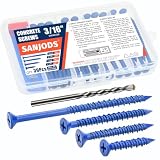
Concrete screws cut threads into a predrilled hole. They are removable, quick to install, and a good fit for attaching furring strips or a bottom plate that does not carry a major structural load. Buy screws intended for concrete or masonry, not ordinary wood or deck screws. Common diameters are 3/16 and 1/4 inch; lengths around 1-3/4 to 2-1/4 inches often suit a 3/4-inch strip with useful embedment, but check the fastener maker’s instructions and account for any foam or other material between the wood and concrete.
For heavier loads, uneven masonry, or a fastening point that must not loosen, consider a sleeve or wedge anchor rated for the base material and load. These are less forgiving to install and usually need a larger hole. Don’t use a light-duty concrete screw as a substitute for a specified structural connection. If the wall is hollow block, follow an anchor maker’s guidance for hollow masonry; an anchor intended for solid concrete may not hold properly in a hollow cell.
Fastener and bit options
| Option | Good for | Trade-off |
|---|---|---|
| Concrete screw | Furring strips and light framing in sound concrete | Needs a precise pilot hole; can strip or snap if the hole is too small or dirty |
| Sleeve anchor | Moderate loads where expansion anchoring is appropriate | Needs a larger, accurately drilled hole and careful tightening |
| Wedge anchor | Heavier loads in solid concrete | Not suitable for every masonry type; installation is less forgiving |
| Carbide masonry bit | Occasional holes in concrete or block | Slower and more prone to overheating during repeated drilling |
| SDS-plus bit | Many holes or harder concrete with a rotary hammer | Requires an SDS chuck; not a standard drill bit |
Buy the right bit and drill
For a small basement project, a concrete screw kit with matching masonry bits can be convenient. Check that the kit states the pilot-hole diameter and includes enough of the correct bit size; a generic assortment is not automatically compatible with your screws.
Use the pilot diameter specified on the screw packaging. A hole that is too small makes the screw bind and can break it; one that is too large gives the threads little material to grip. A carbide-tipped masonry bit in a hammer drill works for occasional holes. If you are drilling dozens of holes, a rotary hammer with SDS-plus bits is faster and puts less effort into each hole. The SDS shank does not fit a regular three-jaw chuck, so check your tool before buying bits. A set of SDS-plus masonry bits makes sense for a larger job, but is unnecessary for a few fasteners.
An impact driver can turn many concrete screws, but it does not replace the drill: the pilot hole still has to be drilled first. Use the correct driver bit, keep it fully seated, and stop if the screw stalls. Excessive impact can damage the screw head, strip the hole, or snap the fastener. A drill driver with a clutch gives more control; an impact driver is handy when the screw maker permits it and you are installing many screws.
Drill and install without wrecking the hole
Mark the locations and check for pipes or wiring before drilling. For a bottom plate, use suitable separation from the concrete where required by local code and the wall design. Do not assume a finished-looking basement wall is dry: address water intrusion before covering the foundation.
Hold the drill square to the surface. Start slowly to keep the bit from walking, then use hammer mode if the tool and bit are designed for masonry. Let the bit cut rather than leaning hard on it. Pull the bit out periodically to clear dust, especially in a deep hole. Drill to the required depth plus a little clearance for debris; a piece of tape on the bit is a simple depth marker. Wear eye protection, and use dust extraction or an appropriate respirator. Concrete dust is hazardous, and drilling overhead makes eye protection particularly important.
After drilling, clear dust from the hole according to the fastener instructions. Seat the screw straight and drive it until snug. Stop when the wood is secure; burying the head or continuing after the screw has seated can strip the concrete threads. If a screw spins without tightening, don’t just keep turning it. Move to a fresh location with adequate edge distance, or use an anchor suited to the material and load. A bit that is worn, bent, or overheated can also make a poor hole, so replace it when drilling slows or the hole becomes ragged.
Where it pays to save
For a handful of holes in ordinary concrete, an inexpensive carbide masonry bit of the correct diameter is usually fine. You do not need a premium rotary hammer or a large bit set for one short wall. Spend more when the job involves hard concrete, many holes, or repeated work: a rotary hammer and good SDS-plus bits reduce time and fatigue. In every case, the fastener’s stated hole size and embedment matter more than buying the most powerful tool.
For fastening into concrete repeatedly, a cordless hammer drill for masonry is a useful middle ground for DIY use. It is more versatile than a rotary hammer, though noticeably slower in hard concrete. Match the tool to the number of holes, use the specified bit, and test one fastener before laying out the whole wall.