What's inside
As an Amazon Associate I earn from qualifying purchases. This post may contain affiliate links at no extra cost to you.
Thin aluminum is easy to drill, but it is also easy to damage. A standard bit can grab as it breaks through, leaving a ragged hole or pulling the panel out of position. For most home and shop jobs, a sharp, ordinary high-speed-steel twist bit is enough. The bigger differences come from bit geometry, panel support, and how you control the drill.
As an Amazon Associate we earn from qualifying purchases at no extra cost to you.


What we cover
Choose the bit for the hole
For holes up to about 1/2 inch, start with a sharp HSS jobber-length twist-bit set. These bits are inexpensive, widely available, and suitable for aluminum. A 118-degree point works for general use; a 135-degree split point can start more reliably on smooth sheet with less wandering. Neither point angle eliminates the need to center-punch or clamp the work.
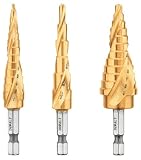
If you need a larger hole, a step bit is often the easier choice for sheet roughly 1/16 to 1/8 inch thick. Its stepped cutting edges make progressively larger holes and are less prone to catching than a large twist bit. The trade-off is that the hole size is limited to the step sizes, and a step bit may not be the best choice for thick stock. Check its stated capacity before buying.
A hole saw can make larger holes in thicker aluminum, but it takes more control and usually leaves a rougher edge. For thin panels, it can grab hard at breakthrough. Use it only when the diameter or material thickness calls for it, and secure the panel firmly.
Bit options at a glance
| Bit type | Good fit | Main advantage | Watch out for |
|---|---|---|---|
| HSS twist bit | Small and medium holes | Low cost; common sizes | Can wander or grab if the panel is unsupported |
| 135-degree split-point HSS bit | Accurate starting on sheet | Starts more easily than a conventional point | Still needs a mark and a steady setup |
| Step bit | Clean, larger holes in thin sheet | Gradual cutting; less likely to snag | Limited to its step sizes and thickness rating |
| Hole saw | Large holes or thicker aluminum | Can cut diameters beyond typical step bits | More torque, heat, and breakthrough risk |
What to buy—and what you can skip
For occasional repairs, a basic HSS set is usually the sensible buy. You do not need cobalt bits for ordinary aluminum; cobalt is mainly useful for tougher metals and will not compensate for a dull edge or poor technique. Titanium-coated bits are still HSS underneath. The coating can reduce friction when new, but it does not make a bargain bit last indefinitely.
For repeated panel work or holes above 1/2 inch, consider a step drill bit rated for sheet metal. Compare its maximum cutting diameter and material-thickness limit with your job. If you need one exact large diameter in thicker stock, a suitable hole saw may be a better match.
A cordless drill is fine for these bits. Use a drill setting rather than an impact driver: impact action adds little benefit here and can make a small bit harder to control. A hammer drill should have hammer mode switched off. A variable-speed trigger helps, but a lower gear on the drill provides better control when using a larger bit.
Set up the panel before drilling
Remove the panel if practical. If it must stay in place, check both sides for wiring, pipes, and other obstructions, then clamp it so it cannot flex. For a loose sheet, sandwich it between sacrificial boards of plywood or scrap wood and clamp the stack to a stable surface. Close support at the hole reduces vibration and helps prevent the bit from tearing the panel as it exits.
Mark the center with a fine marker and make a light center-punch dimple. On very thin aluminum, a heavy punch can dent or distort the sheet, so use only enough force to keep the bit from skating. For a larger hole, drill a small pilot hole first with a twist bit, then use the step bit or larger cutter. A pilot hole is not essential for every step bit, but it can help keep the opening centered.
Drill without tearing the edge
Wear safety glasses; thin aluminum can produce sharp chips. Start slowly, hold the drill square to the panel, and use light, steady pressure. A small bit can often run around 1,000–2,000 rpm in thin sheet, while a larger bit or step bit generally benefits from a slower speed. These are practical starting ranges, not fixed rules: follow the bit maker’s guidance and reduce speed if the bit chatters, heats quickly, or stops cutting cleanly.
Keep the bit cutting rather than forcing it. If chips stop coming out or the edge smears, withdraw the bit, clear the chips, and let the work cool. A drop of cutting fluid can help on repeated holes, though it is not necessary for a couple of small openings. Near breakthrough, ease off the pressure. This is where a bit is most likely to catch, enlarge the hole, or pull the sheet upward.
Do not hold a small panel by hand while drilling. If the bit catches, the panel can spin or cut your hand. Likewise, avoid using an impact driver for a hole saw or large twist bit unless the cutter is specifically intended for it; sudden torque can twist the tool or workpiece.
Check the hole and finish the edge
After drilling, remove burrs with a deburring tool, a countersink turned by hand, or a fine file. Take only a light pass: a powered countersink can quickly make a thin panel’s hole too large. If the hole will take a bolt, check the fit before deburring aggressively. For a clearance hole, the opening is commonly a little larger than the fastener’s nominal diameter, but use the hardware maker’s recommended size when alignment or strength matters.
A clean setup and sharp HSS bit will handle most small holes cheaply. Choose a step bit when you need a larger opening in thin sheet and want better control; reserve a hole saw for jobs its size and thickness range justify.