What's inside
As an Amazon Associate I earn from qualifying purchases. This post may contain affiliate links at no extra cost to you.
Thin carbon steel is easier to drill than thick plate, but it is also easier to snag, distort, and leave with a ragged hole. The best bit depends on the hole diameter, the steel’s thickness, and how many holes you need. For occasional holes in sheet metal, a sharp high-speed steel bit is usually enough. For cleaner, larger holes or repeated work, step bits and cobalt bits can be worth the extra cost.
As an Amazon Associate we earn from qualifying purchases at no extra cost to you.



What we cover
Choose the bit by hole size
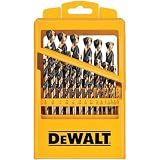
For small holes—roughly 1/8 to 3/8 inch—a standard twist bit is a practical choice. A sharp, general-purpose HSS metal drill bit set costs less than specialty bits and handles occasional work in mild carbon steel. Look for bits marked for metal, and check that the cutting edges are sharp and symmetrical. Dull bits rub instead of cutting, which creates heat and can make the bit wander.
For holes from about 1/4 to 1 inch in thin sheet, a step bit is often easier to control. Its stepped profile enlarges a pilot hole in stages and tends to leave a cleaner edge than a large twist bit. It is a useful buy if you regularly install cable glands, switches, or fittings in sheet metal. The trade-off is that each step limits the hole sizes available, and a step bit is not the right tool for thick plate.
For frequent work or harder steel, consider cobalt twist bits. They cost more than ordinary HSS but tolerate heat better. That advantage matters when drilling multiple holes, using a less-than-ideal drill speed, or working in tougher steel. Cobalt is not a cure for poor technique: excessive speed and pressure can still overheat the cutting edges.
Bit comparison
| Bit type | Best use in thin steel | Main advantage | Trade-off |
|---|---|---|---|
| HSS twist bit | Small holes and occasional jobs | Low cost; useful in many sizes | Can wander or dull faster under heat |
| Cobalt twist bit | Repeated holes or tougher steel | Better heat resistance | Costs more; still needs proper speed |
| Step bit | Medium and large holes in sheet | Easy size changes; often clean edges | Limited step sizes; not for thick stock |
| Unibit-style sheet-metal bit | Clean, round holes in thin panels | Designed for sheet; less grabbing than a large twist bit | Can be expensive for infrequent use |
Set the drill up to cut, not rub
Use a variable-speed cordless drill or corded drill in its low-speed range for larger bits. As a practical starting point in thin steel, run small twist bits around 1,000–2,000 rpm and larger bits or step bits around 300–800 rpm. These are working ranges, not fixed rules: reduce speed if the bit squeals, smokes, or discolors, and follow the bit maker’s guidance when available. A drill’s top speed is not automatically the right speed for metal.
Keep the bit cutting with steady, moderate pressure. Too little pressure polishes the steel and heats the bit; too much can twist a small bit or suddenly pull the drill into the work. Use cutting fluid or a drop of light machine oil for repeated holes, particularly with twist bits. Remove chips when they build up, and do not touch the bit or workpiece immediately after drilling—both can be hot enough to burn.
Keep thin sheet from tearing or distorting
Clamp the work securely and support it with a scrap piece of wood or another firm backing. This helps prevent the sheet from flexing as the bit breaks through. Mark the center with a punch, but use a light tap: a deep dimple can deform thin sheet. For a larger twist-bit hole, drill a small pilot hole first. For a step bit, a pilot hole is usually needed to admit the tip; check the bit’s instructions for the appropriate size.
Thin sheet can catch at breakthrough. Keep both hands on the drill, brace your stance, and ease off the pressure as the bit exits. Avoid using an impact driver for drilling these holes: its impacts can make the bit chatter, damage the hole, or catch the sheet abruptly. A regular drill with a stable grip gives better control.
For larger holes, a step drill bit for sheet metal is often the easier choice. If you only need one small hole, though, there is little reason to buy a specialty bit when a sharp HSS bit will do.
Common problems and fixes
The bit walks off the mark: Use a center punch, or start with a smaller bit. A sharp bit and a firmly clamped panel also help. Do not start at high speed with a large bit.
The hole has a burr: Thin steel commonly leaves a sharp edge. Deburr both sides with a hand deburring tool, countersink, or fine file. Work lightly; a large countersink can enlarge or distort a thin panel.
The bit squeals or turns blue: Stop and let it cool. Reduce speed, use cutting fluid, and inspect the cutting edges. A blue bit has been overheated and may no longer hold an edge well. Replacing a badly dulled bit is often more effective than pressing harder.
The sheet spins or tears at breakthrough: Re-clamp it and add backing. For an oversized hole, use a step bit or enlarge the opening gradually rather than forcing a large twist bit through unsupported sheet.
What to buy for your job
For a few holes up to about 3/8 inch in mild steel, buy a modest HSS set and keep the bits sharp. For a clean hole larger than that in thin sheet, a step bit is usually the more controllable purchase. For repeated drilling or harder steel, spend more on cobalt bits. If the steel is coated, painted, or galvanized, protect the finish where practical and clear the chips; wear eye protection, since metal chips are sharp and can travel farther than expected.