What's inside
As an Amazon Associate I earn from qualifying purchases. This post may contain affiliate links at no extra cost to you.
For most garage workbenches, sleeve anchors or concrete screws are the practical choices. Sleeve anchors suit a bench you expect to keep in place; concrete screws are easier to remove and usually need less room around the hole. The right choice depends on the concrete, the bench’s mounting holes, and whether you can drill accurately—not just on the anchor’s rated load.
As an Amazon Associate we earn from qualifying purchases at no extra cost to you.

What we cover
Choose an anchor that fits the bench and floor
A typical bench needs to resist sliding and tipping, not suspend a heavy load from the floor. Secure each leg or base plate at two points when its design allows, and follow the bench maker’s instructions. Do not assume a particular anchor count or load rating guarantees a safe installation: concrete strength, edge distance, embedment, installation quality, and how the bench is loaded all matter.
| Anchor type | Best use | Trade-off |
|---|---|---|
| Concrete screw | Light to moderate benches; removable mounting | Fast installation, but performance depends on a clean, correctly sized hole and intact threads |
| Sleeve anchor | Permanent mounting through a base plate | Strong mechanical grip, but requires enough hole depth and is less convenient to remove |
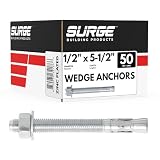
| Wedge anchor | Heavy-duty, permanent fastening in sound concrete | Needs careful hole placement and adequate edge distance; often more anchor than a small bench needs |
| Plastic masonry plug | Very light-duty fixtures, not a bench expected to take substantial force | Cheap, but a poor choice for repeated hammering or a bench that can rack or tip |
For many DIY installations, a quality concrete screw is the economical, reversible option. A sleeve anchor is a sensible step up when the bench will stay put and its base plate can accommodate the anchor diameter.
Check the floor before drilling
Locate the bench so its anchor holes are in sound concrete, away from cracks, crumbling patches, and the slab edge. Keep the distance from an anchor to an edge or another anchor at least what the anchor manufacturer specifies; there is no safe universal spacing for every diameter and concrete condition. A hole too close to an edge can split or spall the slab as the anchor expands. If the base plate forces poor spacing, reposition the bench or use a fastening layout approved by its manufacturer.
Garage slabs may contain reinforcing steel, radiant heat tubing, or post-tensioning cables. Check construction records and scan before drilling where those hazards are possible. Never drill into a suspected post-tensioned slab without qualified guidance. Also check for a floor coating: a thick or brittle coating can crush beneath the base plate, so remove it locally if needed and seat the plate on firm concrete.
Drill and install without damaging the hole
Use the drill-bit diameter, hole depth, and embedment specified for the exact anchor. These are not interchangeable between sizes or brands. A hammer drill with a sharp masonry bit is the usual choice; a regular drill can work in softer concrete with small screws, but it will be slower and may overheat. For a concrete screw, use the specified bit size rather than a larger bit that happens to fit. An SDS-plus masonry bit is useful for repeated holes in hard concrete, though it is unnecessary for a one-off job if a standard hammer-drill bit is suitable.
Mark the holes through the bench base, then move the bench aside. Drill perpendicular to the floor and slightly deeper than the required embedment so dust does not bottom out the fastener. Clear the hole with a vacuum or the cleaning method specified by the anchor maker. Dust left in the hole can prevent a concrete screw from cutting properly or keep an expansion anchor from seating fully. If the bit wanders or hits steel, stop; do not force the anchor into a damaged or misaligned hole.
Set the bench in place and start each fastener by hand to avoid cross-threading. Tighten to the manufacturer’s instructions. Over-tightening a concrete screw can strip its bite; excessive torque on an expansion anchor can damage the concrete or the anchor. If a screw spins without tightening, or an anchor turns in the hole, stop and correct the installation rather than relying on it. Do not simply fit a larger fastener into the same damaged hole unless the manufacturer permits that repair.
Test the mounting and choose the cheaper option wisely
After installation, push the bench sideways and diagonally, then check that the base plates remain flat and the fasteners have not loosened. Recheck after the first few heavy work sessions. A bench that rocks may need shims or a level floor contact before tightening; pulling a warped base down hard with anchors can put uneven stress on the fasteners.
For a light assembly table on sound concrete, concrete screws are often adequate and save time if removal matters. For a heavy bench used with a vise, repeated hammering, or substantial side loads, use the bench maker’s recommended fastening method and consider sleeve or wedge anchors sized for the base plate and slab. If the slab is thin, cracked, or its condition is uncertain, more powerful anchors are not automatically safer. Have the installation assessed rather than guessing at a larger diameter.