What's inside
As an Amazon Associate I earn from qualifying purchases. This post may contain affiliate links at no extra cost to you.
What we cover
Best Cordless Hammer Drills for Installing Concrete Wedge Anchors
Concrete wedge anchors are not a forgiving fastening system. You drill a hole to a specified diameter and depth, clean it, drive the anchor in, and tighten the nut to expand the clip against the concrete. A poor hole can leave the anchor loose, stuck halfway in, or unable to reach its rated holding strength.
For most wedge-anchor work, the best tool is a cordless SDS-plus rotary hammer, not a conventional cordless hammer drill. A standard hammer drill can work for a few small holes in sound concrete, but it is slower and puts more strain on the operator. The right choice depends mainly on anchor diameter, hole count, concrete hardness, and whether you already own batteries.
As an Amazon Associate we earn from qualifying purchases at no extra cost to you.


Quick comparison
| Tool type | Best use | Practical anchor range | Main limitation |
|---|---|---|---|
| 12V cordless hammer drill | Occasional small holes in block or softer concrete | 1/4 inch to 3/8 inch | Slow drilling and limited battery runtime |
| 18V/20V cordless hammer drill | Light-duty concrete anchoring and mixed maintenance work | 1/4 inch to 1/2 inch | Can struggle in dense or reinforced concrete |
| Cordless SDS-plus rotary hammer | Repeated wedge-anchor holes and installation work | 1/4 inch to 3/4 inch | Less useful as a general screw-driving drill |
| Cordless SDS-max rotary hammer | Large anchors and high-volume commercial drilling | 3/4 inch and larger | Heavy, expensive, and excessive for small anchors |
Best tool for most anchor installation
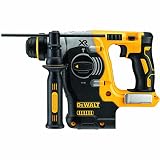
A cordless SDS-plus rotary hammer is the sensible choice for installing several concrete wedge anchors. SDS-plus bits transfer impact energy directly through the bit and do not rely on a three-jaw chuck gripping a round shank. The result is faster drilling, straighter holes, and less effort when drilling 3/8-inch or 1/2-inch holes to 3 or 4 inches deep.
Look for a brushless motor, a two- to four-amp-hour battery at minimum, and a clutch or electronic torque limiter. A compact rotary hammer weighing around 5 to 8 pounds is easier to control from a ladder or overhead. Models with a hammer-only mode are useful for light chiseling, but drilling performance and vibration control matter more for anchors.
For occasional work, a conventional brushless cordless hammer drill is a reasonable cheaper option. Choose one with a side handle and a mechanical clutch. It is fine for a handful of 1/4-inch holes in normal concrete, especially if you already own the battery platform. Expect more pressure, more noise, and considerably longer drilling times.
How much power do you need?
Do not choose a tool by advertised voltage alone. A high-capacity battery can help runtime, but it does not turn a standard hammer drill into a rotary hammer. Impact energy, bit quality, and the tool’s ability to shed dust are more important.
For 1/4-inch anchors, a compact hammer drill may be adequate. For 3/8-inch anchors, an 18V or 20V hammer drill can work in softer concrete, but an SDS-plus rotary hammer is faster and less tiring. For 1/2-inch anchors, use an SDS-plus tool unless you are drilling only one or two holes. Large 5/8-inch and 3/4-inch anchors are better handled by a more powerful SDS-plus or SDS-max machine, depending on the manufacturer’s drilling recommendations.
Dense poured concrete, old concrete, aggregate-heavy slabs, and holes near reinforcing steel expose the limits of a hammer drill quickly. If the bit stops producing dust and the motor begins to labor, continuing to force it can overheat the tool or glaze the bit.
Bits and hole quality
Use a carbide-tipped masonry bit that matches the anchor manufacturer’s specified diameter. For SDS-plus tools, buy SDS-plus four-cutter concrete bits when drilling reinforced or aggregate-heavy concrete. Two-cutter bits cost less and are perfectly serviceable for ordinary concrete, but four-cutter designs are less likely to catch when they encounter rebar and generally produce a more consistent hole.
Mark the required depth on the bit with tape or use the drill’s depth stop. Drill at least the minimum embedment specified for the anchor, plus allowance for dust below the anchor. Do not assume a deeper hole automatically makes the connection stronger; the anchor must have enough sound concrete around it and must meet edge-distance requirements.
Withdraw the bit several times while drilling to clear dust. A plugged hole increases friction and can leave a smaller effective hole than expected. After drilling, clean the hole with compressed air and a hole-cleaning brush, following the anchor maker’s instructions. A vacuum is preferable indoors. Dust left at the bottom can prevent full insertion and reduce expansion.
Installation failures to avoid
The most common mistake is using a worn bit. A dull bit drills slowly, wanders, and may create an undersized or irregular hole. Another is drilling through hollow block while assuming it behaves like solid concrete. Wedge anchors need solid material and sufficient embedment; use a sleeve anchor or another anchor type when the base material calls for it.
Do not use the drill’s hammer function to tighten the nut. Drill the hole in hammer mode, then remove the bit and tighten the anchor with a wrench or socket. Follow the specified torque. Under-tightening may leave the anchor poorly expanded, while excessive torque can damage the threads, strip the nut, or fracture weak concrete around the hole.
Keep the tool square to the surface. A crooked hole can prevent the anchor from seating fully and may reduce contact between the expansion clip and the concrete. Maintain the required spacing from edges and other anchors; concrete can split even when the hole itself is correctly drilled.
What to buy
Buy a cordless SDS-plus rotary hammer if you are installing more than a few wedge anchors, working with 3/8-inch or larger hardware, or drilling into hard structural concrete. Buy a brushless 18V or 20V hammer drill if the job is occasional, the holes are small, and you value one tool for drilling, driving screws, and general repairs. The cheaper option is fine when the workload is genuinely light; it is false economy when slow drilling turns a ten-minute fastening job into an overheated tool and damaged bits.