We research everything we recommend. When you buy through our links, we may earn a commission. As an Amazon Associate we earn from qualifying purchases.
Best Center Punches for Drilling: 5 Picks for Layout
Compare the best center punches for drilling, from automatic spring-loaded models to a manual machinist punch, with specs on length, points, and impact.
Compare the best center punches for drilling, from automatic spring-loaded models to a manual machinist punch, with specs on length, points, and impact.
Quick answer: For most drilling layout work, an automatic center punch is the fastest way to mark a hole location: the Starrett 18A (Premium) is the benchmark pick, with a 5 inch steel body, a 9/16 inch diameter, and an adjustable stroke. The General Tools 78 (Mid-range) is the heavy-duty value pick, the NEIKO 02639A (Mid-range) adds a 6 inch reach and an S2 steel tip, and the NEIKO 02638A (Budget) covers everyday marking at 5 inches. If you prefer a hammer-struck punch, the manual Starrett 117E (Mid-range) is the classic machinist option.
As an Amazon Associate, we earn from qualifying purchases.
A drill bit wants to wander. On flat metal, painted steel, or smooth hardwood, the tip of a twist drill skates sideways as it starts to spin, and the hole ends up offset from the layout line. A center punch solves that problem before the drill ever turns: one strike leaves a small conical dimple exactly on the mark, and the dimple traps the drill point so the bit starts where the layout says it should.
There are two families of center punches. A manual center punch is a solid hardened steel rod with a ground point; you position it on the mark and strike the head with a hammer. An automatic center punch stores energy in an internal spring instead. You press the body down, the mechanism trips, and the internal hammer strikes the point with a consistent force and no hammer swing at all. That one-handed action matters on a drill press table, on a ladder, or anywhere the other hand is holding the workpiece or a square in place.
For drilling layout, the center punch mark is usually the second step in a sequence. A prick punch or scribe makes a fine locating mark first, the center punch enlarges it into a dimple a drill point can follow, and a small pilot drill confirms the location before the final bit size. The five punches below cover that job at every tier: two machinist-grade automatics, two longer and lighter automatics, and one traditional manual punch.
How to Choose
Automatic or manual. Automatic punches deliver the same strike force every time, which keeps dimple depth consistent across a row of holes, and they free up the hand that would otherwise swing a hammer. Manual punches are simpler, have no mechanism to wear, and let you vary the force blow by blow, which some machinists prefer for very deep marks in thick stock.
Adjustable impact. Most automatic punches let you screw the cap in or out to change spring tension. A light setting marks thin sheet, wood, and plastic without denting through; a heavy setting drives a deeper dimple in mild steel. If you mark both sheet metal and plate, adjustability is worth having.
Body length and diameter. Common lengths run from 4 to 6 inches. A longer, thicker body (5/8 inch or 11/16 inch diameter) is easier to hold steady on open stock and suits larger drill work. A shorter, slimmer body fits inside cabinets, enclosures, and hinge mortises where a long tool cannot stand upright.
Point material and replacement. The point does the work, so hardened tool steel or S2 steel points hold up best. A replaceable point, offered on the Starrett 18A and the General Tools 78, extends the life of the tool: when the point dulls or chips, you swap it instead of replacing the whole punch.
Grip and finish. Knurled bodies are easier to hold with oily or gloved hands. Black oxide and chrome finishes slow rust in damp shops; plain steel needs a wipe of oil now and then.
The 18A is the automatic center punch most machinists measure the rest against. Its all-steel body is 5 inches long with a 9/16 inch diameter, a size that sits comfortably in one hand and still stands upright in tight spots like electrical enclosures. The knurled handle gives a positive grip, and the internal mechanism delivers a uniform strike at each setting, so a row of layout marks comes out the same depth from the first hole to the last.
Turning the knurled cap adjusts the stroke, letting you lighten the blow for thin sheet and plastic or run it up for a firm dimple in steel plate before drilling. The point is removable and replaceable (Starrett part PT06690), which is the feature that separates a lifetime tool from a disposable one: a chipped point is a small part swap, not a new punch. Starrett lists a single punch per package, so check that a listing describes the complete tool and not the replacement point alone before ordering.
2. General Tools 78 Heavy-Duty Automatic Center Punch
Runner-Up
2. General Tools 78 Heavy-Duty Automatic Center Punch
The number 78 is General Tools’ largest automatic center punch, built for heavier marking work. The alloy steel body wears a black oxide finish that inhibits rust, and at 5/8 inch in diameter it fills the hand more than slimmer punches, which helps keep it plumb on open stock. General’s own dimension table lists the body at 5-5/8 inches long; some retail copy rounds that figure to 6 inches, so the manufacturer’s dimension is the one used here.
The spring tension adjusts for light or heavy strokes, and the conical point is hardened steel and replaceable (the 78P point), so the tool can be renewed instead of discarded. The published point diameter is 0.083 inches, fine enough for precise layout intersections yet stout enough for repeated strikes in metal. At 4.8 ounces it has enough mass to feel planted without tiring the hand across a long layout session.
The 02639A is the long-reach option in this lineup. At 6 inches it is the longest punch here, which helps when the mark sits down inside a frame rail, behind a flange, or anywhere a shorter tool forces an awkward wrist angle. The shank is chrome plated to resist corrosion, and the tip is premium S2 steel, a shock-resistant tool steel chosen for impact tools because it resists chipping at the point.
The impact adjusts with one hand by turning the cap, so you can soften the strike for aluminum sheet or firm it up for steel. The published listing data does not state an item weight, and no replacement tip is listed for this model, so the point should be treated as fixed: if it dulls, the practical options are careful regrinding or a new punch. For shops that mark automotive panels and fabrication stock, the extra inch of reach and the S2 tip are the reasons to pick it over its shorter sibling below.
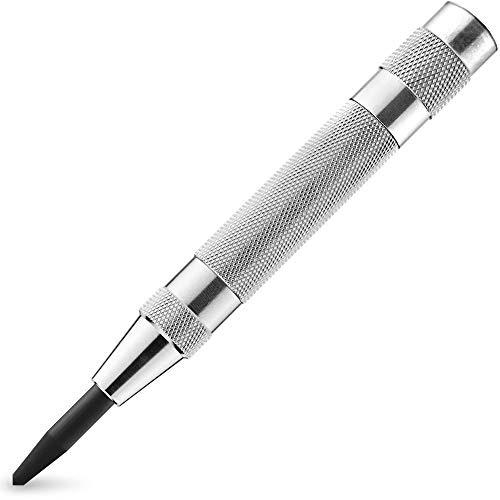
The 02638A is the everyday budget pick: a 5 inch automatic punch with an S2 steel punching bit and an adjustable cap that accommodates light or heavy strokes. NEIKO positions it for marking wood, plastic, metal, glass, and leather ahead of drilling or fastening, and the mechanism works one-handed, so the other hand stays on the workpiece or the square.
At 2.4 ounces it is light enough to live in a tool belt or apron pocket without being noticed. The trade-offs match the tier: the replacement bit is not sold separately, so a worn point means replacing the punch, and the published product dimensions of 7.7 x 2.8 x 1.2 inches describe the packaged item rather than the tool itself. For occasional drilling layout around a home shop, those are reasonable compromises.
The 117E is the traditional option: a solid manual center punch from Starrett’s 117 series, made of specially selected steel, hardened and properly tempered. It has a round shank with a knurled finger grip, and the tapered point measures 1/4 inch in diameter at the top of the taper, the largest point in this roundup, suited to bold layout marks that a large drill point can follow.
Because it is struck with a hammer, the force is entirely in your control: a light tap for a shallow locating dimple, a firm blow for a deep mark in thick plate. There is no spring to fatigue and no mechanism to jam with chips or cutting fluid, which is why manual punches remain standard issue in fabrication shops. The 5 inch length keeps it compact in a tool roll. Note that a hammer is required and is not part of the listing; the punch is sold as a single tool.
Fit and Marking Checks
Check the listing is the complete tool. Several brands sell replacement points under similar names and model numbers. The Starrett PT06690 is a point for the 18A, not a punch; the General 78P is likewise a point for the number 78. If a listing’s title or description names a replacement point, it is not the complete tool.
Match the punch to the drill size. A dimple only guides a bit that fits inside it. Small punches with fine points suit pilot holes and small twist drills; a larger tapered point like the 117E’s 1/4 inch point makes a wider seat for bigger bits. For very large holes, punch the mark, drill a small pilot hole, then step up to the final size.
Set the impact before the real mark. On automatic punches, test the cap setting on scrap of the same material first. Too light a setting leaves a mark the bit can climb out of; too heavy a setting can dent thin sheet or crack brittle plastic and tile.
Keep the punch vertical. A punch tilted at the strike throws the dimple sideways, and the drill follows the dimple, not the layout line. The longer bodies in this roundup (the NEIKO 02639A and the General 78) are easier to hold plumb on flat stock; shorter punches need a steadier hand in tight spaces.
Confirm variant details on the product page. Starrett’s automatic punches come in three sizes (18AA, 18A, and 18C) with different lengths and diameters, and General sells lighter models alongside the heavy-duty 78. Check the model number in the listing’s product information against the model you intend to buy before ordering.
FAQ
Do I need a center punch if I use a drill press?
Yes. A drill press controls the bit’s path after it starts, but it cannot stop the bit from skating at the moment of contact. The punched dimple is what locates the start of the hole, on a drill press just as much as with a hand drill.
What is the difference between a center punch and a prick punch?
A prick punch has a finer, sharper point and makes a small locating mark used to position layout lines. A center punch has a stouter point and enlarges that mark into a dimple deep enough to guide a drill bit. Many machinists use both in sequence.
Can an automatic center punch mark hardened steel?
An automatic punch will mark many hardened surfaces lightly, but published guidance across these listings is to use center punches for marking and starting holes in workable stock, not for striking hardened bolts or tool steel, which can blunt or chip the point. A replaceable point, as on the Starrett 18A and General Tools 78, softens that risk.
How do I keep a center punch point sharp?
Points can be reground on a fine wheel or stone, keeping the original taper and working slowly so the point does not overheat and lose its temper. On models with replaceable points, swapping in a fresh point is faster and restores the factory geometry exactly.
Conclusion
A center punch is a small tool that decides where every hole goes. For most drilling layout, the Starrett 18A is the pick to beat: adjustable, repairable, and sized for one-handed work. The General Tools 78 covers heavier marking with a bigger body and a replaceable point, the two NEIKO punches trade on reach and value, and the Starrett 117E remains the right answer when you want a hammer, a solid steel punch, and nothing else in between. Choose by the stock you mark and the space you work in, verify the model number on the listing, and every drill start gets easier.
M
Miller the Driller Editorial Team
We compare specs, warranty terms, long-term owner feedback and street pricing before anything earns a spot. Rankings are never paid.
Affiliate disclosure. As an Amazon Associate we earn from qualifying purchases at no extra cost to you. Prices accurate as of the date shown.
Three wireless routers for small offices compared on device capacity, network separation, wired speed, and coverage, with specs taken from their Amazon listings.
Compare 5 mechanic tool sets for car repairs: a 247-piece DEWALT kit, a 450-piece CRAFTSMAN set, a drawer-box GEARWRENCH set, a 170-piece Crescent set and a 450-piece WORKPRO set.
Four splitting axes and mauls that actually split firewood: a long 36-inch axe for tall users, a shorter 28-inch option, and two 8 lb mauls for knotty rounds.
Learn whether a 20V rechargeable drill battery can be repaired, which faults you can check safely at home, and when replacing the pack is the safer choice.
A specs-based review of the officially licensed Retro-Bit Sega Saturn 2.4 GHz wireless controller: dual receivers, Genesis Mini and Switch support, battery, layout, limits, and FAQs.
Find the best drill battery for Power Wheels ride-on toys for families, with DeWalt, Milwaukee and Ryobi adapters, voltage and safety guidance in this guide.
Find the best hole saw for noching dom pipe: bi-metal saws, deep cups, and the right sizes for clean, tight notches in DOM tube for fabrication shops today.
Find the best diy tile saws for home tiling projects. Compare wet tile saws by blade size, cutting capacity, and features for ceramic and porcelain tile.


 4. NEIKO 02638A 5-Inch Automatic Center Punch
 5. Starrett 117E Manual Center Punch









