Key takeaways
- Find the best diy tile saws for home tiling projects. Compare wet tile saws by blade size, cutting capacity, and features for ceramic and porcelain tile.
What's inside
As an Amazon Associate I earn from qualifying purchases. This post may contain affiliate links at no extra cost to you.
What we cover
Introduction
Cutting tile by hand is slow, tiring, and hard to keep straight. A wet tile saw changes the job completely. Water flows over a diamond blade while it spins, keeping the blade cool and holding down dust, so each cut comes out cleaner and the blade lasts longer. For a bathroom floor, a kitchen backsplash, or a tiled entryway, a benchtop wet saw is the tool that turns a weekend project from a struggle into steady, repeatable work.

The best diy tile saws share a few traits. They hold the tile steady on a flat table or a sliding tray, they guide straight cuts with a fence, and they let you tilt the table or the blade head for angled cuts. Blade size matters too. A 7-inch saw handles most ceramic and porcelain wall and floor tile found in a home, while a 10-inch saw takes on larger format tile and thicker stone with more depth of cut. Motor power, table size, and water containment separate the saws that feel calm and controlled from the ones that splash and wander.
This guide compares four wet tile saws that suit home use. All four are complete saws with a diamond blade included, all four cut ceramic and porcelain tile, and all four are sized for a home workshop or a garage bench rather than a full-time tiling crew. Read the comparison, match the saw to the tile you plan to cut, and check the fit and installation notes before you buy so the saw works in your space on day one.
At a Glance
| Saw | Blade Size | Motor | Rip Capacity | Depth of Cut | Weight | Best For |
|---|---|---|---|---|---|---|
| DEWALT D24000S | 10 in. | 1.5 HP, 15 amp | 24 in. | 3-1/8 in. | 69 lbs | Large-format tile and bigger rooms |
| SKIL 3540-02 | 7 in. | 4.2 amp | 12 in. tile | 1-3/8 in. | 18 lbs | Small jobs and first-time tilers |
| PORTER-CABLE PCE980 | 7 in. | 15 amp | 17 in. | 1-1/4 in. | 27 lbs | Straight cuts with a built-in guide |
| RIDGID 7-in. Table Top Wet Tile Saw | 7 in. | 6.5 amp | 24 in. with rear support | 1-1/4 in. | 33 lbs | Plank tile and long rip cuts |
1. DEWALT D24000S 10-Inch Wet Tile Saw with Stand
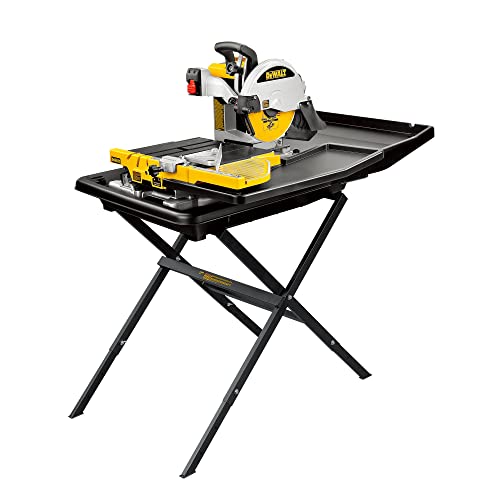
DEWALT D24000S 10-Inch Wet Tile Saw with Stand
The DEWALT D24000S is the largest saw in this guide and the one to pick when the tile itself is large. Its 10-inch blade and 1.5 HP motor cut through thick porcelain and stone tile that would slow a smaller saw, and the sliding cart rides on a cantilever rail so the cut stays straight across long pieces. With a 24-inch rip capacity and a 28-inch plunge capacity, it handles the 24-inch floor tile and large-format planks that are common in modern bathrooms and kitchens.
The saw ships with a folding stand, so it sets up at a comfortable working height and folds away for storage or transport. A cutline indicator helps line up the blade with a marked cut, and the water containment system keeps the work area drier than an open tray design. Depth of cut reaches 3-1/8 inches, which covers thick pavers and stone thresholds as well as standard floor tile.
Listing Features
- 10-inch diamond blade with 1.5 HP, 15-amp motor
- 24-inch rip capacity and 28-inch plunge capacity
- Sliding cart on a cantilever rail for straight, controlled cuts
- Folding stand included for working height and storage
- Cutline indicator for lining up marked cuts
- Water containment system to keep the work area tidy
- Bevel cuts to 45 degrees for angled edges
Considerations
- At 69 pounds, it is the heaviest saw here and needs two hands or a helper to move.
- Its footprint is larger than a benchtop saw, so check bench and storage space first.
- It is more saw than a single small backsplash needs, so match it to the size of your project.
2. SKIL 3540-02 7-Inch Wet Tile Saw
SKIL 3540-02 7-Inch Wet Tile Saw
The SKIL 3540-02 is the simplest and lightest saw in this guide, and that is exactly why it suits a first tiling project. At 18 pounds it lifts onto a bench with one hand, and its compact table fits in a small garage or a crowded workroom. The 7-inch diamond blade spins at 3,600 RPM on a 4.2-amp motor, which is enough for ceramic tile, porcelain tile, and the thin stone tile used in most home backsplashes and bathroom floors.
A stainless steel table top resists corrosion after repeated wet use, and the adjustable rip fence with a miter gauge keeps straight and angled cuts square. The table tilts for bevel cuts from 0 to 45 degrees, useful for the edge pieces and corners that finish a room neatly. A blade cooling water reservoir keeps a steady flow over the blade, holding down dust and heat during the cut. Depth of cut is 1-3/8 inches at 90 degrees and 1 inch at 45 degrees.
Listing Features
- 7-inch diamond blade, 3,600 RPM, 4.2-amp motor
- Stainless steel table top that resists corrosion
- Adjustable rip fence with miter gauge for straight and angled cuts
- Bevel cuts from 0 to 45 degrees
- Blade cooling water reservoir to keep the blade cool and hold down dust
- Compact 18-pound design that is easy to carry and store
Considerations
- The smaller table and shorter rip capacity suit wall tile and standard floor tile better than very large format pieces.
- The lighter frame needs a firm, level bench so it does not shift during a cut.
- Thick stone tile will cut more slowly than on a larger saw, so allow extra time.
3. PORTER-CABLE PCE980 7-Inch Wet Tile Saw
PORTER-CABLE PCE980 7-Inch Wet Tile Saw
The PORTER-CABLE PCE980 sits between the compact SKIL and the large DEWALT in both size and capability. Its defining feature is the on-board cutting guide, a built-in straightedge that helps keep long cuts true without a separate fence setup. For a DIYer cutting a whole bathroom floor, that guide takes guesswork out of the repeated straight cuts that make up most of a tiling job.
The 7-inch diamond blade handles ceramic, porcelain, and stone tile, with a 17-inch rip capacity and a 12-inch diagonal capacity for square floor tile cut corner to corner. The table tilts for bevel cuts to 45 degrees, and the water tray and splash control keep the cutting area contained. A 15-amp motor drives the blade, giving it more cutting power than the lightest saws in this size class while keeping the overall weight manageable at 27 pounds.
Listing Features
- 7-inch diamond blade with 15-amp motor
- On-board cutting guide for straight, repeatable cuts
- 17-inch rip capacity and 12-inch diagonal capacity
- Bevel cuts to 45 degrees
- Water tray with splash control
- 27-pound weight that balances portability and stability
Considerations
- The table is smaller than the DEWALT, so very large format tile needs extra support at the edges.
- Check that the included blade suits your tile type, since glass and mosaic tile often need a different blade.
- The saw needs a level surface and a nearby water source for filling the tray.
4. RIDGID 7-Inch Table Top Wet Tile Saw
RIDGID 7-Inch Table Top Wet Tile Saw
The RIDGID 7-inch table top wet tile saw is built around its fence and table. A die-cast aluminum table gives a flat, rigid cutting surface, and the TrueLock rugged T-square fence locks square with a single lever, so repeated cuts stay consistent across a whole room. A detachable rear table support extends the rip capacity to 24 inches, which makes this 7-inch saw a strong match for plank tile and long rectangular floor tile.
The 6.5-amp motor spins the 7-inch premium diamond blade at 3,450 RPM, with a maximum depth of cut of 1-1/4 inches. An anti-splash system keeps water inside the tray rather than on the floor, and the saw includes a miter guide, a rip guide, and a rear support table in the box. RIDGID backs the saw with its lifetime service agreement covering parts and service.
Listing Features
- 7-inch premium diamond blade, 6.5-amp motor, 3,450 RPM
- Die-cast aluminum table for a flat, rigid cutting surface
- TrueLock T-square fence with single-action lever lock
- Detachable rear table support for rip cuts up to 24 inches
- Anti-splash system to keep the work area dry
- Miter guide, rip guide, and rear support table included
- Lifetime service agreement for parts and service
Considerations
- At 33 pounds it is heavier than the SKIL, so plan a fixed bench spot for it during a project.
- The rear support table adds length, so measure your bench before setup.
- Register the saw and keep the manual so the service agreement stays easy to use.
How to Choose
Start with the tile. Measure the largest piece you will cut, including diagonal cuts on square floor tile, and check the thickness of the thickest piece. A 7-inch saw covers most ceramic and porcelain tile up to about 12 inches square, while a 10-inch saw is the safer pick for large-format tile, thick stone, and pavers. If your project is one bathroom or a single backsplash, a compact 7-inch saw is enough. If you are tiling several rooms with large-format tile, the extra capacity of a 10-inch saw will save time and frustration.
Next, look at the table and fence. A sliding tray or a rigid fence keeps the tile moving straight through the blade, and a fence that locks square without play matters more than motor size for clean results. A rip fence with a miter gauge handles angled cuts, and a table that tilts for bevel cuts covers edge pieces and corners. Check the rip capacity against your longest cut, and remember that a rear support table helps with long plank tile.
Motor power and blade speed affect how fast the saw moves through hard porcelain and stone. A stronger motor holds its speed under load instead of slowing in the middle of a cut, which keeps the cut edge cleaner. For occasional ceramic tile work, a smaller motor is fine. For dense porcelain and natural stone, choose the stronger motor.
Water handling is easy to overlook and hard to live without. A reservoir and pump that keep water flowing over the blade cool the cut and hold down dust. A splash guard and a well-shaped tray keep water off the floor and off you. After the job, a tray that lifts out and a pump that is easy to rinse will make cleanup quick.
Finally, think about weight and storage. A light saw is easy to carry out to a driveway or a patio and easy to store on a shelf. A heavy saw with a stand stays put and feels steadier, but it needs dedicated floor space. Match the saw to where you will actually use it, not just to the tile.
Fit and Installation Considerations
Set the saw on a flat, level, sturdy surface before you cut anything. A wobbling bench transfers movement into the cut, so a solid workbench, a pair of sawhorses with a plywood top, or the included stand on level ground all work well. Leave clear space on both sides of the saw for tile to pass through, and keep the area behind the saw open for long rip cuts.
Fill the water reservoir to the fill line marked on the tray and check that the pump moves water to the blade before the first cut. Running a diamond blade dry overheats it and shortens its life, so keep the water flowing and top it up as it is used. Wear eye protection and hearing protection, keep hands clear of the blade path, and let the blade reach full speed before feeding tile into it.
Feed the tile slowly and steadily, letting the blade do the work rather than pushing hard. Forcing tile through the blade can chip the glaze and bind the cut. For diagonal cuts, mark the tile clearly and use the miter guide to hold the angle. For bevel cuts, set the table angle, lock it, and make a practice cut on a spare piece first.
Plan for drainage and cleanup. Wet cutting creates slurry, a mix of water and fine tile dust, that settles in the tray. Empty the tray into a bucket rather than a drain, wipe the table dry after use, and rinse the pump intake so it does not clog. Store the saw dry with the blade guard in place, and keep spare blades in a dry spot. Before a project, check that the blade is the right type for your tile: a continuous rim blade suits ceramic and porcelain, while glass and mosaic tile often need a blade made for those materials.
Check the electrical setup as well. These saws run on a standard household circuit, but a long extension cord can drop voltage and slow the motor, so use a short, heavy-duty cord or plug directly into an outlet. Keep the cord out of standing water and use a ground fault protected outlet when working outdoors or in a damp area.
Frequently Asked Questions
What size tile saw do I need for a bathroom floor?
A 7-inch wet tile saw covers most bathroom floors, since the tile is usually 12 inches square or smaller and the diagonal cut fits within a 12-inch capacity. If the tile is larger than 12 inches, is a long plank shape, or is thick stone, a 10-inch saw with a 24-inch rip capacity is the safer choice.
Can a wet tile saw cut porcelain tile?
Yes. A wet tile saw with a continuous rim diamond blade is made for porcelain tile, which is harder and denser than ceramic. Feed the tile slowly, keep water flowing over the blade, and use a blade rated for porcelain when the tile is very dense.
Do I need a stand for a DIY tile saw?
A stand is helpful but not required. A benchtop saw works well on a sturdy workbench or sawhorses, while a saw with an included stand sets up at working height and folds for storage. Choose based on where you will cut and how much space you have.
How do I keep cuts from chipping the tile edge?
Mark the cut line clearly, use the fence or miter guide to keep the tile straight, and feed it slowly without forcing it. A sharp, continuous rim diamond blade and steady water flow both help. A practice cut on a spare tile lets you check the setup before cutting a piece you need.
Conclusion
The best diy tile saws match the saw to the tile and to the space you have. The DEWALT D24000S is the pick for large-format tile and multi-room projects, with its 10-inch blade, long rip capacity, and included stand. The SKIL 3540-02 is the light, simple choice for a first project or a small backsplash. The PORTER-CABLE PCE980 adds a built-in cutting guide that makes repeated straight cuts easier, and the RIDGID table top saw pairs a rigid fence and a 24-inch rip capacity with a compact 7-inch design that suits plank tile.
Measure your largest tile, check the rip and diagonal capacity, and pick the saw that covers those cuts with room to spare. Set it up level, keep water flowing, and feed each piece slowly. With the right saw and a steady setup, a home tiling project comes out straight, clean, and ready to grout.
As an Amazon Associate, we earn from qualifying purchases.
Related guides
More from Amazon
Programs that pair well with the guide above. Offers and eligibility are set by Amazon and may change.
A free business account with business pricing and bulk-buying tools for work, shop or home office.
Create a business accountFree shipping on eligible items, Prime Video and more. Eligible new members can start with a free trial.
Start a Prime free trialAudiobooks and podcasts to listen to on the go. Eligible new members can start with a free trial.
Try Audible freeAd-free music streaming. Eligible new subscribers can start with a free trial.
Try Music Unlimited freeAs an Amazon Associate we earn from qualifying purchases.