We research everything we recommend. When you buy through our links, we may earn a commission. As an Amazon Associate we earn from qualifying purchases.
Best Laser Levels for Hanging, Tiling and DIY Projects
Compare the best laser levels for hanging, tiling and DIY layout, from compact cross-line models to bright 360-degree green lasers and a point laser.
As an Amazon Associate I earn from qualifying purchases. This post may contain affiliate links at no extra cost to you.
⭐ Key Takeaways
Quick answer: Our top pick is DEWALT DW088K Self-Leveling Cross Line Laser, with Bosch GLL50-20 Self-Leveling Cross-Line Laser as a strong alternative.
A laser level projects a straight line or dot onto a wall, floor or ceiling, so one person can lay out a whole room without a helper holding the other end of a chalk line. For hanging a gallery wall, setting the first row of tile, installing cabinets or squaring a stud wall, that glowing reference removes the guesswork and repeated measuring that leads to crooked results.
The five tools below cover the main styles you are likely to need: a proven cross-line laser, a compact Bosch for small rooms, a 360-degree green model that wraps a line around the whole room, a three-plane planar laser, and a point laser that transfers plumb points between floor and ceiling.
As an Amazon Associate, we earn from qualifying purchases.
For most people, the DEWALT DW088K is the laser to buy: accurate, tough and simple. The Bosch GLL50-20 suits smaller rooms and tighter budgets. Choose the Huepar 902CG or Klein Tools 93PLL for bright green lines wrapped around the room, and the Bosch GPL100-30G for transferring plumb points instead of drawing lines.
DEWALT DW088K Self-Leveling Cross Line Laser
Top Pick
DEWALT DW088K Self-Leveling Cross Line Laser
Best for: remodelers and serious DIYers who want one dependable cross-line laser for indoor work.
The DW088K is a default recommendation because it gets the basics right. It projects bright red horizontal and vertical lines, self-levels when the base sits within four degrees of level, and blinks the lines when tilted too far to trust. Its accuracy of plus or minus 1/8 inch at 30 feet suits cabinet runs, chair rails and tile layout.
The housing is over-molded and sealed to IP54, so it shrugs off dust and knocks. A magnetic pivoting base grips steel studs and tracks, and full-time pulse mode lets the lines work with an optional detector well beyond what your eye can see. It runs on three AA batteries, so there is no charger to track.
Specs:
– Beam: red cross line, horizontal and vertical
– Accuracy: plus or minus 1/8 inch at 30 feet
– Range: up to 50 feet visible, up to 165 feet with a detector
– Self-leveling: within 4 degrees, blinking out-of-level alert
– Power: 3 AA batteries
– Mounting: magnetic pivoting base, 1/4-20 tripod thread
Bosch GLL50-20 Self-Leveling Cross-Line Laser
Runner-Up
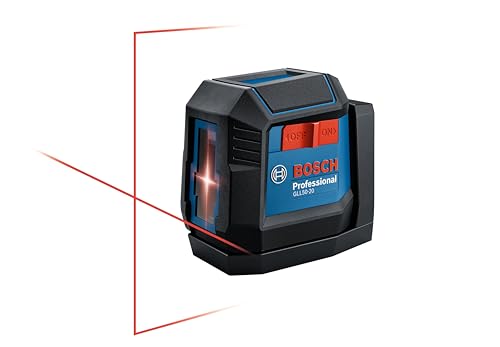
Bosch GLL50-20 Self-Leveling Cross-Line Laser
Best for: homeowners hanging shelves, mirrors and pictures, one room at a time.
The GLL50-20 is Bosch’s current compact cross-line model and the natural pick for smaller rooms and first-time buyers. It throws red horizontal and vertical lines up to 50 feet. Its Smart Pendulum System self-levels within four degrees, flashes the lines when the tool is out of level, and locks the pendulum when switched off. VisiMax technology keeps lines bright while stretching battery life.
A rubber over-mold and IP55 sealing give it dust and water protection beyond its size, and the magnetic mount rotates on its base so you can aim the cross without moving the setup. It runs on two included AA batteries and accepts an optional Bosch rechargeable pack. The trade for the compact size is a looser accuracy figure than the DEWALT above, which matters only on longer runs.
Specs:
– Beam: red cross line, horizontal and vertical
– Range: up to 50 feet
– Accuracy: plus or minus 5/16 inch at 30 feet
– Self-leveling: Smart Pendulum System, within 4 degrees, locks for transport
– Power: 2 AA batteries included, optional rechargeable pack
– Mounting: integrated magnetic mount, 1/4-20 tripod thread
Huepar 902CG Self-Leveling 360-Degree Cross Line Laser
Huepar 902CG Self-Leveling 360-Degree Cross Line Laser
Best for: tilers and renovators who want one setup to cover an entire room.
The 902CG steps up to full-room coverage. Instead of a cross that lands on one wall, it projects one complete 360-degree horizontal line and one complete 360-degree vertical line in green, so the level line wraps around all four walls from a single setup. That saves time on drop ceilings, floor tile and any job where the reference must travel around corners.
The green Osram diode is visibly brighter than a red beam of the same power, which helps in lit rooms, and its accuracy of plus or minus 1/9 inch at 33 feet is the tightest figure here. Pulse mode pairs it with a receiver for longer runs, while manual mode locks the pendulum so you can project deliberate slopes for stair rails and diagonal tile. The kit includes a magnetic pivoting base and target plate; the housing is sealed to IP54.
Specs:
– Beam: green, one 360-degree horizontal and one 360-degree vertical line
– Accuracy: plus or minus 1/9 inch at 33 feet
– Range: up to 130 feet visible, up to 165 feet with a receiver
– Self-leveling: plus or minus 4 degrees, manual mode for angled lines
– Power: 4 AA batteries
– Mounting: magnetic pivoting base, 1/4-20 tripod thread
Klein Tools 93PLL Self-Leveling Green Planar Laser Level
Klein Tools 93PLL Self-Leveling Green Planar Laser Level
Best for: electricians, framers and kitchen installers doing full-room layout regularly.
The 93PLL is the layout specialist of the group. It projects three separate 360-degree green planes, one horizontal and two vertical, which together draw level, plumb and square references on floor, walls and ceiling. Electricians laying out can lights, framers squaring partition walls and anyone setting a grid ceiling can work from one position instead of moving and re-leveling a smaller laser.
Each plane switches on independently to save battery, and the integrated rechargeable lithium-ion battery charges by USB. The magnetic mount and 1/4-20 thread cover tripod and steel-stud mounting, and the green planes stay readable across large rooms where a red cross line would fade. It is bigger and heavier than the cross-line models here.
Specs:
– Beam: three 360-degree green planes, plumb up and down marks
– Accuracy: plus or minus 1/8 inch at 33 feet
– Range: up to 200 feet indoors
– Self-leveling: pendulum system with out-of-level alert
– Power: integrated rechargeable lithium-ion battery, USB charging
– Mounting: integrated magnetic mount, 1/4-20 tripod thread
– Laser class: Class II, output 1 mW or less, 510 to 530 nm
A point laser does a different job from a line laser. The GPL100-30G projects three bright green dots, one straight up, one straight down and one forward, so you can transfer a point from floor to ceiling and check plumb over a full story height. For plumbing runs, recessed lights and ductwork, that dot transfer is faster than reading a line.
The green points stay visible up to 125 feet, far beyond line-laser distances, because the light is concentrated in a dot, not spread along a line. VisiMax technology manages output for visibility and battery life, the Smart Pendulum System self-levels and locks for transport, and the integrated multipurpose mount rotates 360 degrees. It ships with two AA batteries and a hard case.
Specs:
– Beam: three green points, plumb up, plumb down and forward
– Accuracy: plus or minus 1/8 inch at 30 feet
– Range: up to 125 feet
– Self-leveling: Smart Pendulum System, locks when switched off
– Power: 2 AA batteries included
– Mounting: integrated 360-degree multipurpose mount
– Included: hard carrying case
How to choose
Start with beam color. Red lasers cost less, sip power and read well in dim or average indoor light. Green lasers are noticeably easier to see in bright rooms and over longer distances, which is why most 360-degree and professional models use them. The trade is shorter battery runtime and a higher price.
Next, understand self-leveling. Most pendulum lasers self-correct only within about four degrees of level; outside that window the lines blink to warn you. That is a feature, not a fault. For slopes such as stair handrails, drainage runs and diagonal tile, look for a manual mode that freezes the pendulum so the line holds your chosen angle instead of leveling itself.
Match the projection type to the job. A cross-line laser is the right default for hanging and aligning on one or two walls. A 360-degree model earns its keep when the line must wrap a whole room, as with ceilings and floor tile. A point laser draws no lines at all, but nothing beats it for moving a mark straight up from floor to ceiling.
Read accuracy figures with the distance attached. Plus or minus 1/8 inch at 30 feet means the line can sit that far off true at that distance, and the error roughly doubles if you double the distance. For picture hanging that hardly matters; for a long cabinet run, a tighter figure like the Huepar’s pays off. Range claims work the same way: the longer numbers assume a detector.
Finally, check mounting and outdoor use. A standard 1/4-20 thread fits camera tripods and most laser poles; larger 5/8-11 threads fit survey tripods. Magnetic mounts help on steel studs and ductwork. Outdoors in daylight nearly every line washes out, so plan on pulse mode plus a receiver that beeps at the beam. On safety, every tool here is a Class II laser under 1 mW: never stare into the beam, aim it at faces or aircraft, or let children handle it.
Who should skip
Skip a laser level if your whole project is one picture frame or a single shelf; a bubble level or phone app handles that. Skip line and point lasers for outdoor grading and foundation layout in full sun, where a rotary laser with a receiver and grade rod is the correct tool. Also skip these if what you need is distance: a laser level draws lines but measures nothing, so measuring rooms calls for a laser distance measure instead. Rent instead if you cannot store one carefully, since a dropped pendulum laser can lose calibration.
FAQ
Can I use a laser level outdoors in sunlight?
Not by eye, in most cases. Sunlight washes out both red and green lines within a few feet. The workable options are pulse mode with a laser receiver, working at dawn, dusk or in shade, or a rotary laser built for outdoor grading.
What does an accuracy figure like 1/8 inch at 30 feet actually mean?
At 30 feet from the tool, the line can sit up to 1/8 inch above or below true level and still be within spec. The error grows with distance, so across 60 feet the same laser could be off by roughly twice that.
Will a laser level fit my camera tripod?
Usually, yes. Most models here use the same 1/4-20 thread as a camera, so any sturdy photo tripod works. Check the listing before using a survey tripod, since those use a larger 5/8-11 thread and some lasers need an adapter.
Is green really worth choosing over red?
For dim basements and short distances, red is fine and the batteries last longer. In bright rooms, past about 30 feet, or when the line must wrap a whole room, green is much easier to see and worth it. Green diodes draw more power, so expect shorter runtime, or choose a rechargeable model.
Final verdict
Most readers should buy the DEWALT DW088K: it is accurate, rugged and covers nearly every indoor leveling task. The Bosch GLL50-20 is the sensible smaller spend for single-room jobs, while the Huepar 902CG adds full-room green coverage. The Klein Tools 93PLL is the pick for repeated full-room layout, and the Bosch GPL100-30G fills the specialist role of moving plumb points between floor and ceiling.
M
Miller the Driller Editorial Team
We compare specs, warranty terms, long-term owner feedback and street pricing before anything earns a spot. Rankings are never paid.
Affiliate disclosure. As an Amazon Associate we earn from qualifying purchases at no extra cost to you. Prices accurate as of the date shown.
Three wireless routers for small offices compared on device capacity, network separation, wired speed, and coverage, with specs taken from their Amazon listings.
Compare 5 mechanic tool sets for car repairs: a 247-piece DEWALT kit, a 450-piece CRAFTSMAN set, a drawer-box GEARWRENCH set, a 170-piece Crescent set and a 450-piece WORKPRO set.
Four splitting axes and mauls that actually split firewood: a long 36-inch axe for tall users, a shorter 28-inch option, and two 8 lb mauls for knotty rounds.
Learn whether a 20V rechargeable drill battery can be repaired, which faults you can check safely at home, and when replacing the pack is the safer choice.
A specs-based review of the officially licensed Retro-Bit Sega Saturn 2.4 GHz wireless controller: dual receivers, Genesis Mini and Switch support, battery, layout, limits, and FAQs.
Find the best drill battery for Power Wheels ride-on toys for families, with DeWalt, Milwaukee and Ryobi adapters, voltage and safety guidance in this guide.
Find the best hole saw for noching dom pipe: bi-metal saws, deep cups, and the right sizes for clean, tight notches in DOM tube for fabrication shops today.
Find the best diy tile saws for home tiling projects. Compare wet tile saws by blade size, cutting capacity, and features for ceramic and porcelain tile.



 Klein Tools 93PLL Self-Leveling Green Planar Laser Level
 Bosch GPL100-30G Green-Beam 3-Point Self-Leveling Laser









