We research everything we recommend. When you buy through our links, we may earn a commission. As an Amazon Associate we earn from qualifying purchases.
5 Best Small Handsaws for Cutting Plaster (November 2026)
Five small hand saws that punch and slice through plaster and drywall, compared on blade length, tooth count, blade stiffness and grip from listing data.
Five small hand saws that punch and slice through plaster and drywall, compared on blade length, tooth count, blade stiffness and grip from listing data.
As an Amazon Associate I earn from qualifying purchases. This post may contain affiliate links at no extra cost to you.
Cutting into a plaster wall by hand comes down to one decision: whether the saw can punch its own entry hole and keep a straight line once the teeth bite, or whether it skates, flexes and tears the surface around the cut. Plaster and plasterboard punish flimsy blades, so blade stiffness, tooth grind and tip shape matter far more than overall size.
This roundup serves three kinds of buyers: renovators opening walls for outlets and pipe runs, landlords and maintenance workers doing patch repairs, and homeowners tackling a first cutout in an older plaster wall. Every pick is a manual hand saw, and each one was chosen from the names, blade figures and handle descriptions published on its Amazon product page.
As an Amazon Associate we earn from qualifying purchases.
Product
Best for
Key spec from title
Stanley FatMax 6-Inch Jab Saw (20-556)
Everyday plasterboard cutouts
6-inch blade
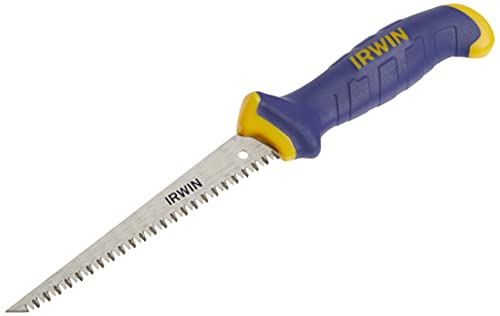
IRWIN Tools ProTouch Drywall/Jab Saw (2014100)
Long cuts that must stay straight
6-1/2-inch blade
Milwaukee 6 Inch Folding Jab Saw (48-22-0305)
Walls that dull blades quickly
6-inch folding blade
Klein Tools Folding Jab Saw (31737)
Carrying in a pouch all day
5.2-inch folding blade
Goldblatt Drywall Saw, 6-Inch Jab Saw
Mixed wallboard, plywood and PVC work
6-inch bi-metal blade, 8 TPI
How to Choose
Blade stiffness decides whether the cut wanders
Plaster is abrasive and dense compared with the paper-faced board most jab saws are drawn cutting, and a thin blade bows sideways the moment you push hard. A thick-body blade, like the 1.5 mm blade on the IRWIN ProTouch, resists that flex and tracks along a marked line instead of drifting. When you compare listings, treat any stated blade thickness as a headline figure: a plain listing that never mentions thickness usually hides a standard thin blade, which suits light plasterboard but complains in hard plaster coats.
Tooth count and grind set the pace through plaster
Most drywall and plaster saws sit between 7 and 9 teeth per inch, ground aggressively so each stroke clears gypsum dust instead of clogging. Triple-ground teeth, fitted to the IRWIN, the Klein and the Goldblatt here, cut on both the push and the pull, which halves the stroking on a long run. Coarser teeth move faster but chip the plaster face around the line; finer teeth leave a tidier edge that needs less filling afterwards. Match the grind to the finish you need, not to the fastest claim on the box.
The tip has to punch its own doorway
A jab saw earns its name by plunging: the sharpened point is pushed and twisted through the wall so the cut begins without a drilled pilot hole. On plasterboard that takes one firm push. On hard plaster over lath, the same point may only score the surface, and forcing it can snap the tip or crack the surrounding coat. Check that a listing actually names a sharpened or piercing tip, and plan on drilling a small pilot hole first whenever the wall is old, thick or lath-backed.
Fixed or folding, and how the grip handles plunge force
Fixed handles give the stiffest connection between hand and blade, which is why the Stanley and IRWIN feel planted during a plunge cut. Folding designs from Milwaukee and Klein trade a little of that rigidity for safe carry: the blade tucks into the handle, so it rides in a pouch without shredding the lining. Whichever format you pick, look for a flat or cushioned butt end, because plunge cuts are driven with the palm, and a rounded butt quickly becomes painful.
The 5 Best Options
Stanley FatMax 6-Inch Jab Saw (20-556)
Top Pick
Stanley FatMax 6-Inch Jab Saw (20-556)
Best for: repeated outlet and switch cutouts in plasterboard.
Blade length: 6 inches
Tooth design: SharpTooth, cuts on push and pull strokes
repeated outlet and switch cutouts in plasterboard.
Watch out for
sellers describe this model’s tooth count inconsistently, so check the listing’s own product fields if TPI matters to you, and confirm the listing is the 20-556 saw rather than a scabbard bundle.
The FatMax is the default recommendation for plasterboard work because its listing copy is built around the plunge: a sharpened tip that punches through drywall, a hardened and tempered blade, and SharpTooth teeth that cut on both strokes. The bi-material handle is moulded for a slip-resistant grip, which matters when gypsum dust coats your gloves. Renovators cutting repeated outlet openings will appreciate that nothing here needs adjustment or assembly; it is a single rigid tool that goes from wall to wall without fuss or setup.
IRWIN Tools ProTouch Drywall/Jab Saw (2014100)
Runner-Up
IRWIN Tools ProTouch Drywall/Jab Saw (2014100)
Best for: long, straight access cuts in plaster and drywall.
long, straight access cuts in plaster and drywall.
Watch out for
confirm a live offer on this exact ASIN before ordering, and check the listing shows the ProTouch 2014100 rather than the plainer Standard 2014102, which uses a different handle.
Where the Stanley is the generalist, the IRWIN is the straight-line specialist. Its blade is a thick-body design, 1.5 mm across, and that rigidity is exactly what long cuts through plaster demand: the blade resists the sideways bow that turns a marked line into a wave. The tri-ground teeth are aggressive, and the ProTouch grip is rubberised, so the saw stays seated in a dusty hand. Electricians and plumbers roughing in openings, or anyone cutting a long access panel, get the most from this one.
Milwaukee 6 Inch Folding Jab Saw (48-22-0305)
Milwaukee 6 Inch Folding Jab Saw (48-22-0305)
Best for: repair rounds where blades dull fast and spares ride along.
repair rounds where blades dull fast and spares ride along.
Watch out for
the included multi-purpose blade is a generalist, so check its tooth pattern against plaster work and plan on fitting a blade intended for drywall and plaster if the wall is hard.
Plaster eats teeth, and this Milwaukee answers that problem differently: the folding handle accepts standard reciprocating saw blades, and a multi-purpose blade is included in the box. When a blade dulls against an abrasive wall, you swap it instead of replacing the whole saw or reaching for a file. The blade folds into the handle for carrying, then locks open for work. It suits maintenance workers moving between plaster, board and the odd piece of timber or plastic on the same round of repairs.
Klein Tools Folding Jab Saw (31737)
Klein Tools Folding Jab Saw (31737)
Best for: electricians and installers who keep a saw in a tool pouch.
electricians and installers who keep a saw in a tool pouch.
Watch out for
at 5.2 inches this is the shortest blade here, so check the wall build-up is within its reach, and make sure the lockback has clicked fully into a stop before you begin a plunge cut.
Klein built this saw for people who carry their tools on their body. The 5.2-inch carbon steel blade folds into the handle, so there are no exposed teeth to tear a pouch or a palm, and a lockback mechanism holds it open at two angles: fully open at 180 degrees, or stopped at 125 degrees for awkward corners and shallow cavities. The triple-ground teeth cut in both directions, and the flat, cushioned end of the grip is shaped for palming the saw through the wall on a plunge cut.
Goldblatt Drywall Saw, 6-Inch Jab Saw
Goldblatt Drywall Saw, 6-Inch Jab Saw
Best for: patch repairs that jump between plaster, board and plastic.
patch repairs that jump between plaster, board and plastic.
Watch out for
this ASIN is commonly offered by third-party sellers, so confirm a live offer before ordering, and check the listing shows the fixed 6-inch saw rather than Goldblatt’s separate folding model.
Goldblatt’s fixed saw leans on its blade material: a bi-metal blade pairs a hard cutting edge with a more flexible backing, which helps the teeth survive the grit in plaster and the shock of hitting a hidden fixing. The 8 TPI teeth are triple ground, and the listing names wallboard, drywall, plywood and PVC among its materials, so it covers the mixed cutting that patch repairs throw up. The soft grip handle keeps the format simple: no hinge, no blade clamp, nothing to work loose mid-cut.
Which One Fits Your Situation
You are cutting an outlet opening in plasterboard
Reach for the Stanley FatMax. Its sharpened tip punches the entry hole without a drill, the teeth cut in both directions so a small rectangular opening takes few strokes, and the rigid one-piece build keeps the corners square. For a single room of sockets and switches, that simplicity beats any folding mechanism.
You are opening an old lath-and-plaster wall
Take the Milwaukee folding saw and bring spare blades. Hard plaster over wooden lath dulls teeth faster than any board, and a blade that swaps in seconds keeps the job moving where a fixed saw would slow to a scrape. Drill a pilot hole through the plaster coat first, then let the blade, not your shoulder, do the work.
You carry your tools in a pouch or belt
The Klein 31737 was designed around your problem. Folded, its teeth sit inside the handle, so the pouch lining survives the week, and the 125-degree lock gives you an angled option when a joist or pipe blocks a straight approach. It is the shortest blade in this group, but for box openings and short cuts that rarely matters.
You need one saw for a whole repair list
Choose the Goldblatt. The bi-metal blade tolerates the variety a repair round involves, from plaster patches to a plywood infill and a length of PVC, and the fixed handle has nothing to adjust between jobs. If your list is mostly long straight cuts instead, the IRWIN’s thick blade is the better single purchase.
Common Mistakes
Forcing a plunge cut through lath-and-plaster without a pilot hole, which cracks the plaster face well beyond the marked line.
Sawing blind into a wall cavity without checking for cables and pipes behind the plaster first.
Gripping a thin-bladed saw too hard on long cuts, bowing the blade so the opening ends up wider than the box it must hold.
Using a full-size wood panel saw for a small cutout, where its long blade cannot turn corners and its teeth tear the plaster surface.
Keeping a dulled blade in service against abrasive plaster, which turns cutting into tearing and leaves edges that need far more filling.
Frequently Asked Questions
Can a small jab saw cut real plaster, or only plasterboard?
Listings for these saws name drywall and plasterboard, and the Milwaukee and Stanley copy also names plaster directly. A jab saw will work through a plaster coat, but lath-and-plaster walls are slower going: drill a pilot hole, expect faster tooth wear, and cut the lath separately if the blade meets timber behind the plaster.
What tooth count suits plaster and drywall?
The saws here run from 8 to 9 teeth per inch, which is the working range for board and plaster. Coarser teeth clear dust quickly and cut fast but chip the face around the line; finer teeth in that range leave a cleaner edge. Triple-ground teeth help at any count because they cut on both strokes.
Do I need to drill a hole before cutting?
On plasterboard, no: the sharpened tip on a jab saw is made to punch its own entry. On hard plaster, especially over lath, a small drilled pilot hole is the safer route. It gives the tip a clean entry, reduces the force your palm must supply, and lowers the risk of the plaster face cracking outward.
How do I keep the cut straight in plaster?
Mark the full outline before you touch the wall, then work in short strokes with light pressure and let the teeth set the pace. A stiffer blade helps most, which is why the thick-body IRWIN suits long runs. Check the line from the front every few strokes, because plaster dust hides drift until the cut is well off course.
M
Miller the Driller Editorial Team
We compare specs, warranty terms, long-term owner feedback and street pricing before anything earns a spot. Rankings are never paid.
Affiliate disclosure. As an Amazon Associate we earn from qualifying purchases at no extra cost to you. Prices accurate as of the date shown.
Find the best golf headcovers for woods, driver, fairway wood, and hybrid clubs. Compare knit, nylon, and leather sets that protect clubheads and fit modern woods.
Compare the best Porter-Cable routers for woodworking, from the compact 450 to the 691 D-handle router and the 693LRPK two-base kit, by motor and base.
Compare the best wood spoon sets in teak and sheesham, from 7-piece and 10-piece cooking sets with spatulas and ladles for nonstick pans and daily use.
Compare four tool box sets, from a stackable three-piece tower to steel boxes on wheels, with drawer, latch and capacity checks for home and site work.
Current Windows laptops for photographers chosen by colour-accurate screens, RAM, SSD storage and card readers, with a clear note on Windows 7 support.
Compare four insect repellent sprays for beach days, from picaridin and DEET aerosols to a plant-based pump, with sizes, coverage times and beach-bag fit.



 Klein Tools Folding Jab Saw (31737)
 Goldblatt Drywall Saw, 6-Inch Jab Saw