What's inside
As an Amazon Associate I earn from qualifying purchases. This post may contain affiliate links at no extra cost to you.
Impact-rated bits are built to handle the repeated twisting and sudden load of an impact driver. Standard driver bits are intended mainly for the smoother rotation of a drill or screwdriver. The difference matters most when you drive lots of long or large fasteners with an impact driver. For occasional screws—or work done with a cordless drill—standard bits are often the sensible, cheaper choice.
As an Amazon Associate we earn from qualifying purchases at no extra cost to you.
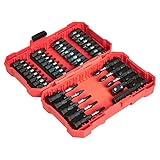


What we cover
What “impact-rated” means
An impact driver turns the bit in short bursts rather than applying torque as one continuous rotation. Those bursts can put substantial stress on the bit, especially when a screw binds or reaches the bottom of its hole. Impact-rated bits are designed to tolerate that repeated torsion. Many use a torsion zone—a narrower or specially shaped section near the shank that flexes slightly to absorb some of the shock.
Standard bits are often harder and less flexible. In an impact driver, they can snap at the shank or tip under repeated high loads. That does not mean a standard bit will instantly fail: a short screw into soft wood may go in without trouble. It means there is less margin when the job gets demanding.
Match the bit to the tool
In a cordless drill’s regular drilling or driving mode, the motor rotates continuously. Standard driver bits generally work well, provided the bit fits the screw head correctly. If your drill has a hammer-drill setting, switch that mode off for screw driving. The hammering action is for drilling masonry, not for driving fasteners.
An impact driver is a different case. Its hammer-and-anvil mechanism delivers rotational blows, so impact-rated bits are the dependable choice for frequent or heavy driving. Use a 1/4-inch hex-shank bit made for impact drivers, and make sure it is fully seated in the collet. A loose fit can contribute to wobble and damage.
Impact-rated vs. standard bits
| Feature | Impact-rated bit | Standard driver bit |
|---|---|---|
| Best match | Impact drivers; also usable in drills | Cordless drills and manual screwdrivers |
| Typical construction | Often includes a torsion zone or other shock-tolerant design | Usually a more uniform, rigid shank |
| Best use | Repeated driving, long screws, larger fasteners | Light-duty work and occasional screws |
| Likely failure under heavy impact use | Eventually wears or breaks, but is designed for the load | May twist, chip at the tip, or snap at the shank sooner |
| Cost | Often higher, especially for premium sets | Often lower |
When impact-rated bits are worth buying
Choose impact-rated bits if you use an impact driver regularly, drive deck or framing screws, install many fasteners in a row, or often work with screws around 3 inches long or longer. These jobs create more resistance and more opportunities for the bit to bind. A bit that survives repeated impacts also means fewer stops to replace broken tips.
For routine home use, a small set of common impact-rated sizes is usually more useful than a large assortment. Start with the bit types and sizes that match your fasteners—often Phillips, square, and Torx-style drives, depending on the screws you use. Browse impact-rated driver bit sets and check that the set includes the specific sizes you need rather than buying by piece count alone.
When standard bits are enough
If you drive a few short screws into predrilled wood with a cordless drill, standard bits are generally fine. They are also reasonable for assembling furniture, installing cabinet hardware, or keeping in a manual screwdriver kit. There is little practical benefit to paying extra for impact-rated bits if the tool and workload do not deliver impact blows.
Standard bits can also be useful for delicate work where you want careful control. Set the drill clutch low and increase it only as needed. On either type of bit, the right size and full engagement with the screw head matter more than the label. A poorly fitting bit can cam out, chew up the recess, or slip and mar the workpiece.
Reduce breakage and stripped screws
Use steady pressure along the fastener’s axis; leaning sideways encourages the bit to slip. Start at low speed so the tip seats cleanly, then increase speed once it is engaged. For long screws or dense lumber, a pilot hole can reduce driving effort and lower the chance of splitting wood. Choose a pilot-hole diameter based on the screw’s core diameter and the material; there is no single size that fits every screw.
Stop if the bit starts slipping or the screw head is already damaged. Continuing to hammer on it often makes the recess worse. Replace bits with rounded or chipped tips: a worn bit is more likely to cam out, even if it is impact-rated. If a fastener binds, back it out, clear debris, check alignment, and try again rather than relying on extra force.
If you are buying one set to use with both a drill and an impact driver, impact-rated 1/4-inch hex driver bits are a practical all-around choice. They work in a drill as well as an impact driver, though standard bits remain a good value for light drilling-and-driving jobs. Pay for impact-rated construction where the tool and workload call for it—not simply because the packaging sounds tougher.