What's inside
As an Amazon Associate I earn from qualifying purchases. This post may contain affiliate links at no extra cost to you.
What we cover
What makes overhead concrete drilling different
Drilling upward into a concrete ceiling is harder on the tool and the person holding it than drilling a wall. The drill’s weight is above your shoulders, dust falls toward your face, and a bit that binds can twist the tool suddenly. A hammer drill helps cut the hole, but it does not make an awkward setup safe or eliminate the need for the right bit and anchor.
For occasional holes around 1/4 inch (6 mm) for light-duty anchors, a compact 18V or 20V cordless hammer drill is often enough. Repeated holes, larger diameters, or hard concrete favor a more powerful drill or a rotary hammer. Check the anchor maker’s specified hole diameter and depth; drilling a neat but oversized hole can leave an anchor loose.
As an Amazon Associate we earn from qualifying purchases at no extra cost to you.


Hammer drill or rotary hammer?
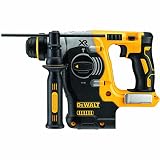
A cordless hammer drill uses a toothed mechanism to add rapid, relatively short impacts while the bit rotates. It can drill masonry and still serve as a general-purpose drill, but it takes more pressure and time in concrete than a rotary hammer. A rotary hammer uses a piston mechanism, typically delivers stronger impacts, and accepts SDS-Plus bits. It is the better choice for many larger holes or a long run of ceiling anchors, but it is heavier and less versatile for ordinary screwdriving.
If the job is a few small holes, paying for a rotary hammer may not be worthwhile. If you are drilling dozens of holes, holes larger than about 3/8 inch, or working in especially hard concrete, the extra impact energy can reduce fatigue. For general overhead drilling, compare tool weight with battery attached, not just the bare-tool figure.
Quick comparison by job
| Tool type | Best fit | Main trade-off |
|---|---|---|
| Compact cordless hammer drill | A few small anchor holes; lighter overhead handling | Slower in hard concrete and limited for large holes |
| Full-size cordless hammer drill | Regular drilling across wood, metal, and masonry | More weight and wrist strain overhead |
| Cordless SDS-Plus rotary hammer | Repeated or larger concrete holes | Less useful as an everyday screwdriving drill; often heavier |
For a balanced general-purpose option, look at a cordless hammer drill kit with a side handle and at least one battery. For repeated concrete work, compare cordless SDS-Plus rotary hammer kits by weight, battery capacity, and vibration control rather than headline voltage alone.
Features worth paying for
A side handle is important: fit it and hold it with both hands when drilling overhead. A clutch is useful for driving fasteners, but drilling masonry generally calls for hammer mode and the manufacturer’s recommended speed. A two-speed gearbox gives useful control: use the lower range when a large bit or tough hole is loading the drill, and avoid forcing the tool when it slows.
Battery capacity affects runtime and weight. A 2.0Ah battery is lighter and may be comfortable for a few holes; a 4.0Ah or larger pack usually lasts longer but adds weight above your head. If the tool will be used overhead for extended periods, the lighter battery can be the sensible choice, with a spare ready. Brushless motors can improve efficiency, but a well-matched brushed drill is not automatically inadequate for occasional small holes.
Bits, depth, and dust
Use a sharp carbide-tipped masonry bit, or an SDS-Plus bit in a rotary hammer. A worn bit drills slowly, heats up, and can wander. Match the bit diameter to the anchor instructions, and mark the required depth with a stop collar or tape. Many small anchors need holes only a few inches deep, but the anchor’s stated embedment and the concrete thickness determine the correct depth—not guesswork.
Concrete dust is a health hazard. Wear eye protection and a properly fitted respirator rated for fine particles, and use a dust extractor or a suitable dust-collection attachment where possible. Keep dust out of the drill’s vents and clear the hole as directed by the anchor maker; dust left at the bottom can prevent an anchor from seating fully.
Safe overhead drilling
Before drilling, confirm what is above the surface. Concrete can contain rebar, electrical conduit, or post-tension cables. Do not drill into a suspected post-tension slab without approval and reliable plans or scanning; striking a cable can cause severe injury and structural damage. A basic detector may not reliably identify every embedded service. If the location is uncertain, stop and get the area checked.
Use a stable platform that lets you work with the drill near shoulder height rather than stretching from a ladder. Keep your feet planted, both hands on the tool, and your face out of the line where dust and chips fall. Start at low pressure to establish the hole, then let the bit do the work. Pushing hard can make the bit bind, stall the motor, or wrench your wrist. If you hit steel, stop rather than forcing the bit; check the plans and use a method appropriate for the reinforcement and the installation.
How to choose for your project
For a few holes up to roughly 1/4 inch, a compact hammer drill and a good masonry bit are a reasonable, lower-cost buy. A compact hammer drill with a side handle is easier to control overhead, though it will be slower than a rotary hammer in hard concrete. For regular anchor work, a full-size hammer drill offers more reserve but can tire your arms sooner.
Choose an SDS-Plus rotary hammer when the hole count, diameter, or concrete hardness makes a hammer drill laborious. Check that the kit includes a suitable battery, charger, and side handle; then price the bits and any dust attachment separately. The best buy is the lightest tool that can reliably drill the required holes at the specified size and depth—not the tool with the biggest claimed torque number.