What's inside
As an Amazon Associate I earn from qualifying purchases. This post may contain affiliate links at no extra cost to you.
A heavy mirror needs a fastener rated for the load, not just a screw that feels tight. The best option is usually a screw driven into a wall stud. If the mirror’s position rules that out, choose a toggle-style anchor rated for the weight and thickness of your drywall, and use the number of attachment points the mirror maker specifies.
As an Amazon Associate we earn from qualifying purchases at no extra cost to you.


What we cover
Check the load and wall
Find the mirror’s weight in its product details or weigh it on a bathroom scale. Include the weight of any hanging wire, cleat, or mounting rail only if the manufacturer’s instructions call for it; the mirror itself is the main load. Check whether the wall is standard 1/2-inch drywall or thicker, and look for pipes or wiring before drilling. A stud finder helps locate studs, but confirm a suspected stud with a small pilot hole or another reliable method.
Also check how the mirror hangs. A mirror with a French cleat or mounting rail spreads the load across several screws. A single wire hung from one point concentrates the load, and the wire or its fittings may be the weak link. Use the mirror maker’s hardware instructions where available.
Anchor options at a glance
| Fastener | Best use | Trade-off |
|---|---|---|
| Wood screw into a stud | Heavy mirrors when a stud lines up with a mounting point | Strong and inexpensive, but limits placement |
| Self-drilling plastic anchor | Light mirrors and small loads | Quick to install; not my choice for a heavy mirror |
| Metal expansion or screw-in anchor | Moderate loads when its rating matches the wall and application | Easy to install, but can loosen or damage drywall under sustained load |
| Toggle bolt or strap toggle | Heavy loads in hollow drywall when no stud is available | More installation work; needs a larger hole and enough space behind the wall |
Best choice: fasten to a stud
If a stud is behind the mirror’s mounting point, use a suitable wood screw rather than a drywall anchor. A screw with roughly 1 to 1 1/2 inches of embedment into sound framing is a common starting point, but account for drywall thickness and follow the mirror and screw manufacturers’ instructions. Avoid driving a screw so long that it risks reaching wiring or plumbing.
A stud is especially useful for mirrors with a cleat or rail: putting two screws into framing can provide a dependable base without asking drywall to carry the load. If the mounting holes do not line up, a properly secured wood mounting board can span studs, though it changes the look and adds work. For a range of suitable wood screws for mirror mounting, check the screw diameter and length against the hardware and wall construction.
Best hollow-wall choice: toggle anchor
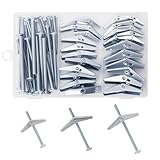
When no stud is available, a toggle-style anchor is generally the safer pick for a heavy mirror. A toggle opens behind the drywall and bears against its back face, spreading the load over a wider area than a small plastic anchor. Strap toggles are often easier to position than traditional spring-wing toggles, but both require the correct drilled hole and adequate clearance behind the wall.
Anchor ratings vary by product, drywall thickness, installation quality, and whether the load pulls straight down or away from the wall. Do not treat a package’s maximum rating as a guaranteed working load for your setup. Choose an anchor whose stated capacity comfortably exceeds the load at each attachment point, and use the specified number of anchors. A pair of anchors does not always share weight evenly, especially with a flexible wire. For strap toggle drywall anchors, verify the listed capacity for your drywall thickness and the screw size included.
When a cheaper anchor is fine
A plastic expansion anchor or self-drilling drywall anchor is inexpensive and quick, and can be perfectly adequate for a small, light mirror. It is not automatically unsafe, but it has less margin for error in a heavy-mirror installation. Drywall can crumble around an anchor, a screw can pull through, or repeated bumps can loosen the fastener. A mirror above a bed, sink, or busy walkway is a poor place to gamble on an undersized anchor.
If you are considering an expansion anchor, use it only when its rated load suits the mirror and the manufacturer allows that use in drywall. Avoid relying on adhesive strips or generic picture hooks for a heavy mirror unless the mirror maker specifically rates the system for that weight and wall surface.
Install carefully
Use the drill bit size printed on the anchor package; an oversized hole can let an anchor spin or pull out. A cordless drill is useful for pilot holes and driving screws, but set the clutch low enough to avoid crushing drywall or stripping the fastener. For toggles, drill straight, clear dust from the hole, and follow the installation sequence exactly. Do not force a toggle through a hole that is too small.
Keep the fastener level and snug, not overtightened. If the anchor spins, the drywall breaks away, or the screw will not hold torque, stop and repair the hole or move to a sound location. Never install a heavy mirror into damaged or damp drywall. After hanging, check that the mirror sits securely and does not rock; do not use a sharp tug as a “test,” since that can damage the wall without proving the mount is safe.
What to buy
For the most reliable setup, buy the right-length wood screws and locate framing. If the mirror must hang between studs, choose a rated toggle system matched to the drywall and mounting hardware rather than a basic plastic anchor. A heavy-duty drywall toggle anchor kit is useful only when its instructions and capacity fit your specific wall and load; the label alone cannot compensate for a poor hole, damaged drywall, or an unsuitable hanging wire.