What's inside
As an Amazon Associate I earn from qualifying purchases. This post may contain affiliate links at no extra cost to you.
Recessed screws in cabinets, machinery, appliance housings and framed walls can be hard to reach with a standard driver bit. A drill bit extension helps by moving the drill or impact driver away from the work, but the right choice depends on the fastener, available clearance and how much torque you need. A long extension is not automatically better: extra length can wobble, twist or make it harder to keep the bit seated.
As an Amazon Associate we earn from qualifying purchases at no extra cost to you.



What we cover
Choose by fastener and access
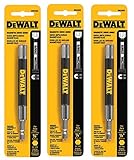
For an ordinary Phillips, square or Torx screw, start with a magnetic bit holder or a one-piece bit extension sized to the recess. For a hex-head lag screw or nut, use a socket extension and the correct nut driver or socket. A screwdriver-bit extension is not a substitute for a socket extension: its hex collet may not hold a socket securely, and it may not be rated for the load.
Measure how far the drill chuck must stay from the surface, then add enough length for the bit to engage the screw fully. A 3- to 6-inch extension is enough for many cabinet and fixture jobs. A 12-inch extension can reach deeper, but it flexes more and is harder to control. If the drill body itself will not fit, a right-angle attachment may be more useful than adding length.
Extension types compared
| Type | Best for | Trade-offs |
|---|---|---|
| Rigid magnetic bit holder | Routine screws in shallow recesses | Simple and inexpensive; limited reach and magnetic hold may be weak. |
| Long rigid bit extension | Deeper access with steady alignment | More reach, but greater length can amplify wobble and side load. |
| Flexible shaft | Curved or awkward access where a straight tool cannot line up | Useful for light fastening; not for high torque or driving stubborn screws. |
| Impact-rated extension | Driving with an impact driver | Built for impact loading, but still needs a suitable bit and controlled trigger use. |
| Socket extension | Hex-head fasteners and nuts | Requires a matching socket drive and socket; not a holder for screwdriver bits. |
What to buy
For occasional household work with a cordless drill, a short magnetic holder is usually the best-value choice. Look for a 1/4-inch hex shank that fits the drill chuck and a positive bit-retention mechanism. A magnetic sleeve can help keep a screw on the bit, but it does not prevent cam-out; the bit still has to match the screw head and stay square.
If you use an impact driver, choose an extension specifically rated for impact use. Impact drivers deliver repeated rotational blows that can fatigue ordinary extensions or crack a weak holder. Search for impact-rated 1/4-inch hex bit extensions. For a drill used at moderate speed, a standard rigid extension is often fine; paying extra for impact rating brings little benefit if the tool is not an impact driver.
When the fastener is a bolt or nut, buy a socket extension in the drive size that matches your socket set, commonly 1/4, 3/8 or 1/2 inch. For example, a 3/8-inch drive extension only fits sockets with a 3/8-inch drive; it does not describe the size of the bolt. A 3/8-inch-drive socket extension set is sensible if you already own matching sockets. For one occasional job, buying a single extension is cheaper and less cluttered.
Flexible or rigid?
Choose a rigid extension whenever the drill can line up with the screw. It transfers torque more directly and makes it easier to maintain pressure. Flexible shafts are for access around an obstruction, not a shortcut for reaching farther in a straight line. They can wind up under load, slip out of the screw recess and damage the head. Use one with a cordless drill at low speed for small screws, and stop if the shaft visibly twists or chatters. Do not use a flexible shaft to loosen a seized fastener.
For a narrow cabinet or a fastener close to a wall, a right-angle drill attachment can solve a clearance problem that an extension cannot. Check the attachment’s speed and torque limits. Small, inexpensive heads can overheat or develop play under sustained load; they are better suited to light work than driving large structural screws.
Use the extension without damaging the screw
Set the clutch low on a drill when starting a screw, then raise it only if needed. Keep the extension as close to the fastener axis as possible and press firmly enough to keep the bit seated. A long extension magnifies small alignment errors, so begin slowly rather than squeezing the trigger fully. If the bit climbs out, stop and reset; continuing can round the recess or snap the bit.
For a stubborn fastener, first confirm you have the correct bit size. A worn Phillips bit or a Torx bit that is one size too small can cam out even with plenty of reach. Switch to a hand screwdriver or a properly fitting impact-rated bit if control matters more than speed. If a bit holder repeatedly drops bits, clean out metal chips and check its locking sleeve; magnetic holders do not lock every bit in place.
Quick buying checklist
Before ordering, check the extension’s overall length, shank size, retention method and tool compatibility. Confirm whether the job calls for a screwdriver bit or a socket. For frequent impact-driver use, prioritize impact rating over a long accessory set. For occasional straight access with a drill, a basic short holder is enough. Buy longer or flexible extensions only when the space genuinely requires them, since extra reach comes with less control and more chance of wobble.