What's inside
As an Amazon Associate I earn from qualifying purchases. This post may contain affiliate links at no extra cost to you.
A towel bar or toilet-paper holder can feel secure at first and still pull out after repeated use. The problem is often not the accessory but the anchor: hollow-wall fasteners vary in holding strength, need different hole sizes, and behave differently when someone leans or yanks on the fixture.
As an Amazon Associate we earn from qualifying purchases at no extra cost to you.


What we cover
Check the wall before buying anchors
Look for a stud with a stud finder, then confirm its location with a small pilot hole in a spot the accessory will cover. If a mounting hole lines up with a stud, use a screw long enough to get roughly 1 inch into solid wood. That is usually more dependable than any hollow-wall anchor.
If there is no stud, identify the wall material. A hollow drywall partition is different from tile over drywall, plaster, or a masonry wall. Check for pipes and electrical wiring before drilling, especially around sinks and switches. For tile, use a tile-rated bit and drill the tile without hammer mode; switch modes only after the bit reaches masonry, if applicable.
Hollow-wall anchor options
For a light toilet-paper holder, a quality self-drilling anchor may be enough. For a towel bar that will see regular pulling, a metal toggle or strap-toggle anchor is a safer choice. A conventional molly bolt can work well too, but it needs a clean, correctly sized hole and must be set properly.
| Anchor type | Best use | Trade-offs |
|---|---|---|
| Plastic expansion anchor | Very light accessories in drywall | Cheap and easy, but poor for repeated pulling or leverage |
| Self-drilling drywall anchor | Light to moderate loads where installation speed matters | No large pilot hole, but can strip drywall if overtightened |
| Molly bolt | Medium-duty fixtures needing a firm, flush mount | Requires a drilled hole and correct setting; removal can leave a larger hole |
| Toggle or strap-toggle anchor | Towel bars and other fixtures subject to repeated force | Strong when installed correctly, but needs cavity clearance and a larger hole |
Published load ratings are not directly comparable: they depend on drywall thickness, anchor size, installation quality, and whether the load is pulling straight out or downward. A towel bar creates leverage, so its real-world demand can be greater than the accessory’s weight suggests. Do not treat a package rating as a guarantee.
What to buy for a bathroom accessory
For a light-duty holder, choose metal self-drilling drywall anchors rather than relying on the small plastic plugs often included in the box. They are convenient for ordinary drywall, but they are not a good match for grab bars or fixtures people may lean on.
For a towel bar with mounting points that miss the studs, consider strap-toggle hollow-wall anchors. They spread the load behind the board and are less sensitive to repeated tugging than small expansion anchors. Check the package for the required wall thickness and hole diameter; some versions need a hole around 1/2 inch, which is substantially larger than a screw pilot.
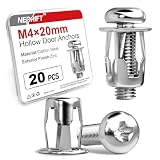
A molly-bolt kit is a reasonable lower-cost option for a fixture that needs a firm mount but does not justify toggles. Buy the size that matches the accessory screw and wall thickness, and use the setting tool if the kit calls for one. A molly that spins in the hole has not been installed securely.
Install without damaging the wall
Mark both accessory holes with a level. Before drilling, check the anchor instructions for hole diameter and wall-thickness limits. Use a drill bit that matches the specified size; making a hole too large is a common reason an anchor spins. For a toggle, confirm there is enough clear space behind the drywall for the wings or strap to open.
With self-drilling anchors, turn the anchor slowly and keep it square to the wall. A cordless drill on a low clutch setting or a hand screwdriver gives better control than an impact driver. Stop when the flange sits flat. Driving farther can crush the drywall face or strip the anchor’s threads, leaving a fastener that feels tight but has little holding power.
For a molly, tighten the setting screw until the sleeve expands firmly behind the board, then remove the screw and attach the accessory. For a toggle, hold the strap as directed while tightening the bolt. Do not spin the bolt endlessly: if the toggle is turning behind the wall, the hole may be oversized or the wings may not have opened correctly.
Tighten accessory screws until the bracket is snug, not until the wall dimples. If the fixture has two mounting brackets, both need to be secure and level; one strong anchor does not compensate for a loose second side. Test with a gradual hand pull before loading the accessory.
When anchors are not enough
For a grab bar or any accessory intended to support a person’s weight, do not rely on ordinary drywall anchors. Locate studs and fasten into them, or use a mounting system specifically rated for the wall construction and intended use. If the wall is tiled over an unknown substrate, the tile may conceal cement board, plywood, or only drywall; verify the layers before selecting fasteners.
When an old anchor hole is loose, do not install a larger screw into the same damaged opening and assume it is fixed. Shift the bracket if possible, use a suitable toggle with the required hole size, or repair the drywall and let it cure before remounting. A few extra minutes choosing the right anchor is cheaper than patching a cracked wall or replacing a fallen accessory.