What's inside
- Quick Comparison
- Best Overall: DeWalt DCF887
- Best Compact: DeWalt DCF845
- Best for Tight Spaces: DeWalt DCF840
- Best Budget: Craftsman V20 Brushless Impact Driver
- Best for Occasional Use: Black+Decker 20V MAX Impact Driver
- How Much Torque Do You Need?
- Impact Driver or Drill: Which Do You Need?
- Ownership Realities
- Decision Matrix: Which 20V Impact Driver Fits You
- Worked Example: Screws Per Battery
- Bits and Accessories That Matter
- Frequently Asked Questions
As an Amazon Associate I earn from qualifying purchases. This post may contain affiliate links at no extra cost to you.
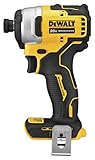
The best 20 volt impact driver for most woodworkers is DeWalt’s DCF887 (20V MAX XR), a brushless 1/4-inch hex driver with a published 1,825 in-lbs of torque and three speed modes. The compact DCF845 trades a little size for the same torque class, and Craftsman’s V20 brushless impact driver is the sensible budget pick. All three accept the 20V MAX or V20 batteries your drill already uses.
An impact driver is not a drill replacement. It adds rotational hammering that drives long screws without twisting your wrist, but it is a poor tool for fine clutch-controlled driving or drilling holes with round-shank bits. The guide below sorts 20V impact drivers by torque class so you can match the tool to the fasteners you actually drive.
As an Amazon Associate we earn from qualifying purchases at no extra cost to you.


What we cover
- Quick Comparison
- Best Overall: DeWalt DCF887
- Best Compact: DeWalt DCF845
- Best for Tight Spaces: DeWalt DCF840
- Best Budget: Craftsman V20 Brushless Impact Driver
- Best for Occasional Use: Black+Decker 20V MAX Impact Driver
- How Much Torque Do You Need?
- Impact Driver or Drill: Which Do You Need?
- Ownership Realities
- Decision Matrix: Which 20V Impact Driver Fits You
- Worked Example: Screws Per Battery
- Bits and Accessories That Matter
- Frequently Asked Questions
Our Top Picks


Quick Comparison
| Pick | Best for | Key specs (per maker listings) | Price range |
|---|---|---|---|
| DeWalt DCF887 | Best overall | 1/4-inch hex, brushless, 1,825 in-lbs, 3 speeds, LED | Mid to upper mid |
| DeWalt DCF845 (Atomic) | Best compact | 1/4-inch hex, brushless, 1,825 in-lbs class, short head length | Mid |
| DeWalt DCF840 (Atomic compact) | Best for tight spaces | 1/4-inch hex, brushless, shorter and lighter, lower torque than the DCF887 | Mid |
| Craftsman V20 brushless impact driver (CMCF820) | Best budget | 1/4-inch hex, brushless, V20 batteries | Budget |
| Black+Decker 20V MAX impact driver | Best for occasional use | 1/4-inch hex, brushed, entry torque | Budget |
Best Overall: DeWalt DCF887
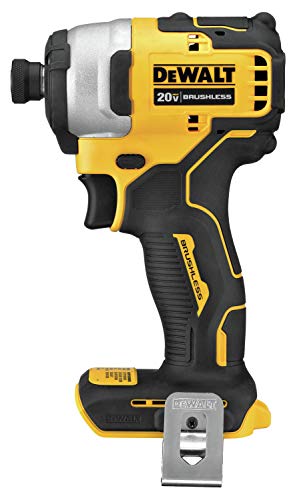
The DCF887 is a long-running favorite. Its three-speed trigger-selected modes let you pick a gentle setting for small screws and the full 1,825 in-lbs for lag screws and structural fasteners. The 1/4-inch quick-release collet holds standard hex bits, and the front LEDs light the work area. For woodworkers who build workbenches, decks, sheds or framing alongside furniture, this is the one to own.
The trade-off is length. It is longer than the Atomic models, which matters when you drive screws inside a tight cabinet. It is also loud, as every impact driver is, so hearing protection belongs on your list.
Best Compact: DeWalt DCF845
The Atomic DCF845 is shorter and lighter than the DCF887 while keeping the same published torque class. That makes it comfortable for overhead screws, deck-board edges and work inside enclosed cabinets. DeWalt calls its three-speed setup “precision drive,” meaning the driver slows when it detects a screw seating, which helps reduce stripped heads in softwood.
Its main limit is battery: the compact body invites compact batteries, which give less runtime under repetitive heavy driving. Pair it with at least a 2.0 Ah pack.
Best for Tight Spaces: DeWalt DCF840
If you do a lot of cabinet and trim work, the shorter DCF840 is easy to maneuver in places that block a full-size driver. It has less torque than the DCF887, so it is not ideal for long structural screws, but for hinges, drawer slides and screws up to about 3 inches it is plenty.
Best Budget: Craftsman V20 Brushless Impact Driver
The V20 impact driver gives you a brushless motor and a 1/4-inch hex chuck at a lower price. It suits a homeowner or new woodworker who wants a driver and a drill on the same battery without spending DeWalt money. The trade-off is that the tool and accessory range is narrower, and the highest torque levels are not offered.
Best for Occasional Use: Black+Decker 20V MAX Impact Driver
A basic Black+Decker driver is a fine tool for light jobs: furniture assembly, deck screws now and then, and hanging shelves. It is brushed and has lower torque, so it will bog down with long lag screws. Think of it as a household tool rather than a shop tool.
How Much Torque Do You Need?
| Fastener | Typical torque class | Suitable driver |
|---|---|---|
| #8 x 1-5/8 inch deck screw into softwood | Under 600 in-lbs | Any brushless impact driver |
| #10 x 3 inch construction screw into hardwood | 800 to 1,200 in-lbs | Mid or high torque brushless |
| 1/4 x 4 inch structural lag screw | 1,500+ in-lbs | 1,825 in-lbs class driver |
| Hinge screws, drawer slides | Under 300 in-lbs | Any model on low speed |
These are planning ranges based on typical fastener sizes, not manufacturer specifications. Pre-drilling reduces the required torque and helps prevent splitting in hardwood.
Impact Driver or Drill: Which Do You Need?
Own both if you can. The drill gives you clutch control for fine work and drilling round-shank bits. The impact driver gives you speed with long screws and less fatigue. If you can only buy one for woodworking, a 1/2-inch drill/driver is more versatile; if you mostly drive screws on decks and framing, an impact driver is faster and easier on your wrist.
Ownership Realities
- Use impact-rated bits. Standard bits can snap under the hammering action.
- Do not use an impact driver to drive a hole saw or a large round-shank bit; the collet is designed for hex shanks.
- The anvil and collet are the parts that wear first. Keep them free of dust.
- Match the battery to the job: compact packs for overhead work, larger packs for decks.
Decision Matrix: Which 20V Impact Driver Fits You
| Your situation | Choose | Reason |
|---|---|---|
| Building decks, sheds and workbenches | DeWalt DCF887 | Full 1,825 in-lbs class torque and three speed modes |
| Cabinet installs and overhead screws | DeWalt DCF845 or DCF840 | Shorter, lighter body reduces fatigue and fits tight spaces |
| First tool set on a tight budget | Craftsman V20 brushless | Brushless motor at a lower price |
| A few jobs a year | Black+Decker 20V MAX | Low cost, adequate for light fastening |
Worked Example: Screws Per Battery
A 20V MAX pack rated 2.0 Ah holds roughly 36 watt-hours at 18V nominal. If each 3-inch construction screw takes about 0.4 watt-hours to seat, a 2.0 Ah pack drives about 90 screws and a 5.0 Ah pack about 225. A 12 by 12 foot deck needs around 300 to 400 deck screws, so plan on two 5.0 Ah batteries or a charger on standby. Pre-drilling hardwood cuts the energy per screw and protects the bit.
Bits and Accessories That Matter
An impact driver is only as good as its bits. Choose impact-rated bits with a torsion zone, a magnetic holder for one-handed starts and a quick-release collet. Replace worn bits promptly: a rounded tip is the main cause of cam-out and stripped screw heads. Keep a set of square-drive (Robertson) and Torx bits, since many deck and construction screws now use them because they hold the bit better than Phillips.
Frequently Asked Questions
What is the difference between an impact driver and a drill?
A drill spins steadily and has a clutch for control. An impact driver adds short rotational blows when resistance rises, which drives long screws with less effort. It uses a 1/4-inch hex chuck rather than a keyless three-jaw chuck.
Is 1,825 in-lbs of torque enough?
For woodworking, yes. It is more than you need for almost all screws and is a typical ceiling for 20V impact drivers. Larger fastening work is typically handled by an impact wrench.
Can I drill holes with an impact driver?
You can with hex-shank bits, such as impact-rated twist bits, but the hammering can wander on fine work. A drill is better for precise holes.
Do I need brushless?
For regular use, yes: runtime, heat and lifespan all improve. For an occasional household tool, brushed is acceptable.
Will 20V MAX batteries fit my impact driver?
Within the same brand, yes. DeWalt 20V MAX packs fit DeWalt tools. Craftsman V20 packs fit Craftsman tools. Cross-brand compatibility is not available without adapters.
Why do impact drivers sound so loud?
The internal hammer and anvil strike at a high rate when under load. Wearing hearing protection is recommended, particularly in enclosed workshops.