What's inside
As an Amazon Associate I earn from qualifying purchases. This post may contain affiliate links at no extra cost to you.
What we cover
Best 4V Small Cordless Screwdrivers for Tight Spaces
The best 4V small cordless screwdriver for confined work is the Bosch GO 3 if you need a slim, trigger-free driver with useful clutch control; choose the Milwaukee M4 2401-22 for greater torque and a pistol grip, or the SKIL SD561201 for an affordable, compact tool for occasional assembly. For very small electronics, a pen-style 4V driver can fit better, but it usually gives up torque and grip comfort.
Dimensions matter more than a headline torque figure when you’re working inside a cabinet, assembling a drawer slide, or reaching between components. The comparison below focuses on published tool dimensions and practical differences. Dimensions and weights can vary by kit, battery, and regional version; confirm the exact model’s specifications before buying. Runtime figures are not directly comparable unless manufacturers specify the same test conditions, so treat runtime as a use-case consideration rather than a precise ranking.
As an Amazon Associate we earn from qualifying purchases at no extra cost to you.



Quick comparison
| Tool | Form and published size | Torque / control | Battery and grip | Best fit |
|---|---|---|---|---|
| Bosch GO 3 | Straight body; about 190 mm long | Up to about 5 Nm; adjustable torque settings plus shutoff | Built-in 3.6V battery; push-to-drive or switch operation | Cabinet hardware and small assemblies where a straight tool helps reach in |
| Milwaukee M4 2401-22 | Pistol-grip body; about 165 mm long | Up to 44 in-lb (about 5 Nm); variable-speed trigger | 4V-class removable battery; pistol grip | Repeated fastening where trigger control and a removable battery matter |
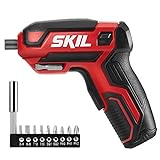
| SKIL SD561201 | Compact inline body; about 180 mm long | Up to about 36 in-lb (about 4 Nm); forward/reverse control | Built-in 4V battery; pivoting handle allows inline or pistol-style use | Occasional household assembly and positions that need two grip shapes |
| Pen-style 4V screwdriver | Usually about 140–170 mm long; varies by model | Typically lower torque than the three tools above; model-dependent | Usually built-in battery; narrow barrel grip | Small electronics and light-duty fasteners with ample manual finishing |
Tool makers sometimes quote maximum torque under different conditions, and a maximum figure doesn’t tell you how gently a driver starts. For delicate work, clutch settings, trigger response, and the option to finish by hand are more useful than a small difference in peak torque. Check each manufacturer’s current specification sheet for the exact dimensions, weight, battery capacity, and runtime of the version sold in your region.
Choose by the space and work
For a narrow cabinet or an awkward reach: Bosch GO 3
The GO 3’s straight shape can be easier to position than a pistol-grip tool when the handle would otherwise hit a cabinet side or adjacent fitting. Its selectable operating modes also make it adaptable: push-to-drive operation is convenient when you can press the nose squarely into a screw, while the switch gives another way to control the tool. It is not as short as a stubby right-angle driver, however, and the body still needs clearance behind the bit.
Choose it for small furniture, hinges, and general assembly when you value an inline profile and more control than a basic single-speed driver. If the workpiece is fragile or the fastener is tiny, set a low torque level and complete the last turns manually.
For frequent fastening and a familiar trigger: Milwaukee M4 2401-22
The M4 is the stronger choice for someone who expects to drive many small screws and prefers a conventional trigger. Its pistol grip can be comfortable during repeated work, and its removable battery is an ownership advantage if you already have compatible batteries or want to swap a depleted one. That grip can also be a disadvantage in confined spaces: the handle may collide with a shelf, frame, or neighboring component even when the bit itself fits.
Pick it for routine cabinet installation and assembly at a bench, especially when trigger control is more important than the slimmest possible outline. It is not a substitute for a drill or impact driver on long structural screws.
For mixed angles on a budget: SKIL SD561201
A pivoting handle gives the SD561201 two useful configurations: a pistol-style grip for leverage and an inline shape for reaching into tighter areas. That flexibility helps when the work changes from one screw location to another, though a hinge adds a moving part that should be kept clean and locked securely before applying pressure. Its built-in battery keeps the kit simple, but you can’t swap in a fresh pack to continue working.
This is a sensible fit for occasional furniture assembly, household repairs, and users who want one small tool that can change grip. For daily trade use, compare the cost and availability of replacement tools or batteries before choosing a built-in-battery model.
For electronics: a low-torque pen driver
A pen-style driver is often the easiest to steer among small screws, but it is also easiest to overestimate. Tiny fasteners can strip, and delicate plastic housings can crack if powered down carelessly. Use the motor to start or remove a screw, then finish by hand. If the driver lacks a clutch, stop before the screw seats and use a manual screwdriver for the final turns.
How to judge whether it will fit
Overall length alone does not determine access. Measure the clear space from the screw head to the nearest obstruction, then compare it with the tool’s body length behind the bit and the space needed for your hand. Also check the width and height of the handle: a 165 mm pistol-grip driver can be harder to use inside a narrow box than a longer inline tool.
- Check the approach angle. A straight driver needs room directly behind the screw. A pivoting handle can improve wrist position but does not make the bit itself turn a corner.
- Include the bit. A long bit may reach past an obstruction but can wobble more; a short bit reduces the tool’s reach. Confirm the driver’s bit-holder type and use a properly seated, undamaged bit.
- Plan for your hand. If you cannot hold the tool squarely, the screw is more likely to cam out. A compact tool that fits the gap but cannot be controlled is not a good fit.
- Account for screw size and material. Pilot holes, screw diameter, and wood hardness affect required torque. For a close-to-edge screw in hardwood, predrilling is safer than forcing a small driver to its limit.
Runtime, grip, and ownership trade-offs
For intermittent assembly, a built-in battery is usually adequate: drive a batch of screws, recharge, and keep a manual driver nearby. For a long installation session, a removable battery can reduce downtime, but only if a spare pack is available and compatible. A battery-capacity number alone cannot predict screw count reliably; screw length, material, clutch setting, and how often the motor stalls all change consumption.
Grip shape affects accuracy as much as comfort. Inline drivers encourage a straight push and are easier to align in a narrow corridor. Pistol grips provide leverage and familiar trigger control, but need more space around the handle. Pivoting handles offer a compromise for varied work, at the cost of a joint that should be checked for play and locked before use.
Bits are the first consumable to watch. A worn or mismatched Phillips bit slips, damages the screw head, and can make a low-power driver seem weak. Replace rounded bits promptly, keep dust out of the bit holder, and avoid using the tool as a pry bar. If a screw stops moving, release the trigger rather than repeatedly stalling the motor; back it out, check for a misaligned pilot hole or obstruction, and resume with the correct bit.
Bottom line
- Best for a slim, controllable inline tool: Bosch GO 3.
- Best for repeated work with a trigger and swappable battery: Milwaukee M4 2401-22.
- Best for adjustable grip shape on occasional jobs: SKIL SD561201.
- Best for tiny, light-duty fasteners: a low-torque pen-style 4V driver, used with manual finishing.
Before buying, compare the exact tool’s body dimensions with the tightest space you’ll encounter, not just the length listed in a headline. For furniture and cabinetry, a clutch or sensitive trigger and a bit that fits the screw are usually more valuable than extra peak torque.