What's inside
As an Amazon Associate I earn from qualifying purchases. This post may contain affiliate links at no extra cost to you.
Deep holes in framing lumber are harder on a drill than ordinary screw holes. The bit has to clear chips through a long flute, stay straight through the board, and avoid twisting the drill out of your hands when it meets a knot. For most framing work, a traditional wood auger bit is the best starting point. It cuts efficiently, clears waste well, and needs less pushing than a spade bit.
As an Amazon Associate we earn from qualifying purchases at no extra cost to you.


What we cover
What to buy for deep holes
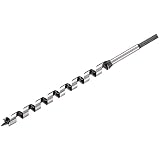
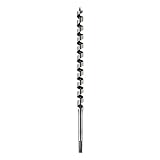
Choose a long wood auger bit set with a lead screw, pronounced flutes, and a hex shank that matches your drill chuck. Common diameters for framing are 1/2, 5/8, 3/4, and 1 inch. A 3/4-inch bit is a useful general-purpose size for wire, small tubing, and many low-voltage runs.
Length matters more than the package label suggests. A “12-inch” bit may have only 9 or 10 inches of usable cutting length after the shank and lead screw are accounted for. Measure the timber, add clearance for the chuck and a little extra for chip removal, and then buy accordingly. For a 5-1/2-inch wall made from a 2×6, a bit with at least 8 inches of cutting reach is more practical than a short bit with a nominal 6-inch overall length.
For occasional holes in soft framing lumber, an inexpensive carbon-steel auger set is usually adequate. A premium set earns its price when you drill dozens of holes, work in hardwood, or need consistent straight holes. The cheaper bits can have less accurate tips and may dull sooner, but replacing one after a small project is often cheaper than buying a professional set.
Auger bit types compared
| Bit type | Best use | Deep-hole strengths | Main drawback |
|---|---|---|---|
| Standard wood auger | Framing lumber and general rough carpentry | Good chip clearance, controlled cutting, efficient drilling | Can bend or twist if forced through knots |
| Self-feed auger | Large holes, typically 1-1/2 inches and larger | Fast cutting and strong pull-through action | Needs a high-torque drill and can grab violently |
| Spade bit | Shallow or occasional holes | Cheap, widely available, fast in soft wood | Poor chip clearing and rougher results in deep holes |
| Ship auger | Heavy timber and repeated deep boring | Long reach, aggressive lead screw, excellent waste removal | More expensive and demanding on the drill and operator |
The best all-around choice: standard wood augers
For most framing projects, buy standard wood auger bits in the sizes you actually use rather than a large set full of duplicates. Look for a sharp lead screw, a cutting spur at the tip, and flutes that run nearly the full length. The lead screw pulls the bit into the wood, while the spiral flute carries chips back out of the hole.
A hex shank is preferable for cordless drills because it reduces chuck slipping. Some bits are specifically rated for impact drivers, but do not assume every hex-shank auger is impact-rated. An impact driver can deliver damaging torsional shock to a long bit and can also make a grabbing bit harder to control. Use an impact-rated product only when the manufacturer explicitly permits it, and use the lowest practical speed.
For holes larger than about 1 inch, consider ship auger bits. They are especially useful in beams, posts, and doubled joists. Their aggressive screw point makes them pull through efficiently, but that same feature can yank the drill forward when the bit breaks through the far side.
Match the bit to the cordless drill
A compact 12-volt drill may handle a 1/2-inch auger in a single 2×4, but it is a poor choice for repeated deep holes. A 1/2-inch cordless drill with a mechanical low gear is a better minimum for 3/4-inch and larger bits. Use low speed, keep both hands on the tool, and make sure the side handle is installed.
Do not judge the drill only by its advertised maximum chuck size. Torque, battery condition, and the gear reduction matter more. A drill that stalls or overheats after two holes will be slower than a larger tool running comfortably below its limit. If you regularly bore 1-inch holes through 2x lumber, a high-torque cordless drill with a side handle is a worthwhile upgrade.
A hole hawg-style right-angle drill is justified for production framing, but it is excessive for a few wiring holes. The trade-off is control: right-angle drills provide torque and a useful grip, yet they can cause serious wrist injuries if the bit catches and the tool lacks a clutch or proper reaction handle.
How to bore a clean, deep hole
Mark both faces of the lumber when accuracy matters. Start from the visible face and keep the drill square in both directions. Let the lead screw do the pulling; forcing the drill increases heat and makes the bit more likely to wander.
After several inches, reverse briefly or withdraw the bit while it is still turning slowly to clear packed chips. Do not run a long auger at maximum speed. For a 3/4-inch bit, low gear and moderate pressure are usually faster overall than high speed because the flutes stay clear and the cutting edges remain cooler.
When the tip is close to breaking through, reduce pressure. The exit side is where splintering and sudden grabbing happen. If both sides must look clean, drill from one face until the lead screw or pilot point just appears, then finish from the opposite side.
Common failures and when to replace the bit
A bit that squeals, produces fine dust instead of curled chips, or requires steadily more pressure is dull. Sharpening is possible on quality augers, but the cutting spur and lead screw must retain their original shape. For cheap bits, replacement is usually more sensible.
If the bit stops advancing, do not keep squeezing the trigger. Withdraw it, clear the flutes, and inspect for a nail, screw, or embedded gravel. Nails can destroy an edge instantly. A magnetic stud finder or careful inspection helps, but no detector is perfect; wear eye protection and expect hidden fasteners in reclaimed or engineered lumber.
For the best balance of cost and performance, start with a small set of standard auger bits and add individual long or ship augers only when the job demands them. That approach covers normal framing without paying for oversized bits that spend most of their time unused.