What's inside
- Telescoping vs. Folding: Head-to-Head
- Decision Criteria That Actually Determine Easy Boarding
- Which Type Should You Buy? Decision Matrix
- Spec Comparison: Common Models by Type
- Fit Calculation: Will It Reach the Water?
- Durability and Ownership Realities
- Installation and Maintenance Tips for Long Life
- Frequently Asked Questions
- Telescoping vs. Folding: Head-to-Head
- Decision Criteria That Actually Determine Easy Boarding
- Which Type Should You Buy? Decision Matrix
- Spec Comparison: Common Models by Type
- Fit Calculation: Will It Reach the Water?
- Durability and Ownership Realities
- Installation and Maintenance Tips for Long Life
- Frequently Asked Questions
As an Amazon Associate I earn from qualifying purchases. This post may contain affiliate links at no extra cost to you.
The best boat ladders for easy boarding are 3-step or 4-step stainless steel telescoping models for most powerboats and pontoons, and heavy-duty folding pontoon ladders for wide-beam boats where step width and stability matter most.
Choosing between telescoping and folding comes down to how you mount, how deep the ladder needs to reach below the waterline, and how much storage space you have when it’s stowed. Below is how each design performs across the criteria that matter for safe, repeatable reboarding.
As an Amazon Associate we earn from qualifying purchases at no extra cost to you.


What we cover
- Telescoping vs. Folding: Head-to-Head
- Decision Criteria That Actually Determine Easy Boarding
- Which Type Should You Buy? Decision Matrix
- Spec Comparison: Common Models by Type
- Fit Calculation: Will It Reach the Water?
- Durability and Ownership Realities
- Installation and Maintenance Tips for Long Life
- Frequently Asked Questions
Telescoping vs. Folding: Head-to-Head
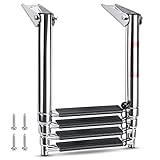
Telescoping ladders slide out from a compact housing and lock step-by-step. Folding ladders hinge at one or two points and swing down, often with wider treads. Both can be excellent, but they solve different problems.
| Feature | Telescoping (Transom / Platform Mount) | Folding (Pontoon / Gunwale Mount) |
|---|---|---|
| Typical profile | 2-step to 4-step, 12″ to 14″ narrow rungs | 3-step to 5-step, 14″ to 18″ wide flat steps |
| Stowed length | 13″ – 16″ housing, 2.5″ – 3.5″ thick | 28″ – 42″ folded length, 4″ – 6″ thick |
| Deployed length below platform | 22″ (2-step) to 42″ (4-step) | 36″ to 54″ (4-step pontoon models) |
| Waterline reach (steps submerged) | 1 step on 2-step, 2-3 steps on 3/4-step | 2-3 steps consistently due to longer drop |
| Rated load capacity | 250 – 400 lbs (most 300 lbs) | 300 – 500 lbs (many rated 400+ lbs) |
| Weight | 7 – 13 lbs (316 stainless) | 12 – 22 lbs (aluminum + stainless hardware) |
| Mounting | Under-platform slide or top-mount transom brackets | Pontoon deck hinges, gunwale hooks, or transom hinges |
| Best for | Runabouts, center consoles, swim platforms with limited space | Pontoons, deck boats, and boats needing maximum stability |
Decision Criteria That Actually Determine Easy Boarding
1. Mounting Method and Transom Compatibility
Mounting determines whether the ladder is always ready or needs to be retrieved from storage.
- Under-platform telescoping slide: Bolts to the underside of an integrated swim platform. This is the cleanest setup for 18-26 ft bowriders and center consoles. It stays hidden and deploys by pulling a handle. Requires at least 14″ of flat underside clearance and access to through-bolt with backing plates.
- Top-mount transom telescoping: Uses two brackets on the vertical transom face or on top of a small platform. Works when you have no under-platform space. Look for models like the Garelick EEz-In series or Windline telescoping transom ladders that include stand-offs to clear outboards and trim tabs.
- Pontoon / deck hinge folding: Bolts to the aft deck or side gate with heavy hinges. Common on pontoon ladders from JIF Marine and RecPro. Provides the most rigid connection and the widest stance, but permanently occupies deck space when folded.
- Removable gunwale hook folding: Hooks over the side for inflatables, jon boats, and small fishing boats without a platform. Portable and no drilling required, but less stable and lower load ratings. Avoid if you have high freeboard.
Through-bolting with stainless hardware and marine sealant is essential for any permanent mount. Surface screws alone will pull out under dynamic load when a wet boarder bounces on the bottom rung.
2. Waterline Reach: How Many Steps Are Actually Underwater?
Easy boarding is not about total ladder length, it is about how many steps sit below the waterline when loaded. If the bottom rung is at or above the waterline, you have to muscle yourself up with upper-body strength alone.
For an average adult, you need at least two rungs submerged to get a knee or foot planted and push up:
- 2-step telescoping (approx. 22″ drop): Only the bottom rung is underwater on most boats with a 12″-15″ platform height. Adequate for athletic swimmers and children, but difficult for older adults or when wearing a life jacket.
- 3-step telescoping (approx. 32″-36″ drop): Two rungs submerged on most powerboats. This is the sweet spot for most owners and the reason 3-step is the most common recommendation.
- 4-step telescoping or 4-step pontoon folding (approx. 40″-54″ drop): Two to three rungs submerged even on high platforms or pontoons with 20″+ deck height. Recommended if your platform sits high, you boat in choppy water, or you want dogs or divers with fins to reboard easily.
Measure from the top of your swim platform or deck to the waterline at rest with your typical load. Add 24″ to 30″ to that measurement – that is the minimum deployed length you need to get two steps underwater.
3. Step Width, Depth, and Comfort
Narrow 12-inch round rungs are hard on bare feet and become slippery when algae builds up. Wider flat steps distribute weight and reduce foot fatigue.
- Telescoping rungs: Typically 11.5″ to 13″ wide, 1″ to 1.5″ diameter round or oval tubing. Some premium 316 stainless models add flat plastic treads over the tube. Lightweight and compact, but less comfortable for extended use.
- Folding pontoon steps: Typically 14″ to 18″ wide, 4″ to 6″ deep flat aluminum or stainless treads with molded non-skid. Significantly easier for seniors, children, pets, and anyone carrying gear. The extra width adds drag in the water but improves stability dramatically.
If anyone on board has limited mobility, prioritize a folding ladder with at least 15″ wide flat steps and a 400+ lb rating, even if it takes more storage space.
4. Load Rating and Construction
Load ratings are static ratings. Dynamic load when climbing from water can be 1.5x body weight. Choose a margin above the heaviest user.
- 250-300 lbs: Entry-level 2-step and 3-step telescoping ladders in 304 stainless. Fine for lighter crews on small boats with calm-water boarding.
- 300-400 lbs: Standard for quality 3-step and 4-step 316 stainless telescoping ladders from Garelick, Windline, and Sea-Dog. This is the range to target for family boats.
- 400-500 lbs: Common for heavy-duty pontoon folding ladders with aluminum frames and stainless hinges, such as JIF Marine folding pontoon models. Needed for frequent use, double-boarding, or when ladder is also used as a dive step.
5. Corrosion Resistance
For freshwater-only use, 304 stainless or powder-coated aluminum is adequate with regular rinsing. For salt or brackish water, 316 stainless is worth the premium. It resists pitting at welds and around fasteners far better than 304.
Plastic or nylon bushings at telescoping joints and hinge points also matter. Bare metal-on-metal joints gall and freeze after a season of salt exposure. Models that use Delrin or nylon inserts stay smooth and rattle-free longer.
6. Storage and Deployment
A ladder you cannot deploy from the water is not a safety ladder. Telescoping under-platform models can be pulled down by a swimmer using a release strap. Many folding pontoon ladders require someone on deck to unfold them, which is a disadvantage if you fall overboard alone.
If you boat solo, choose a telescoping model with an over-center lock and a pull strap that hangs within reach of the water. If you always have crew on board, a folding ladder’s extra stability may outweigh that concern.
Which Type Should You Buy? Decision Matrix
| Your Situation | Best Match | Why |
|---|---|---|
| Runabout or center console with integrated swim platform, limited storage | 3-step or 4-step telescoping under-platform, 316 stainless, 300-400 lb rating | Compact stow, deploys from water, adequate submersion |
| Pontoon or deck boat, priority is stable, wide steps for kids/pets/seniors | 4-step folding pontoon ladder, 16″+ wide flat treads, 400+ lb rating | Widest, deepest steps and highest capacity |
| High freeboard (20″+ platform height) or offshore boat | 4-step telescoping or 5-step folding | Only these get 2+ steps below waterline on high platforms |
| Small fishing boat, jon boat, or inflatable with no platform | 3-step removable gunwale-hook folding or rope-assisted folding | No drilling, portable, adequate for low sides |
| Saltwater use year-round | 316 stainless telescoping (Garelick, Windline) or anodized aluminum folding with stainless hardware | Superior pitting and crevice corrosion resistance |
| Tight budget, freshwater lakes, occasional swimming | 3-step 304 stainless telescoping top-mount | Lowest cost that still provides two submerged steps |
Spec Comparison: Common Models by Type
These are representative real-world specs for categories you will find in 2026. Exact dimensions vary by manufacturer, but the ranges help you compare apples to apples.
| Model Type (Example Brand) | Steps | Material | Deployed Length | Step Width | Rated Capacity | Weight |
|---|---|---|---|---|---|---|
| Garelick EEz-In Telescoping Under-Platform | 3-step | 316 stainless, plastic treads | 34″ | 12″ | 400 lbs | 9.5 lbs |
| Windline Telescoping Transom | 4-step | 304 / 316 stainless options | 42″ | 12.5″ | 300 lbs | 12 lbs |
| Sea-Dog Stainless Telescoping Transom | 3-step | 304 stainless, oval rungs | 32″ | 11.5″ | 300 lbs | 8 lbs |
| JIF Marine Pontoon Folding | 4-step | Anodized aluminum / stainless hinges | 48″ | 16″ | 400 lbs | 18 lbs |
| RecPro Pontoon Folding Wide-Step | 4-step | Aluminum flat treads | 52″ | 18″ | 450 lbs | 21 lbs |
General market ranges in 2026: telescoping 3-step stainless ladders typically run $90-$220, 4-step $140-$350 depending on 304 vs 316. Folding pontoon ladders with wide flat steps typically run $180-$450.
Fit Calculation: Will It Reach the Water?
Use this quick calculation before ordering:
1. Measure Platform Height (PH): Distance from the top surface where the ladder mounts to the waterline at rest with normal load.
2. Measure Desired Submersion (DS): 24″ minimum to get two steps underwater for average adults, 30″ for high platforms or less-mobile boarders.
3. Required Deployed Length = PH + DS
Example: A center console with a 15″ platform height needs at least 39″ of deployed length (15 + 24) to be comfortable. A 3-step telescoping at 34″ would leave only one step well submerged. In this case, step up to a 4-step at 42″ for true easy boarding. For a pontoon with a 22″ deck height, you need 46″ to 52″ – that points directly to a 4-step or 5-step folding pontoon ladder, not a short telescoping model.
Durability and Ownership Realities
Stainless ladders are low-maintenance, not no-maintenance. What wears first is not the tubing, but the moving parts.
- Telescoping joints: Sand, grit, and salt crystallize inside the tubes and cause sticking. Extend fully, rinse with fresh water, and spray with a dry silicone lubricant – not grease, which traps grit – every 3-4 outings in saltwater, monthly in freshwater.
- Hinge pins and bushings: On folding ladders, nylon bushings compress and oval out after 2-3 seasons of heavy use, causing rattling. Replacement bushing kits are inexpensive and worth keeping on hand.
- Non-skid treads: Molded plastic treads crack from UV after 3-5 years. Replace them before they become slick; worn treads are the most common cause of foot slips.
- Mounting hardware: Check through-bolts and backing plates each spring. Crevice corrosion under washers is common on 304 hardware in saltwater. Upgrade to 316 bolts and nyloc nuts if you see rust staining.
- Common mistake: Leaving a telescoping ladder deployed while underway. Even at idle, hydrodynamic force bends rungs and wallows out the slide tracks. Always lock it fully retracted and secure the retention strap before moving.
Installation and Maintenance Tips for Long Life
Most permanent ladders need two people, a drill, marine sealant, and 60-90 minutes.
- Dry-fit the ladder and confirm the deployed ladder clears the propeller, trim tabs, and transducers by at least 6″. Swing the engine lock-to-lock while checking.
- Through-bolt with stainless fender washers and a solid backing plate (aluminum or marine plywood encapsulated in epoxy) – never rely on self-tapping screws into fiberglass alone.
- Bed all holes with marine-grade sealant to prevent water intrusion into the transom core.
- After installation, test-boarding with the heaviest intended user in calm, shallow water while someone spots from the boat. Watch for flex at the brackets – any more than slight deflection means you need a backing plate or higher-rated model.
- End of season, extend the ladder, scrub rungs with a soft brush and mild soap, rinse, dry, lubricate joints, and store retracted.
Frequently Asked Questions
Do I need a 3-step or 4-step ladder?
If your platform is under 14″ above the waterline, a 3-step usually gives two rungs underwater and is sufficient. If it is 15″ or higher, or if you want easier boarding for children, seniors, or divers with gear, choose a 4-step. When in doubt, the longer ladder is easier to use – you do not have to deploy the bottom step if you don’t need it.
Can I add a ladder to a boat that never had one?
Yes, if the transom or platform is solid fiberglass or has a wood or composite core. Avoid mounting into thin unsupported aluminum skins without a backing plate spanning multiple ribs. If the structure is questionable, a portable gunwale-hook folding ladder is a safer no-drill alternative.
Are telescoping ladders safe for dogs?
Narrow round rungs are difficult for dogs. For pets, choose a folding pontoon-style ladder with 16″+ wide flat steps and a shallow angle, or add a dedicated dog ramp. Dogs need to be able to walk up, not hop rung to rung.
What keeps a ladder from rattling underway?
Proper tension on the retention strap or latch, nylon bushings in good condition, and rubber bumpers between ladder and hull. If a telescoping ladder rattles, the internal detent springs are often worn and should be replaced.