What's inside
- Best Budget Hammer Drill for Home Projects: Quick Answer
- Best Budget Hammer Drills Compared
- Head-to-Head: Cordless Convenience Versus Corded Value
- Brick Versus Concrete: What to Expect
- Decision Matrix for Choosing One
- How to Set Up a Budget Hammer Drill Correctly
- Ownership Costs and Common Failure Points
- Final Verdict
- Related Guides
- Best Budget Hammer Drill for Home Projects: Quick Answer
- Best Budget Hammer Drills Compared
- Head-to-Head: Cordless Convenience Versus Corded Value
- Brick Versus Concrete: What to Expect
- Decision Matrix for Choosing One
- How to Set Up a Budget Hammer Drill Correctly
- Ownership Costs and Common Failure Points
- Final Verdict
- Related Guides
As an Amazon Associate I earn from qualifying purchases. This post may contain affiliate links at no extra cost to you.
What we cover
- Best Budget Hammer Drill for Home Projects: Quick Answer
- Best Budget Hammer Drills Compared
- Head-to-Head: Cordless Convenience Versus Corded Value
- Brick Versus Concrete: What to Expect
- Decision Matrix for Choosing One
- How to Set Up a Budget Hammer Drill Correctly
- Ownership Costs and Common Failure Points
- Final Verdict
- Related Guides
Best Budget Hammer Drill for Home Projects: Quick Answer
The best budget hammer drill for most occasional home projects is a compact 18V cordless model such as the Bosch GSB 18V-50, while the Makita HP1640 is the better low-cost choice if you want maximum runtime without buying batteries and mainly drill brick, block, and light concrete.
For a few shelves, curtain rails, or masonry anchors, a budget hammer drill is usually enough. The important distinction is between brick and concrete: hammer drills can handle both, but concrete is slower, harder on the tool, and often better served by an SDS rotary hammer when holes are large or numerous.
As an Amazon Associate we earn from qualifying purchases at no extra cost to you.


Best Budget Hammer Drills Compared
| Model | Type | Chuck capacity | Weight | Power or battery | Best use | Typical market range in 2026 |
|---|---|---|---|---|---|---|
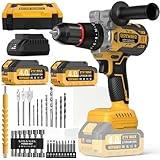
| Bosch GSB 18V-50 | Cordless | 1.5–13 mm | About 1.5 kg bare tool | 18V; commonly paired with 2.0Ah or 4.0Ah batteries | General home repairs and occasional masonry | About $130–$230 as a kit |
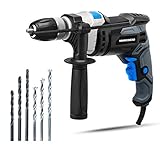
| Makita HP1640 | Corded | 1.5–13 mm keyed | About 1.7 kg | 680W; up to 2,800 rpm and 44,800 impacts per minute | Frequent drilling in brick and block near an outlet | About $60–$100 |
| DeWalt DWD520K | Corded | 1.5–13 mm keyed | About 1.9 kg | 710W; up to 2,800 rpm and 47,600 impacts per minute | Heavier-duty DIY work and mixed materials | About $100–$160 |
| Ryobi P251 | Cordless | Up to 13 mm | About 1.1 kg bare tool | 18V ONE+ battery system | Light-duty drilling for existing ONE+ owners | About $70–$140 as a bare tool or kit |
Weights vary slightly by chuck, battery, side handle, and regional package. Cordless figures above exclude the battery, which can add roughly 0.4 to 0.8 kg. Market prices are broad 2026 ranges rather than fixed quotes.
Head-to-Head: Cordless Convenience Versus Corded Value
Bosch GSB 18V-50: Best all-round cordless option
The Bosch GSB 18V-50 is a sensible choice when portability matters more than the lowest purchase price. Its 13 mm chuck accepts common wood, metal, and masonry bits, and the two-speed gearbox gives better control than a basic single-speed drill. With a 2.0Ah battery, expect roughly 20 to 40 small masonry holes, such as 6 or 8 mm holes 40 to 60 mm deep, depending on the wall material, bit sharpness, and pressure. A 4.0Ah battery can approximately double that working window, but also makes the drill heavier.
In brick, this type of drill is comfortable and quick for wall plugs. In concrete, it can make small holes, but the motor will slow noticeably and the operator must avoid forcing the bit. It is a good household tool if you also need to drive screws or drill timber away from a power outlet.
Makita HP1640: Best low-cost corded choice
The Makita HP1640 offers unusually strong value because the purchase includes continuous electrical power rather than a battery system. Its keyed 13 mm chuck holds larger bits securely, and its 680W motor is well suited to repeated small holes in brick, concrete block, and mortar joints.
The drawback is control and convenience. The cord limits movement, and the keyed chuck takes longer to change bits. It is also less pleasant for overhead work because the cable and roughly 1.7 kg body add fatigue. Choose it if your projects happen near an outlet and you would rather spend money on quality masonry bits and a dust-control setup.
DeWalt DWD520K: Best for tougher occasional work
The DeWalt DWD520K is heavier than the compact cordless alternatives, but its 710W motor gives it more headroom during prolonged drilling. It suits homeowners who regularly install brackets, handrails, cabinets, or wall-mounted storage in masonry.
Its extra weight is not automatically an advantage. A heavier drill can make it easier to maintain pressure, yet it becomes tiring during a series of overhead holes. The DWD520K is most attractive when you need corded power but want a more robust tool than an entry-level model.
Ryobi P251: Best if you already own ONE+ batteries
The Ryobi P251 makes financial sense mainly for existing Ryobi ONE+ users. Buying a bare tool avoids paying for another charger and battery, and its lighter body is convenient for shelves, pictures, and curtain hardware. New buyers should compare the complete kit price with the Bosch before deciding; a seemingly cheap bare tool can become expensive once a battery and charger are added.
Brick Versus Concrete: What to Expect
| Material | Typical 6–8 mm hole | Suitable budget tool | Practical advice |
|---|---|---|---|
| Soft brick | Usually 10–30 seconds | Any listed model | Use moderate speed and avoid overdrilling the plug depth |
| Hard brick | About 20–60 seconds | Corded models for many holes; cordless for occasional work | Keep the bit straight and clear dust periodically |
| Concrete block | About 20–90 seconds | Any model, with a sharp masonry bit | Reduce pressure if the bit binds in aggregate |
| Poured concrete | Often 1–3 minutes or more | Prefer an SDS rotary hammer for repeated holes | Stop if the motor overheats or progress becomes very slow |
These are planning estimates, not guaranteed drilling times. Reinforcing steel, dense aggregate, blunt bits, and wall finish can change them dramatically. A hammer drill creates a rapid tapping action around a rotating bit; it does not deliver the concentrated impact of an SDS tool. For holes larger than about 10–12 mm, deep anchor holes, or more than a handful of concrete holes, renting or buying an SDS rotary hammer is usually more efficient.
Decision Matrix for Choosing One
| Your situation | Best direction | Why |
|---|---|---|
| Lowest total price and work near an outlet | Makita HP1640 | No battery or charging system is required |
| Apartment or house with no convenient outlet | Bosch GSB 18V-50 | Portable and useful as both drill and driver |
| Already own Ryobi ONE+ batteries | Ryobi P251 | The bare tool can reduce the real cost |
| Many masonry holes several times a year | DeWalt DWD520K or an SDS rotary hammer | Continuous power helps, but concrete may justify a different tool class |
| Mostly screws, wood, and occasional wall plugs | Compact cordless model | Lower fatigue and better control matter more than maximum impact rate |
How to Set Up a Budget Hammer Drill Correctly
-
Mark the hole and check for pipes or cables before drilling. A detector is useful, but do not rely on a single reading in an uncertain wall.
-
Choose a carbide-tipped masonry bit that matches the wall plug. For an 8 mm plug, use the bit size specified by the plug manufacturer; do not assume every plug uses the same diameter.
-
Start slowly without hammer action to create a shallow guide mark. This reduces wandering on painted or tiled surfaces.
-
Engage hammer mode after the bit is seated. Use firm, moderate pressure and keep the drill square to the wall.
-
Withdraw the bit every few seconds in deep holes to clear dust. This reduces friction and lets the flutes carry debris out.
-
Stop at the required depth, clear loose dust, and fit the plug fully before driving the screw.
Ownership Costs and Common Failure Points
The cheapest drill can become the expensive choice if consumables and maintenance are ignored. Masonry bits wear first, especially when used on concrete or when the operator presses hard after cutting edges have dulled. Keep separate bits for masonry, wood, and metal; using a masonry bit on steel quickly damages it.
On cordless models, the battery is usually the highest-cost replacement component. Store lithium-ion batteries cool and dry, avoid leaving them fully discharged, and remove them from the charger when practical. A 2.0Ah battery is lighter, while a 4.0Ah battery generally provides about twice the energy but increases wrist fatigue.
For corded drills, protect the cable at the plug and inspect it for cuts. Clean ventilation openings with a soft brush or low-pressure air rather than packing dust deeper into the motor. Do not operate hammer mode continuously until the housing is hot; short pauses help protect the motor and gearbox.
Final Verdict
Choose the Makita HP1640 for the lowest-cost, high-runtime masonry work, the Bosch GSB 18V-50 for the best balance of portability and capability, and the Ryobi P251 only when you already own compatible batteries. Pick the DeWalt DWD520K when corded power and heavier occasional use matter more than weight. For substantial poured-concrete work, skip the budget hammer-drill category and use an SDS rotary hammer instead.