What's inside
- Quick comparison: budget mag drills for steel
- Best overall budget choice: Hougen HMD130
- Best for larger holes: DEWALT DWE1622K
- Best middle ground: Evolution EVO42
- When the Milwaukee 4272-21 is worth the extra money
- Decision matrix: choose by the work, not just the price
- Magnetic holding force: what the number leaves out
- How to size the drill and cutter
- Safety features that matter in light fabrication
- Ownership realities: cutters, cleaning, and wear
- Final recommendation
- Quick comparison: budget mag drills for steel
- Best overall budget choice: Hougen HMD130
- Best for larger holes: DEWALT DWE1622K
- Best middle ground: Evolution EVO42
- When the Milwaukee 4272-21 is worth the extra money
- Decision matrix: choose by the work, not just the price
- Magnetic holding force: what the number leaves out
- How to size the drill and cutter
- Safety features that matter in light fabrication
- Ownership realities: cutters, cleaning, and wear
- Final recommendation
As an Amazon Associate I earn from qualifying purchases. This post may contain affiliate links at no extra cost to you.
The best budget magnetic drill press for most light steel fabrication is the Hougen HMD130, while the Evolution EVO42 is the better choice when you need a larger cutter and the DEWALT DWE1622K suits heavier, less portable work.
As an Amazon Associate we earn from qualifying purchases at no extra cost to you.



What we cover
- Quick comparison: budget mag drills for steel
- Best overall budget choice: Hougen HMD130
- Best for larger holes: DEWALT DWE1622K
- Best middle ground: Evolution EVO42
- When the Milwaukee 4272-21 is worth the extra money
- Decision matrix: choose by the work, not just the price
- Magnetic holding force: what the number leaves out
- How to size the drill and cutter
- Safety features that matter in light fabrication
- Ownership realities: cutters, cleaning, and wear
- Final recommendation
Quick comparison: budget mag drills for steel
Magnetic drills, or mag drills, are portable drilling machines that clamp to ferrous steel with an electromagnet. Their usefulness depends on more than motor power: magnetic grip, cutter size, machine weight, controls, and protection against accidental start-up all matter.
| Model | Typical market range | Magnetic holding force | Annular cutter capacity | Maximum cutting depth | Approx. weight | Best fit |
|---|---|---|---|---|---|---|
| Hougen HMD130 | $700–$950 | About 1,400 lb manufacturer-stated maximum | 1-3/8 in | 2 in | 27.5 lb | Portable light fabrication |
| Evolution EVO42 | $750–$1,000 | Manufacturer rating varies by market and test condition | 1-5/8 in | 2 in | About 35 lb | Larger holes and workshop use |
| DEWALT DWE1622K | $900–$1,200 | About 1,530 lb maximum holding force | 2 in | 2 in | 47 lb | Maximum capacity on a budget |
| Milwaukee 4272-21 | $1,100–$1,500 | High-force, manufacturer-rated magnetic base | 1-1/2 in | 2 in | About 35 lb | Frequent professional fabrication |
Prices are broad 2026 market ranges and can change with included cutters, cases, and regional voltage. Magnetic holding force is not perfectly comparable between brands because manufacturers may use different test plates, air gaps, and measurement methods. Treat it as a safety specification, not as a guarantee that the drill will remain attached to every workpiece.
Best overall budget choice: Hougen HMD130
The HMD130 is a strong balance of capacity, portability, and established cutter support. Its 1-3/8-inch annular-cutter limit covers common holes for brackets, base plates, handrail components, and structural repair work. At roughly 27.5 pounds, it is easier to position on a vertical beam or overhead surface than a 40-plus-pound machine.
Its main limitation is capacity. If your regular work involves 1-1/2-inch or 2-inch holes, buying a larger model now can be cheaper than replacing a smaller drill later. For occasional holes below 1-1/4 inches, however, the HMD130 avoids carrying unnecessary weight and motor capacity.
Best for larger holes: DEWALT DWE1622K
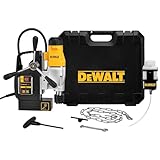
The DWE1622K is the capacity leader in this group, with a 2-inch annular-cutter rating and a two-speed gearbox. That extra range is useful for equipment mounting plates, large conduit openings, and heavier steel fabrication.
The trade-off is its approximately 47-pound weight. That is manageable on a horizontal shop table but awkward when the machine must be lifted onto a tall column, positioned against a vertical frame, or held in place while the magnet is engaged. Its overload protection, two-speed operation, and safety-oriented controls make it more appropriate for demanding work than for occasional hobby use, but the added mass is part of the ownership cost.
Best middle ground: Evolution EVO42
The EVO42 occupies the useful middle ground between the compact Hougen and the heavy DEWALT. Its approximately 1-5/8-inch cutter capacity gives more clearance for common fabrication holes without jumping to the weight of the DWE1622K. Its multi-speed arrangement is helpful when switching between small cutters and larger annular cutters.
Choose it when your work is split between a home workshop and on-site fabrication. It is not the lightest option, and buyers should confirm the included arbor, cutter compatibility, electrical version, and replacement-part availability before ordering.
When the Milwaukee 4272-21 is worth the extra money
The Milwaukee 4272-21 is not the cheapest option, but its approximately 35-pound body and 1-1/2-inch cutter capacity make it attractive for frequent steel work. It is aimed more at trade users than occasional DIY drilling. The extra price can make sense when downtime, difficult repositioning, or repeated work on beams costs more than the initial difference.
For a few holes per month, its cost is harder to justify. For daily fabrication, a better-supported machine with robust controls and readily available accessories may be less expensive over several years than a low-cost drill with worn parts or difficult-to-source arbors.
Decision matrix: choose by the work, not just the price
| Your situation | Recommended direction | Why |
|---|---|---|
| Under $900, fewer than 10 holes per month | Hougen HMD130 | Low carrying weight and enough capacity for ordinary brackets and plates |
| Mostly workshop use, holes from 1-1/4 to 1-5/8 in | Evolution EVO42 | More capacity without the mass of a 2-inch machine |
| Frequent 1-1/2 to 2-inch holes | DEWALT DWE1622K | Largest cutter rating and strong control features |
| Daily professional use and service support matters | Milwaukee 4272-21 | Higher purchase cost may be offset by durability and reduced downtime |
| Vertical or overhead work by one person | Lightest suitable model | Reducing lifting and positioning effort improves control and safety |
Magnetic holding force: what the number leaves out
A magnetic base reaches its rated force only on a clean, thick, flat steel surface. Paint, rust, mill scale, chips, curved tubing, thin sheet, and a visible air gap can reduce grip dramatically. A magnet that holds well on a thick plate may perform poorly on a thin sign bracket.
Before drilling, scrape away loose coating and scale, wipe the base and workpiece, and check that the entire magnet sits flat. Do not assume that a stronger magnet makes an unsafe setup acceptable. The machine can still shift if the cutter binds, the workpiece flexes, or the base is only partly supported.
How to size the drill and cutter
Annular cutters remove a ring of steel rather than grinding out the entire hole, so they usually cut faster than a twist drill at larger diameters. A simple capacity check helps prevent overspending:
- For holes up to 1 inch, a 1-3/8-inch-class machine is usually sufficient.
- For regular holes between 1-1/4 and 1-1/2 inches, choose a machine with capacity above your largest cutter rather than operating at its limit every time.
- For 2-inch holes, use a machine specifically rated for 2-inch annular cutters and verify that the arbor and pilot pins match.
- For thin sheet, confirm the cutter manufacturer’s minimum material thickness; some annular cutters need enough wall thickness for their teeth to engage correctly.
As a worked example, suppose you drill twenty 1-1/4-inch holes each month. A compact 1-3/8-inch machine costing $850 has an approximate equipment cost of $3.54 per hole during the first year: $850 divided by 240 holes. A $1,150, 2-inch machine costs $4.79 per hole at the same usage, before cutters and maintenance. If you rarely need the larger capacity, the heavier machine does not provide value merely because its specification is higher.
Safety features that matter in light fabrication
- Magnet interlock: Prevents the motor from running unless the magnetic base is energized.
- Overload protection: Reduces motor damage when a cutter binds or feed pressure is excessive.
- Mechanical or electronic restart protection: Helps prevent an unexpected start after power interruption.
- Guarding and secure handles: Important when repositioning a machine on vertical steel.
- Safety strap or chain: Use a secondary restraint for vertical, inverted, or overhead drilling. The magnet is not a substitute for fall protection.
Use cutting fluid recommended for the cutter, keep hands away from the rotating arbor, and stop the machine before clearing a slug. Never try to steady the workpiece by hand while feeding the cutter.
Ownership realities: cutters, cleaning, and wear
The first consumable to wear is usually the annular cutter, especially when it is fed too aggressively or used dry in thick steel. Pilot pins also wear and can stick if chips accumulate. Keep a spare pilot pin, inspect cutter teeth after each job, and replace a damaged cutter rather than compensating with excessive pressure.
Clean chips from the magnetic base after every use. Even a thin chip layer creates an air gap and reduces holding force. Check the power cord, magnet face, arbor retention, gearbox noise, and slide play periodically. Do not flood the motor or magnet with cutting fluid; apply lubricant at the cutter and protect electrical components.
Final recommendation
Buy the Hougen HMD130 if portability and sensible cost are your priorities. Choose the Evolution EVO42 for a useful step up in hole size without a very heavy machine. Choose the DEWALT DWE1622K when 2-inch holes are genuinely part of the job, not merely an occasional possibility. For frequent professional use, the Milwaukee 4272-21 can justify its higher price through its trade-focused design and manageable weight.