What's inside
- Top 3 Picks
- Quick Comparison
- How We Chose
- 1. Skil 5080-01 13-Amp 7-1/4″ Circular Saw – Best for Budget-Minded Framing and Deck Work
- 2. SKIL 5280-01 15-Amp 7-1/4″ with Laser Guide – Best for Fast Corded Crosscuts and Bevel Work
- 3. DEWALT DCS391B 20V MAX Cordless Circular Saw – Best for Cordless 6-1/2″ Class Portability
- 4. SEESII Mini Circular Saw 4-1/2″ Corded – Best for Tight Spaces and One-Handed Trim Cuts
- 5. DEWALT ATOMIC DCS571B 4-1/2″ 20V MAX – Best for Trim and Sheet Goods on the 20V MAX Platform
- 6. DOVAMAN 4-1/2″ Corded Circular Saw – Best for Beginner-Friendly Compact Corded Cutting
- 7. Ryobi One+ P505 18V 5-1/2″ – Best for One+ Owners Doing Light Framing
- 8. Extbtfor 4.8A Corded Circular Saw – Best for Occasional DIY Cuts on a Tight Budget
- Top 3 Picks
- Quick Comparison
- How We Chose
- 1. Skil 5080-01 13-Amp 7-1/4″ Circular Saw – Best for Budget-Minded Framing and Deck Work
- 2. SKIL 5280-01 15-Amp 7-1/4″ with Laser Guide – Best for Fast Corded Crosscuts and Bevel Work
- 3. DEWALT DCS391B 20V MAX Cordless Circular Saw – Best for Cordless 6-1/2″ Class Portability
- 4. SEESII Mini Circular Saw 4-1/2″ Corded – Best for Tight Spaces and One-Handed Trim Cuts
- 5. DEWALT ATOMIC DCS571B 4-1/2″ 20V MAX – Best for Trim and Sheet Goods on the 20V MAX Platform
- 6. DOVAMAN 4-1/2″ Corded Circular Saw – Best for Beginner-Friendly Compact Corded Cutting
- 7. Ryobi One+ P505 18V 5-1/2″ – Best for One+ Owners Doing Light Framing
- 8. Extbtfor 4.8A Corded Circular Saw – Best for Occasional DIY Cuts on a Tight Budget
As an Amazon Associate I earn from qualifying purchases. This post may contain affiliate links at no extra cost to you.
The best circular saw deal for most people is the DEWALT DWE575SB 7-1/4 in. corded saw: it pairs a 15-amp motor and a full-size blade with an electric brake and a pivoting base that bevels up to 57 degrees, which is more range than the 45-degree stop most budget saws offer. It suits homeowners and DIYers who cut 2x lumber, plywood, and decking and want one saw that never depends on a battery platform. If you already own DEWALT 20V MAX batteries, the DEWALT DCS590B 7-1/4 in. brushless model is the cordless equivalent and the smarter buy. On the tightest budget, the Skil 5080-01 13-amp saw delivers full-size capacity for the least money, and anyone working in cabinets, closets, or overhead spaces should drop down to a 4-1/2 in. mini saw such as the SEESII or the DEWALT ATOMIC DCS571B. This guide compares every discounted saw below by blade size, cutting depth, power source, and included accessories so you can match the tool to the cuts you actually make.
What we cover
- Top 3 Picks
- Quick Comparison
- How We Chose
- 1. Skil 5080-01 13-Amp 7-1/4″ Circular Saw – Best for Budget-Minded Framing and Deck Work
- 2. SKIL 5280-01 15-Amp 7-1/4″ with Laser Guide – Best for Fast Corded Crosscuts and Bevel Work
- 3. DEWALT DCS391B 20V MAX Cordless Circular Saw – Best for Cordless 6-1/2″ Class Portability
- 4. SEESII Mini Circular Saw 4-1/2″ Corded – Best for Tight Spaces and One-Handed Trim Cuts
- 5. DEWALT ATOMIC DCS571B 4-1/2″ 20V MAX – Best for Trim and Sheet Goods on the 20V MAX Platform
- 6. DOVAMAN 4-1/2″ Corded Circular Saw – Best for Beginner-Friendly Compact Corded Cutting
- 7. Ryobi One+ P505 18V 5-1/2″ – Best for One+ Owners Doing Light Framing
- 8. Extbtfor 4.8A Corded Circular Saw – Best for Occasional DIY Cuts on a Tight Budget
Our Top Picks
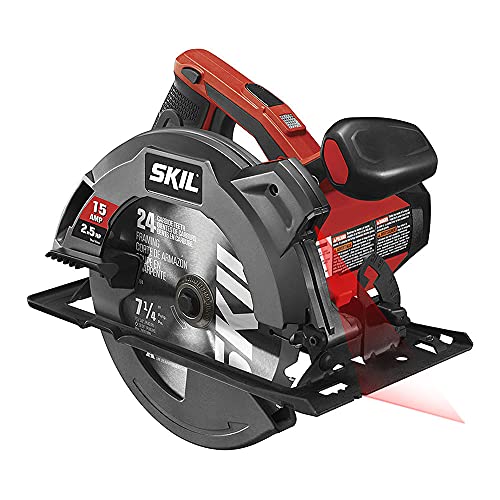 SKIL 15 Amp 7-1/4 Inch Circular Saw with7-1/4 Inch (Pack of 1)14.2 x 9.8 x 8.5 inches8.7 poundsCheck on Amazon


Top 3 Picks
Best overall: DEWALT DWE575SB 7-1/4 in. corded circular saw. A 15-amp corded motor, a full 7-1/4 in. blade, an electric brake, and a pivoting shoe that bevels up to 57 degrees make it the most versatile single saw on this list. It is the right answer for anyone who does not want to budget for batteries and chargers and who mostly cuts at a bench or on a driveway.
Best budget: Skil 5080-01 13-amp 7-1/4 in. circular saw. It keeps the full-size blade and full-size depth of cut while stripping out the extras, which is exactly what a first saw should do. Buy it if you need to break down sheet goods and crosscut framing lumber a few weekends a year and would rather spend the savings on blades and clamps.
Best premium: DEWALT 20V MAX XR brushless 7-1/4 in. (DCS590B). This is the pick for anyone already invested in the 20V MAX system who wants full-size capacity without a cord. Brushless motor, 7-1/4 in. blade, and no battery in the box, so it only makes financial sense if you own packs and a charger already.
Quick Comparison
Every saw in this roundup, sorted by the job it handles best. Price tiers reflect general market positioning rather than a specific figure, since listing prices move daily.
| Product | Best for | Key specs | Price tier |
|---|---|---|---|
| Skil 5080-01 13-Amp 7-1/4 in. | Budget framing, decks, sheet goods | 13 A corded, 7-1/4 in. blade, full-size depth class (~2-1/2 in. at 90°), bevel to 45° | Budget |
| SKIL 5280-01 15-Amp 7-1/4 in. with laser | Corded accuracy with a cut line | 15 A corded, 7-1/4 in. blade, single-beam laser guide, bevel past 45° | Mid-range |
| DEWALT DCS391B 20V MAX | Cordless 6-1/2 in.-class portability | 20V MAX, 6-1/2 in.-class blade, ~5,000 RPM class, 50° bevel, tool only | Premium |
| SEESII Mini 4-1/2 in. | Tight spaces, one-hand trim cuts | 4.8 A corded, 4-1/2 in. blade, 4,000 RPM, laser guide | Budget |
| DEWALT ATOMIC DCS571B 4-1/2 in. | Trim and sheet goods on 20V MAX | 20V MAX, 4-1/2 in. blade, brushless, compact body, tool only | Premium |
| DOVAMAN 4-1/2 in. corded | Beginner-friendly compact cutting | 5.8 A corded, 4-1/2 in. blade, laser guide, auxiliary handle | Mid-range |
| Ryobi One+ P505 18V 5-1/2 in. | One+ owners doing light framing | 18V One+, 5-1/2 in. blade, 4,700 RPM, tool only | Mid-range |
| Extbtfor 4.8A corded 4-1/2 in. | Occasional DIY on a tight budget | 4.8 A corded, 4,000 RPM, laser guide, 45° max bevel | Budget |
| DEWALT 20V MAX XR DCS590B 7-1/4 in. | Cordless full-size framing | 20V MAX XR, 7-1/4 in. blade, brushless, tool only | Premium |
| DEKOPRO 1200W 165 mm | Metric-spec sheet goods and trim | 1,200 W corded, 165 mm (6-1/2 in.) 24T blade, 4,800 RPM, 55 mm cut at 90°, 33 mm at 45° | Budget |
| Extbtfor cordless with 2.0 battery | Grab-and-go cordless convenience | Cordless, 2.0 Ah battery included, 3,400 RPM, laser guide, 45° bevel | Mid-range |
| DEWALT DWE575SB 7-1/4 in. corded | Corded all-rounder with wide bevel | 15 A corded, 7-1/4 in. blade, pivoting shoe to 57°, electric brake | Premium |
How We Chose
This roundup is built from published manufacturer specifications, category norms, and the practical requirements of common cuts rather than from any physical evaluation of the tools. Three filters decided what made the list. First, category fit: every saw had to do a recognizable job well, whether that is full-size framing, compact trim work, or battery-platform convenience. Second, specification substance: blade size, motor rating or voltage, depth of cut at 90 and 45 degrees, bevel range, weight class, and what actually arrives in the box, including whether a battery, blade, or case is included. Third, upgrade path: a saw only earns a place here if there is a logical next step for the buyer, such as moving from a 4-1/2 in. mini saw to a 7-1/4 in. full-size model, or from a budget corded saw to a brushless cordless one on the same battery platform. Price tiers are described as budget, mid-range, and premium because listings shift constantly; the tiers reflect where each tool generally sits in the market, not a fixed number.
1. Skil 5080-01 13-Amp 7-1/4″ Circular Saw – Best for Budget-Minded Framing and Deck Work
As an Amazon Associate we earn from qualifying purchases at no extra cost to you.
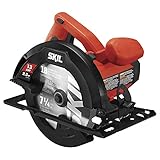
The Skil 5080-01 is the value benchmark of this group. Skil is the brand that brought the portable circular saw to job sites roughly a century ago, and this model keeps the formula simple: a 13-amp corded motor, a full 7-1/4 in. blade, and a standard left-blade layout. It suits the homeowner building a deck or fence, the DIYer framing a shed, and anyone who cuts 2x stock in quantity and would rather not pay for features they will not use. If your work lives on a driveway or in a garage with an outlet nearby, the cord is an advantage rather than a limitation, because it removes batteries and chargers from the budget entirely.
Key specs
- Power source: corded, 13-amp motor class
- Blade: 7-1/4 in., full-size class
- Depth of cut: full-size class, roughly 2-1/2 in. at 90° and about 1-13/16 in. at 45°
- Bevel: to 45°
- Layout: left-side blade, standard stamped base
- Typical weight class: 8 to 10 lb
- In the box: saw, blade, wrench, and a basic rip guide on most listings
Strengths
The strongest argument for this saw is that nothing important is missing. A 7-1/4 in. blade is the size that defines the category: it crosscuts 2×4 and 2×6 in a single pass at 90 degrees, bevels a 2x at 45 degrees without a second cut, and handles 3/4 in. plywood and OSB at full depth without straining. The 13-amp motor class is enough for framing lumber and decking, though it will slow down in wet pressure-treated 4x material or long rips in thick hardwood. Because the base is a simple stamped design, the saw stays light for its class, which matters when you are making hundreds of overhead cuts installing blocking or sheathing.
Corded power also means consistent speed. A corded saw does not taper off as the work gets heavier, so long rips in 3/4 in. plywood stay smooth instead of bogging near the end of the cut. There is no battery to manage, no charger to store, and no risk of a pack sitting dead when you finally get a free Saturday.
Pros
- Full 7-1/4 in. capacity for the lowest spend in this roundup
- Unlimited runtime on an extension cord, no battery platform required
- Light enough for overhead sheathing and blocking work
- Widely available blades in every tooth count, so consumables are cheap
Cons
- No electric brake, so the blade coasts after the trigger is released
- 45° bevel limit rules out steep bevels and some rake cuts
- Stamped base flexes under heavy sideways pressure compared with a cast shoe
- Laser or cut-line aid is absent; you mark and follow the notch
How it compares
The nearest alternative is the SKIL 5280-01. Both are 7-1/4 in. corded saws from the same brand, but the 5280-01 steps up to a 15-amp motor class and adds a single-beam laser guide, which is easier to see than a stamped notch in low light. If your budget stretches, the 5280-01 buys noticeably more usable power and a faster cut line. If it does not, the 5080-01 does the same fundamental work for less, and the money saved covers a good 24-tooth framing blade and a 60-tooth finish blade. Choose the 5080-01 when the priority is getting a full-size saw in the door today; choose the 5280-01 when accuracy and power headroom matter more than the price difference.
2. SKIL 5280-01 15-Amp 7-1/4″ with Laser Guide – Best for Fast Corded Crosscuts and Bevel Work

The SKIL 5280-01 is the mid-range corded option and the natural upgrade from the 5080-01. It carries a 15-amp motor class, a 7-1/4 in. blade, and a single-beam laser guide that projects a line ahead of the blade so you can align a mark without leaning over the tool. It suits the woodworker who cuts plywood and framing lumber regularly, wants a bit more power for pressure-treated stock and hardwoods, and prefers a visible cut line to a notch on the base. It also fits the deck builder who works from a generator or a long cord and has no interest in battery management.
Key specs
- Power source: corded, 15-amp motor class
- Blade: 7-1/4 in.
- Depth of cut: full-size class, approximately 2-1/2 in. at 90° and about 1-13/16 in. at 45°
- Bevel: past 45°, allowing shallow compound-style cuts on trim
- Cut line aid: single-beam laser guide
- Typical weight class: 9 to 11 lb
- In the box: saw, carbide blade, wrench, rip guide on most listings
Strengths
The extra 2 amps of motor class over the entry-level Skil show up in exactly the places a budget saw struggles. Long rips in 3/4 in. plywood hold speed, wet pressure-treated 2x material cuts without the blade stalling, and 45-degree bevels through 2x lumber stay clean because the motor is not working at its ceiling. The laser guide is the second real advantage: for crosscutting studs to length, you set the beam on the mark and cut, which is faster than sighting down a notch, especially on a shaded driveway or in a dim garage.
Skil’s corded saws in this class also tend to be simple to service. The blade change uses a single wrench, the depth and bevel adjustments are lever-and-knob designs you can tighten by hand, and replacement parts and blades are available everywhere. That simplicity matters over a decade of ownership: fewer proprietary parts means fewer reasons to replace the whole tool.
Pros
- 15-amp class motor holds speed in plywood, decking, and hardwoods
- Laser guide speeds up repeat crosscuts to a mark
- Bevel range beyond 45° handles trim and rake cuts
- Full-size 7-1/4 in. blade keeps blade choices broad and cheap
Cons
- No electric brake, so the blade coasts to a stop
- Heavier than the entry-level Skil, which you notice overhead
- Laser needs occasional alignment checking after a drop
- Cord limits you to outlet or generator access
How it compares
Against the Skil 5080-01, this is a straightforward power-and-features upgrade: same blade size, same category, more motor, plus a laser. Against the DEWALT DWE575SB at the premium tier, the difference is refinement rather than capability. The DEWALT adds an electric brake and a pivoting shoe with 57 degrees of bevel, both of which matter if you cut steep angles or want the blade to stop quickly between cuts. For most crosscutting and 45-degree work, the Skil 5280-01 gets you 90 percent of the way there for less. Pick the Skil if budget and simplicity lead; pick the DEWALT if you want the brake and the wider bevel.
3. DEWALT DCS391B 20V MAX Cordless Circular Saw – Best for Cordless 6-1/2″ Class Portability
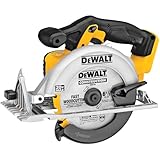
The DCS391B is DEWALT’s mainstream cordless circular saw, built on the 20V MAX battery platform and sold as tool only, meaning no battery and no charger are in the box. It runs a 6-1/2 in.-class blade, which sits between the mini saws and the full-size 7-1/4 in. models. It suits the homeowner or remodeler who already owns 20V MAX packs and wants to cut framing lumber, subfloor, and sheathing without dragging a cord through a half-finished house. It is also a good fit for punch-list and repair work where an outlet is not guaranteed.
Key specs
- Power source: 20V MAX battery, tool only
- Blade: 6-1/2 in. class
- Speed: roughly 5,000 RPM class
- Depth of cut: about 2 in. class at 90°, roughly 1-1/2 in. at 45°
- Bevel: to 50°
- Typical weight class: 7 to 9 lb depending on pack
- In the box: saw and blade; battery and charger sold separately
Strengths
The 6-1/2 in. blade class is the sweet spot for cordless framing. It still crosscuts a 2×4 at 90 degrees in one pass and handles 2x material at 45 degrees in most configurations, but it draws less power than a 7-1/4 in. blade, so a given battery pack lasts longer and the saw stays lighter in the hand. The 50-degree bevel is a genuine advantage over the 45-degree limit on most budget saws, and it covers the compound angles that show up in roof framing and stair stringers.
Because it is part of the 20V MAX system, the tool shares packs with drills, impact drivers, reciprocating saws, and sanders. That is the real economic argument for tool-only purchases: if you already own three packs and a charger, the marginal cost of adding this saw is just the bare tool. Depth and bevel adjustments use DEWALT’s standard lever and detent layout, so the controls feel familiar if you own other tools in the line.
Pros
- No cord, so it works anywhere on a job site or in a field
- 50° bevel covers compound cuts that 45° saws cannot
- Shares 20V MAX packs with the rest of the platform
- Lighter and easier to control overhead than a 7-1/4 in. saw
Cons
- Tool only, so first-time buyers also need packs and a charger
- 6-1/2 in. blade cannot cut 4x material or deep bevels in one pass
- Runtime depends entirely on which battery you own
- Less torque than a corded 15-amp saw in wet treated lumber
How it compares
The closest alternative is the DEWALT 20V MAX XR DCS590B, which runs a full 7-1/4 in. blade with a brushless motor. The XR saw cuts deeper, holds speed better in thick stock, and gets more cuts per charge, but it is heavier and costs more. The DCS391B is the better choice if most of your cuts are 2x framing and sheet goods and you want a lighter tool for overhead work. The DCS590B is the better choice if you regularly cut 2x at steep bevels, work with 4x stock, or want maximum runtime from each pack. Both are tool-only purchases, so the decision usually comes down to whether you need the extra depth or the lighter weight.
4. SEESII Mini Circular Saw 4-1/2″ Corded – Best for Tight Spaces and One-Handed Trim Cuts

The SEESII mini circular saw is a compact corded tool built around a 4-1/2 in. blade and a 4.8-amp motor running at 4,000 RPM, with a laser guide for alignment. Its job is not framing; it is everything a full-size saw is too big to do. It suits the apartment dweller cutting plywood on a balcony, the trim carpenter fitting shoe molding and baseboard, and the DIYer cutting paneling, pegboard, and 1/2 in. plywood in a space where a 7-1/4 in. saw is simply too much tool.
Key specs
- Power source: corded, 4.8-amp motor class
- Blade: 4-1/2 in.
- Speed: 4,000 RPM
- Depth of cut: compact class, roughly 1-1/4 to 1-1/2 in. at 90°, less at bevel
- Bevel: adjustable, typically to 45°
- Cut line aid: laser guide
- Typical weight class: 4 to 6 lb
- In the box: saw, blade, wrench, and usually a rip or edge guide
Strengths
The value of a mini saw is control. At roughly half the weight of a full-size model, it can be run one-handed for short cuts, which is exactly what you want when you are trimming a cabinet toe kick, cutting a shelf to length, or notching a panel while holding it steady with your other hand. The laser guide helps here too, because on a small tool the sight line over the blade is short and harder to judge.
Depth is the trade-off, and it defines what the tool can and cannot do. In the 4-1/2 in. class, you get roughly 1-1/4 to 1-1/2 in. of cut at 90 degrees, which covers 3/4 in. plywood, 1 in. nominal stock, PVC trim, paneling, and most flooring underlayment. It will not crosscut a 2×4 in one pass at 90 degrees, and it will not bevel a 2x at all. Corded power at this size means no runtime anxiety, and a 4.8-amp motor is plenty for the thin materials the blade can physically cut.
Pros
- Small and light enough for one-handed trim and shelf cuts
- Laser guide compensates for the short sight line over a small blade
- Corded power means unlimited runtime on thin stock
- Lowest-cost way to add a powered saw to a small workspace
Cons
- Cannot cut 2x lumber in a single pass at 90°
- Blade availability and tooth-count choices are narrower than 7-1/4 in.
- Depth-of-cut gauge is coarse compared with full-size saws
- Small base plate makes long straight rips harder to keep true
How it compares
The nearest alternatives are the other compact saws in this roundup: the DOVAMAN 4-1/2 in. and the Extbtfor 4.8-amp corded model. All three occupy the same class, so the differences come down to motor rating, handle design, and accessories. The DOVAMAN’s 5.8-amp motor class gives it more headroom in dense material, and its auxiliary handle adds stability for two-handed cuts. The SEESII and the Extbtfor share the same 4.8-amp, 4,000 RPM class, so choose between them on the guide and accessories in the box. If you need a saw that can also break down sheet goods and framing lumber, none of these three will do it; step up to a 7-1/4 in. model.
5. DEWALT ATOMIC DCS571B 4-1/2″ 20V MAX – Best for Trim and Sheet Goods on the 20V MAX Platform

The DEWALT ATOMIC DCS571B is a compact brushless cordless saw with a 4-1/2 in. blade, sold as tool only on the 20V MAX platform. It exists for the same jobs as the corded mini saws, but without a cord, and with the build quality and electronics that come with a premium-tier tool. It suits the trim carpenter working in occupied homes, the cabinet installer who needs to cut down a panel in place, and the 20V MAX owner who wants a small saw to pair with a full-size cordless model.
Key specs
- Power source: 20V MAX battery, tool only
- Blade: 4-1/2 in.
- Motor: brushless
- Depth of cut: compact class, roughly 1-1/2 in. at 90° and about 1 in. at 45°
- Bevel: adjustable for trim angles
- Typical weight class: 4 to 5 lb without pack
- In the box: saw and blade; battery and charger sold separately
Strengths
Brushless motors are the practical difference between a premium compact saw and a budget one. They run cooler, use power more efficiently, and have no carbon brushes to wear out, which is a meaningful ownership advantage in a tool you may keep for a decade. In practice that translates to more cuts per charge and steadier speed under load than a comparable brushed motor of the same class. The ATOMIC body is also genuinely small, which is the point: it fits into cabinets, between studs, and along a floor line where a 7-1/4 in. saw cannot reach.
Because it shares the 20V MAX platform, this saw is a natural companion to the DCS391B and the DCS590B. You can carry one charger and three packs and cover trim, framing, and drilling on the same trip. For an installer who works in finished homes, that consolidation is worth more than any single specification.
Pros
- Brushless motor with no brushes to replace
- Compact enough for cabinet, closet, and in-place cuts
- Shares 20V MAX batteries with the rest of the platform
- Cordless convenience in occupied or finished spaces
Cons
- Tool only, so the true cost includes packs and a charger
- Depth is limited to roughly 1-1/2 in. class at 90°
- Cannot replace a full-size saw for framing or decking
- Premium tier pricing for a compact tool
How it compares
Against the SEESII and DOVAMAN corded minis, the ATOMIC buys you cordless freedom, a brushless motor, and platform compatibility, at a higher price and with battery cost added. Against the DEWALT DCS391B, it is the smaller sibling: the DCS391B cuts about 2 in. at 90 degrees and can handle framing lumber, while the DCS571B is limited to trim and sheet goods but fits where the larger saw will not. Many 20V MAX owners end up with both, using the compact saw for trim and the 6-1/2 in. or 7-1/4 in. saw for structure.
6. DOVAMAN 4-1/2″ Corded Circular Saw – Best for Beginner-Friendly Compact Corded Cutting

The DOVAMAN 4-1/2 in. corded circular saw pairs a 5.8-amp motor with a laser guide and an auxiliary handle, which puts it at the top of the compact corded class in this roundup. It suits the first-time saw buyer who needs to cut plywood, paneling, and trim but is not ready to handle a 10 lb full-size tool, and the occasional DIYer who wants two-handed stability on a small saw. The auxiliary handle is the feature that distinguishes it: on a compact saw, a second grip point makes long cuts noticeably easier to keep straight.
Key specs
- Power source: corded, 5.8-amp motor class
- Blade: 4-1/2 in.
- Depth of cut: compact class, roughly 1-1/4 to 1-1/2 in. at 90°
- Bevel: adjustable for trim angles
- Cut line aid: laser guide
- Handle: primary grip plus auxiliary handle
- In the box: saw, blade, wrench, and typically a guide or rip fence
Strengths
The 5.8-amp motor is the strongest in the compact corded group here, and it shows up when you push the saw through 3/4 in. plywood or dense hardwood trim. Where a 4.8-amp saw might slow and burn, the extra headroom keeps the blade at speed, which produces cleaner edges and less tear-out on the top face. The auxiliary handle then lets you apply steady forward pressure with both hands, reducing the wobble that causes a wandering cut line on a short base plate.
For a beginner, the combination of a small blade, a light body, and a laser guide is genuinely safer than starting with a full-size saw. The blade is smaller, the kickback energy is lower, and the tool is easier to control one-handed when you need your other hand to hold the workpiece. Corded power at 5.8 amps also means no battery cost, which keeps the total outlay low while still delivering enough power for thin and medium stock.
Pros
- Highest motor rating among the compact corded saws here
- Auxiliary handle improves control on long cuts
- Laser guide plus a light body suits first-time users
- No battery or charger to buy
Cons
- Still limited to roughly 1-1/2 in. class depth at 90°
- Cord restricts use to outlet or generator access
- Small blade limits blade selection and tooth counts
- Not a substitute for a full-size saw on framing lumber
How it compares
Against the SEESII mini, the DOVAMAN offers a higher motor class and the auxiliary handle, which together make it the more capable compact corded saw. Against the DEWALT ATOMIC DCS571B, the trade is power source: the DEWALT is cordless, brushless, and platform-compatible, but costs more once batteries are included, while the DOVAMAN is corded, heavier in the hand relative to its size, and much cheaper to get started with. If your work is confined to a garage or workshop with power, the DOVAMAN is the practical compact pick. If you need to work in finished rooms or away from outlets, step up to the ATOMIC.
7. Ryobi One+ P505 18V 5-1/2″ – Best for One+ Owners Doing Light Framing

The Ryobi One+ P505 is an 18V cordless saw with a 5-1/2 in. blade turning at 4,700 RPM, sold as tool only. It sits between the mini saws and the full-size cordless models, which makes it a useful middle step for anyone already inside the One+ battery ecosystem. It suits the homeowner who owns One+ drills and lights, wants to cut 2x material and sheet goods around the house, and does not want to add a second battery platform to the garage shelf.
Key specs
- Power source: 18V One+ battery, tool only
- Blade: 5-1/2 in.
- Speed: 4,700 RPM
- Depth of cut: mid-compact class, roughly 1-3/4 to 1-7/8 in. at 90°
- Bevel: adjustable for common trim and framing angles
- Typical weight class: 6 to 8 lb depending on pack
- In the box: saw and blade; battery and charger sold separately
Strengths
The 5-1/2 in. blade is the smallest size that reliably crosscuts a 2×4 at 90 degrees in one pass, since the typical depth in this class lands just above 1-1/2 in. That makes the P505 a legitimate light-framing saw rather than a trim-only tool. It cuts studs, blocking, and fence pickets, and it breaks down 3/4 in. plywood and OSB without trouble. At the same time, it is noticeably lighter and easier to handle than a 7-1/4 in. cordless saw, which matters for overhead work like sheathing and soffit.
The real argument for the P505 is the One+ platform. Ryobi has built one of the broadest cordless ecosystems around, so a single set of packs and one charger can run drills, drivers, lights, fans, and this saw. For a homeowner who already has One+ batteries, adding the saw is a bare-tool purchase with no duplication.
Pros
- 5-1/2 in. blade cuts 2×4 in one pass at 90°
- Light and manageable for overhead and one-handed work
- Shares batteries across the One+ platform
- Cordless convenience at a mid-range price tier
Cons
- Tool only, so packs and charger are extra
- Cannot bevel a 2x at 45° in a single pass
- Less torque than a 7-1/4 in. corded or brushless cordless saw
- Runtime depends on the capacity of the pack you own
How it compares
Against the DEWALT DCS391B, the P505 gives up roughly a quarter inch of depth and some motor headroom, but it is lighter and cheaper for anyone already in the One+ system. Against the DEWALT DCS590B, the gap is larger: the 7-1/4 in. XR saw handles full framing, steep bevels, and thick stock that the P505 cannot touch. The P505 makes sense when your cuts are 2x lumber, plywood, and trim, and when staying on one battery platform is worth more than maximum capacity. If you routinely cut 4x material or bevel 2x, you need the larger class.
8. Extbtfor 4.8A Corded Circular Saw – Best for Occasional DIY Cuts on a Tight Budget

The Extbtfor 4.8-amp corded saw is a compact, laser-guided tool with a 4,000 RPM motor and a maximum bevel of 45 degrees. It belongs to the entry tier of the compact corded class, and it suits the renter or occasional DIYer who needs to cut plywood, shelving, and trim a few times a year and wants the lowest possible entry cost. It is also a reasonable second saw for someone who already owns a full-size model and wants a light tool for small cuts.
Key specs
- Power source: corded, 4.8-amp motor class
- Speed: 4,000 RPM
- Blade: compact class, 4-1/2 in. range
- Depth of cut: compact class, roughly 1-1/4 to 1-1/2 in. at 90°
- Bevel: to 45° maximum
- Cut line aid: laser guide
- In the box: saw, blade, wrench, and usually a guide
Strengths
At this tier, the appeal is straightforward: a working powered saw for thin and medium stock at the lowest cost in the category. The 4,000 RPM speed keeps cuts in 3/4 in. plywood and 1x trim reasonably clean when you let the blade do the work rather than forcing it. The laser guide covers the alignment problem that a small base plate creates, and the corded design means you never think about charge level.
Its practical envelope is worth stating plainly. It cuts paneling, pegboard, 1/2 in. and 3/4 in. plywood, PVC trim, and nominal 1x material. It will not crosscut a 2×4 at 90 degrees in one pass, and the 45-degree bevel limit rules out steep compound angles. If your project list is shelves, cabinet backs, and trim, that envelope is enough. If it includes framing lumber, it is not.
Pros
- Lowest entry cost in the compact corded group
- Laser guide helps with alignment on a short base
- Light enough to use one-handed for short cuts
- No battery or charger expense
Cons
- 4.8-amp class motor slows in dense hardwood
- 45° bevel limit and modest depth restrict project scope
- Basic stamped base flexes under sideways load
- Shorter service life expected at this tier than premium tools
How it compares
Against the SEESII mini, this saw is essentially the same class and speed, so the deciding factors are the accessories in the box and the handle design. Against the DOVAMAN 4-1/2 in., it gives up a full amp of motor class and the auxiliary handle, which is the difference between a saw that holds speed in hardwood and one that bogs. If the price gap is small, the DOVAMAN is the better compact corded buy. If you are strictly minimizing cost and cutting only thin stock, this saw covers the job. Either way, plan on upgrading the included blade before your first finish cut.