What's inside
As an Amazon Associate I earn from qualifying purchases. This post may contain affiliate links at no extra cost to you.
What we cover
Choose the fastener for the track and slab
For a light-gauge steel track on sound, ordinary concrete, concrete screws are usually the best starting point. They are removable, need no separate expansion anchor, and are available in lengths suited to fastening through track into a slab. For a temporary layout or a small job, powder-actuated pins can be quicker. For heavy loads, weak or cracked concrete, or a connection that must meet an engineered specification, use the anchor type and spacing required by the plans rather than choosing by convenience.
First identify what the track is doing. A non-load-bearing partition bottom track is different from a track anchoring a structural wall, guard, or piece of equipment. Also check the slab for radiant heating, post-tensioning, or embedded services before drilling or shooting pins. If you cannot verify what is in the slab, stop and find out; hitting reinforcement or a tendon can be dangerous and costly.
As an Amazon Associate we earn from qualifying purchases at no extra cost to you.
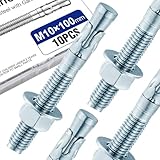


Fastener options at a glance
| Fastener | Good fit | Main trade-off | Typical installation needs |
|---|---|---|---|
| Concrete screw | Light to moderate-duty track on sound concrete | Requires a correctly sized, clean pilot hole | Hammer drill, masonry bit, driver or wrench |
| Powder-actuated pin | Fast installation on suitable concrete | Not adjustable; performance depends on concrete and tool setup | Powder-actuated tool, correct pin and load |
| Wedge or sleeve anchor | Heavier connections where the design calls for expansion anchors | Needs more edge distance and a larger hole | Hammer drill, bit, setting tool or wrench |
| Adhesive anchor | Specified connections, including some cases where expansion is unsuitable | Slower; hole cleaning and cure time are critical | Specified adhesive, mixing nozzle, brush and blowout method |
Concrete screws: the practical default
For ordinary track work, compare concrete screws for metal track. Many light-track installations use screws around 3/16 inch in diameter, but the right diameter, minimum embedment, spacing, and edge distance depend on the fastener listing and the project requirements. Do not treat a common size as an engineering specification.
Choose a length that passes through the track and reaches the required embedment in concrete. Track thickness does not count as embedment. For example, a 1-inch screw through roughly 1/8-inch track leaves less than 1 inch in the slab before allowing for any clearance or washer. Check the manufacturer’s table, not just the package headline. A screw that is too short can pull out; one that is too long can hit something embedded in the slab.
Drill the pilot hole to the diameter and depth specified for that exact screw. A hammer drill and carbide masonry bit make this faster than a standard drill, especially across multiple holes. Brush or blow out dust as directed: packed dust can stop the screw before it seats and make a good fastener feel tight when it is not. Drive it snug, not excessively hard. Overdriving can strip the concrete around the threads or damage the track.
A cordless hammer drill and masonry bit are useful for this method. For a few holes in soft concrete, a suitable standard drill may work, but it will be slower. If the screw spins without tightening, stop: the hole may be oversized, dusty, or drilled into weak concrete. Moving to a nearby fresh hole may work only if spacing and edge-distance requirements still allow it.
When powder-actuated pins make sense
A powder-actuated tool can fasten track quickly, with no pilot hole. It is a reasonable choice for repetitive work when the tool, pin, and load are approved for the concrete and the application. The concrete must be strong enough and thick enough for the selected system. A pin that barely holds is not a bargain, and a pin that is too powerful can spall the slab, bend the track, or pass through thin material.
Test the setup in a scrap piece or inconspicuous area. If the pin stands proud, the tool may need a different load or pin; if it sinks too far or cracks the concrete, stop and adjust according to the tool manual. Keep the tool perpendicular to the surface and follow its safety instructions. Powder-actuated tools are not a sensible first purchase for a handful of holes, and they should not be used where the tool maker or job specification prohibits them.
Use larger anchors only when the job calls for them
Wedge and sleeve anchors can provide a robust connection, but they are often unnecessary for ordinary light-gauge track. Their expansion force can crack concrete near an edge, so hole location and minimum spacing matter. They also require a larger, deeper hole than a small concrete screw. Use them when the design specifies them or when the load and substrate call for a listed anchor, not simply because the anchor looks heavier.
Adhesive anchors have their own failure modes. Dust left in the hole, incorrect mixing, expired material, or loading before full cure can undermine the connection. They are not a quick substitute for a screw. Follow the product’s installation sheet for hole cleaning, temperature, cure time, and loading. For structural work, use the exact anchor system and installation procedure specified by the engineer.
Layout, drilling, and common failures
Lay out the track straight and mark holes at the spacing required by the plans or the fastener manufacturer. Do not put a hole so close to a slab edge that the concrete can break out; the required distance varies by anchor type and diameter. Avoid existing cracks when possible. If a hole lands in a crack or crumbles while drilling, do not assume a larger fastener will fix it.
Use eye protection and hearing protection when drilling or using a powder-actuated tool. Keep the drill square, use the specified bit, and control drilling depth. A depth stop or tape mark helps prevent drilling farther than intended. For a pilot hole, drill slightly deeper than the fastener’s required embedment only if the manufacturer’s instructions allow it; dust and the screw tip need room, but extra depth is no reason to risk buried services.
Before fastening the full run, install one or two anchors and check that the track sits flat and cannot shift. A screw that breaks during driving may indicate an incorrect bit, a hole that is too tight or shallow, or excessive torque. A fastener that turns freely may have stripped the hole. Replace failed fasteners in a fresh location only where the required spacing and edge distances remain intact. If several holes fail, reassess the concrete and fastener choice instead of adding more hardware.
For a small, non-structural partition on sound slab, properly installed concrete screws are often the cheapest sensible choice. Pins can save time on repetitive work, while larger or adhesive anchors belong in applications that specifically require them. When the track is structural or the slab condition is uncertain, the plans and the fastener manufacturer’s published data should decide the purchase.