What's inside
As an Amazon Associate I earn from qualifying purchases. This post may contain affiliate links at no extra cost to you.
What we cover
What to buy for conduit straps
For most indoor electrical conduit straps fastened to sound concrete, a blue-coated or stainless steel concrete screw in a 1/4-inch diameter is a practical choice. Buy a length that gives the screw at least 1 inch of embedment in solid concrete after passing through the strap and any gap. A common starting point is a 1-3/4-inch screw for a thin strap; check the fastener maker’s embedment and hole-depth instructions before buying.
Concrete screws are removable, need no plastic plug, and are usually easier to place accurately than expansion anchors. For a light conduit run, the cheapest suitable screw is often fine. Pay more for corrosion-resistant material where dampness or chemical exposure makes rust a concern—not simply because the package claims a larger load rating.
As an Amazon Associate we earn from qualifying purchases at no extra cost to you.


Compare the main options
| Fastener | Best fit | Trade-off |
|---|---|---|
| Coated concrete screw | Typical indoor conduit straps in sound concrete | Affordable and removable; coating can be damaged during installation or unsuitable for corrosive exposure. |
| Stainless concrete screw | Damp locations or situations where rust resistance matters | Costs more; still requires a correctly sized, clean pilot hole. |
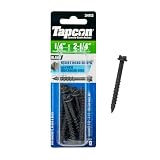
| Tapcon-style hex-head screw | Work where a nut driver offers better control than a Phillips or star bit | Head may be bulky for narrow strap holes; verify the head fits before drilling. |
| Plastic plug with a screw | Very light-duty fastening when a compatible plug is already on hand | Can loosen or pull out more readily; not the default choice for a lasting conduit installation. |
Shop by screw diameter, length, head style, and approved base material, not just package count. A useful 1/4-inch hex-head concrete screw search can help compare coated options. If the installation is exposed to moisture, compare stainless concrete screws as well.
Choose length and diameter
Measure the strap thickness and any shim or spacer, then add the embedment required by the screw manufacturer. For example, if the material stack is about 1/8 inch and the product requires 1 inch of embedment, a 1-1/2-inch screw may leave little margin for uneven concrete or a countersunk head; a 1-3/4-inch screw is a more sensible starting point. Do not assume that extra length always means extra strength: the screw needs enough sound concrete around its pilot hole.
A 3/16-inch screw may suit small straps and light conduit when its listed capacity and the strap’s hole size match. A 1/4-inch screw gives more margin for many general-purpose jobs but needs a larger pilot hole and more clearance. Use the fastener maker’s specified drill-bit diameter; for many concrete screws that is around 3/16 inch for a 1/4-inch screw, but specifications vary. Never substitute a bit size from memory.
Drill and install without stripping the hole
Use a hammer drill and a sharp masonry bit for ordinary concrete. A standard drill may work in soft masonry, but it can drill slowly and overheat the bit. An impact driver can drive some concrete screws, yet it does not drill the pilot hole and can snap a screw or damage its drive recess if used aggressively. A drill with adjustable clutch gives more control near the end of the drive.
Mark the strap holes, move it aside, and drill straight to the required depth. Make the hole deeper than the screw’s embedment—often by roughly 1/4 inch—to leave room for dust. Clear the hole with a vacuum or suitable brush. Dust left at the bottom can stop the screw early and make it seem tight when it has not seated correctly.
Put the strap back and drive the screw steadily. Stop when the head holds the strap snugly; crushing the strap or continuing to spin after resistance rises can strip the concrete. If the screw turns without tightening, the hole may be oversized, dusty, or damaged. Remove it and relocate the fastener, keeping the manufacturer’s required edge distance and spacing. A screw that spins freely is not fixed by adding more torque.
Check the concrete and the location
Old, cracked, hollow, or unusually soft concrete changes the choice. Avoid drilling close to an edge or into a crack: the concrete can break out, and the screw may not develop its intended hold. If a hole fails, move to fresh material rather than reusing it. For overhead work, heavier conduit, or an installation with meaningful consequences if it loosens, follow the screw manufacturer’s load data and applicable electrical requirements rather than treating a light-duty strap example as a design rating.
Before drilling, check for concealed wiring, plumbing, and reinforcement. Use a suitable detector where needed, and do not drill where you cannot rule out a hazard. Exterior or wet locations also call for attention to corrosion compatibility: stainless steel is useful in many such settings, but the correct grade and compatibility with nearby metals matter.
A short buying checklist
For a straightforward indoor job, buy a box of concrete screws that matches the strap holes, a compatible masonry bit, and a driver bit or nut driver that fits the screw head. A masonry drill-bit set is handy if you need more than one pilot size, but a single correctly specified bit is enough for a small run. Choose hex head when access and strap clearance allow; choose a low-profile head if the strap design requires it. For a few light straps in good concrete, there is no need to buy a premium anchor system. The right size, a clean pilot hole, and a controlled installation matter more.