What's inside
As an Amazon Associate I earn from qualifying purchases. This post may contain affiliate links at no extra cost to you.
What we cover
What the job demands
Assembling a wood frame with structural screws is a different task from driving a handful of deck screws. Long screws have to pull heavy members together, often through knots or dense, wet lumber. An impact driver’s short rotational blows help keep the bit turning under load, while its compact body is easier to position around framing and brackets.
For most framing work, a 18V or 20V-class cordless impact driver with a 1/4-inch hex chuck is a practical choice. Voltage labels vary by brand and do not tell you how much usable torque or runtime a tool delivers. More useful buying considerations are battery capacity, speed control, ergonomics, and whether the driver can run the screw manufacturer’s specified bit.
As an Amazon Associate we earn from qualifying purchases at no extra cost to you.



Structural screws are not interchangeable with ordinary construction or deck screws. Follow the screw maker’s instructions for screw diameter, length, pilot holes, edge distance, and bit type. A screw that is too long, too close to a board’s edge, or driven into a knot can split the wood even if the driver is powerful enough.
What to buy
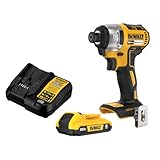
For an occasional project, a basic cordless impact driver from a reputable tool line is usually enough. A kit with two batteries is useful if you have many screws to drive or want one battery charging while you work. A 2.0Ah battery keeps the tool light; a 4.0Ah or larger pack generally lasts longer but adds weight and bulk. Battery compatibility with tools you already own can matter more than a small difference in advertised power.
Look for a trigger that is easy to feather and, ideally, multiple speed or assist modes. Starting slowly helps the screw catch without walking, and lower speed gives you more control near a board edge. A bare-tool purchase makes sense if you already own compatible batteries and a charger. Otherwise, compare kit pricing before choosing.
Compare cordless impact driver kits for a framing project. If you expect repeated long-screw work, step up to a higher-performance tool in a battery platform you can support; don’t buy solely on a maximum torque number, which can be measured under conditions unlike your actual job.
Choosing a driver for the work
| Option | Best for | Trade-off |
|---|---|---|
| Basic 18V/20V impact driver | Occasional frames, repairs, and typical structural screws | May slow down on large screws in dense lumber; usually the best-value choice |
| Higher-performance impact driver | Frequent framing or many long, large-diameter screws | Often heavier or more expensive; extra power does not prevent splitting or overdriving |
| Compact 12V impact driver | Light framing, tight spaces, and small batches | Convenient and light, but less reserve for demanding screws and long sessions |
| Corded drill/driver | Controlled drilling and occasional screw driving near power | Less convenient on a jobsite and can twist hard when a large fastener binds |
A drill/driver is still useful alongside an impact driver. Use it to drill pilot holes where the fastener maker calls for them, or to make clean clearance holes. For driving structural screws, an impact driver is generally easier to hold under load, but it is not a substitute for the correct fastener or a properly supported workpiece.
Bits and setup matter
Use the exact drive bit specified for the screw, whether that is a hex, Torx-style, or another profile. A worn or poorly seated bit can cam out, chew up the recess, and leave a screw stuck halfway in. Keep a spare bit nearby, and replace it when its edges are visibly rounded. Find impact-rated structural-screw bits matched to your fasteners.
Clamp or brace the framing so it cannot shift as the screw starts. Align the boards, seat the bit squarely, and start at low speed with firm pressure. Once the threads have engaged, increase speed while keeping the tool straight. Near the end, ease off the trigger. An impact driver can bury a head quickly, strip the drive, or crush soft wood if you hold the trigger after the head is seated.
For large screws, hardwood, or lumber prone to splitting, check the screw maker’s pilot-hole guidance rather than guessing. A pilot hole that is too small may make driving difficult; one that is too large can reduce holding strength. Keep fasteners away from board ends and edges by the distances specified for the particular screw and framing layout.
Common problems and when to change approach
If the driver repeatedly stalls, the bit slips, or the screw stops advancing, don’t just keep pulling the trigger. Back the fastener out if possible and check for a mismatched bit, a knot, a misaligned joint, or a need for a pilot hole. A fully charged battery can help if the tool is slowing under load, but a larger battery will not fix a damaged bit or a screw that is binding.
If a screw snaps, the wood splits, or the joint opens up, stop and inspect the assembly. Driving another screw immediately beside a failed one may weaken the same area. Follow the fastener manufacturer’s repair guidance or use a new, properly located fastening point only if the framing design allows it. For structural connections where failure could affect safety, follow the plans and applicable code rather than improvising.
For a small repair with a few modest structural screws, a budget impact driver is fine if it has a controllable trigger and accepts the required bit. For a full wall frame or repeated work with long screws, prioritize a comfortable grip, a good battery platform, and enough power to drive without constant stalling. The right tool makes the work steadier; correct screw selection and careful setup are what make the connection reliable.