What's inside
As an Amazon Associate I earn from qualifying purchases. This post may contain affiliate links at no extra cost to you.
What we cover
What a cordless drill needs to do
Building a plywood cabinet is mostly a sequence of controlled holes and screws, not a test of maximum torque. You may drill pilot holes, countersinks, shelf-pin holes, and hardware holes, then drive screws into plywood without splitting an edge or burying a head. A compact 18V or 20V-class drill/driver is enough for most cabinet work; the battery voltage labels are not directly comparable between brands.
For a first drill, choose a variable-speed model with a clutch, a two-speed gearbox, and a keyless chuck that accepts bits up to 1/2 inch. A clutch is useful when driving screws: it can reduce the chance of stripping a screw head or crushing the plywood face, though it is not a substitute for setting the depth carefully. The lower gear gives better control for larger bits and screws; the higher gear is useful for ordinary twist-bit drilling.
As an Amazon Associate we earn from qualifying purchases at no extra cost to you.
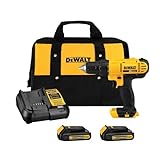


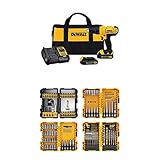
Drill options for cabinet building
| Option | Best for | Trade-off |
|---|---|---|
| 12V drill/driver | Small cabinets, hardware, and occasional assembly | Light and easy to control, but less reserve for large holes or repeated long screws |
| 18V/20V drill/driver | One-tool setup for most plywood cabinet work | More capable, but usually heavier; battery and tool cost can be higher |
| Drill/driver plus impact driver | Frequent cabinet assembly or many long screws | Faster screw driving, but an impact driver is noisier and less gentle on small fasteners |
| Hammer drill | Occasional drilling into masonry as well as wood | Hammer mode adds weight and cost; it is unnecessary for plywood |
A good-value 18V cordless drill/driver kit is usually the sensible starting point if you do not own compatible batteries. Check what the kit includes: some packages have a small battery, a charger, and little else. One battery is workable for a single cabinet, but a second lets you keep going while the first charges.
Do you need an impact driver?
Not for one plywood cabinet. A drill/driver can make pilot holes and drive cabinet screws, especially if you use the clutch and stop when the head seats. An impact driver delivers short rotational blows, which can drive long screws with less reaction twisting at your wrist. It can also snap small screws, damage a driver bit, or pull a head below the surface if you keep pressing after seating.
If you build cabinets regularly, a drill and impact driver combo kit can be convenient: use the drill for holes and delicate fastening, and the impact driver for longer structural screws. For one project, put the money toward sharp bits, clamps, and a suitable square instead.
Bits, speed, and screw control
Use a sharp brad-point or standard twist bit for clean holes, and a countersink bit where screw heads should sit flush. For common cabinet screws, pilot-hole size depends on the screw’s core diameter and the plywood; test on an offcut rather than assuming one size fits every screw. A pilot hole that is too small can split a panel edge or make a screw wander. One that is too large gives the threads little material to grip.
For a clean hole, clamp the work, support the exit side with scrap, and keep the drill square. Start slowly so the bit does not skate across veneer. With a countersink, take off only enough material for the head. Plywood face veneer is thin; an over-deep countersink can expose the next layer and leave a ragged crater.
When driving screws, begin with a low clutch setting and raise it only if the drill stops before the head seats. The numbered clutch settings are not a precise torque scale, so test on scrap. Keep the driver bit fully seated in the screw head and maintain steady pressure. A cam-out—when the bit slips out—can chew up the head or mark the cabinet face. If it happens repeatedly, check that the bit type matches the screw and replace a worn bit.
Battery, size, and handling
For cabinet assembly, weight and balance matter more than an oversized battery. A compact drill is easier to hold straight while working inside a cabinet, but very small models may feel strained with a large hole saw or repeated long screws. A 2.0Ah battery is generally adequate for a modest cabinet; higher amp-hour ratings provide more runtime, usually with extra size and weight. Keep a spare charged if you are drilling many holes or working away from an outlet.
Try the grip if you can. A drill that feels top-heavy is harder to control in tight corners. A belt hook and work light are useful, but neither is worth choosing a poor drill over. If your other tools already use a battery platform, buying a bare tool can save money—just confirm the battery actually fits that tool’s voltage and generation.
When a hammer drill makes sense
Hammer mode is for drilling masonry, not for plywood. It adds a rapid forward tapping action that helps a masonry bit cut brick or concrete. Leave it off for wood: the extra vibration can make holes rougher and reduce control. If the cabinet is going against a masonry wall and you need to fit wall anchors, a hammer drill may be useful for the wall holes, but use an ordinary drill setting for the cabinet itself. For occasional anchor installation, a basic cordless hammer drill/driver is optional, not a cabinet-building requirement.
A practical buying decision
For a single plywood cabinet, buy or borrow a compact drill/driver with a clutch, two speeds, and a decent chuck. Spend enough to get a reliable battery and charger, but do not pay extra for hammer action unless you also drill masonry. Add an impact driver only if you expect frequent assembly or long screws. The biggest gains in clean results come from clamping the panels, drilling accurate pilot holes, and stopping the screw when it seats—not from choosing the highest-torque tool.