What's inside
As an Amazon Associate I earn from qualifying purchases. This post may contain affiliate links at no extra cost to you.
What we cover
Choose the right tool for the footing
For a few small holes in cured concrete, a cordless hammer drill can do the job. For repeated or large holes, a rotary hammer is usually the better buy: its hammering action is more effective in concrete, so it drills faster and puts less strain on the operator. Don’t choose by voltage alone. Check the drill’s hammer mode, chuck capacity, battery size, and the bit diameter it can handle comfortably.
A hammer drill uses a toothed mechanism to make the bit vibrate rapidly. A rotary hammer uses a piston mechanism that delivers stronger blows. That difference matters in dense footings, especially when drilling holes larger than about 3/8 inch or making several holes in a row. For occasional 1/4-inch holes for small anchors, a competent cordless hammer drill is often enough.
As an Amazon Associate we earn from qualifying purchases at no extra cost to you.
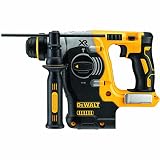


Hammer drill or rotary hammer?
| Tool | Best fit | Trade-off |
|---|---|---|
| 12V hammer drill | Light-duty holes, tight access, occasional work | Limited power and runtime; slow in dense concrete |
| 18V/20V hammer drill | Several small-to-medium holes; general jobsite use | Less effective than a rotary hammer as hole size and count increase |
| 18V/20V rotary hammer | Repeated anchor holes and larger concrete bits | Heavier, costlier, and often overkill for a couple of small holes |
For a one-off project, renting a rotary hammer can make more sense than buying one. If you expect to drill concrete regularly, compare cordless rotary hammers with hammer drills based on the holes you actually make, not the biggest bit listed in the product specifications.
What to look for when buying
Hammer mode and bit capacity: Confirm the tool has a true hammer-drill setting, not just drill and driver modes. A standard three-jaw chuck accepts round- or hex-shank masonry bits. Rotary hammers commonly use SDS-Plus bits, which lock into the chuck and transfer impact energy more efficiently. Check the manufacturer’s recommended maximum concrete drilling diameter; maximum capacity is not a promise of fast drilling.
Battery and weight: An 18V/20V tool with a 4.0Ah or larger battery is a practical starting point for a run of footing holes. A compact battery saves weight but may run down quickly under sustained hammering. A heavy battery can help balance a larger drill, but adds fatigue when working overhead or at arm’s length. If you already own batteries in a tool platform, staying with it may be cheaper than buying into a new one.
Clutch, side handle, and control: A side handle helps control the drill if a bit catches. Use it. A clutch is mainly for driving fasteners; it does not replace a steady two-handed grip while drilling. A variable-speed trigger helps start accurately, but don’t creep so slowly that the bit rubs without cutting.
Use the right bit and anchor
Use a carbide-tipped masonry bit rated for hammer drilling, in the diameter and type specified for the anchor. A wood or metal bit will not cut concrete properly. For a sleeve, wedge, or concrete screw anchor, follow the package instructions for hole diameter and depth. Many small anchors need a hole only a few inches deep, but the correct depth depends on the anchor, embedment, and footing dimensions.
For a clean hole, mark the depth on the bit with tape or use a depth stop. Drill slightly deeper than the anchor’s required embedment only if the anchor instructions allow room for concrete dust. Clear dust from the hole as directed; packed dust can prevent an anchor from seating fully. A small hand pump or vacuum is more reliable than blowing dust toward your face.
For occasional holes, carbide-tipped masonry bits are inexpensive and widely available. For repeated holes or rotary-hammer use, buy bits with the correct shank and a quality carbide tip. A worn or overheated bit drills slowly and can wander.
Drill safely into a footing
Before drilling, locate buried utilities and check whether the footing contains reinforcing steel. If plans are available, use them; a suitable scanner can help identify metal, but readings are not infallible. Don’t blindly drill through rebar or near the footing edge. Rebar provides structural strength, and a hole too close to an edge can cause cracking or spalling. If the footing’s design or reinforcement is uncertain, ask the project engineer or a qualified contractor before changing it.
Wear safety glasses and hearing protection. Concrete dust contains respirable silica, so use dust extraction or a suitable vacuum attachment and follow current workplace or local safety guidance. Avoid dry sweeping. Keep both hands on the tool, stand square to the work, and brace yourself so a binding bit does not twist your wrist.
Start the hole slowly with the bit held perpendicular to the surface. Once the tip is established, use steady pressure and let the hammer mechanism work. Excess pressure can stall the drill, overheat the bit, or drain the battery without improving the cut. Pull the bit out periodically to clear dust, especially in deeper holes. If the hole stops progressing, pause and check for a worn bit, packed dust, or a rock-hard aggregate—not just a low battery.
When to step up to a rotary hammer
Choose a cordless SDS-Plus rotary hammer if the job calls for many holes, larger anchors, or frequent drilling into dense concrete. It costs more and is bulkier, but it generally makes concrete drilling less laborious. For two or three small holes, a good hammer drill and a fresh masonry bit are the cheaper, sensible choice. If the drill is taking several minutes per hole, repeatedly overheating, or struggling to maintain progress, stop and change tools rather than forcing it.