We research everything we recommend. When you buy through our links, we may earn a commission. As an Amazon Associate we earn from qualifying purchases.
Best Cordless Ratchets for Automotive and Shop Work
Compare the best cordless ratchets by torque, speed, drive size and battery platform, with five picks for automotive and shop fastener work.
As an Amazon Associate I earn from qualifying purchases. This post may contain affiliate links at no extra cost to you.
⭐ Key Takeaways
Quick answer: Our top pick is Milwaukee M12 FUEL 3/8 in. High Speed Ratchet — The Fastest Spin on 12 Volts, with DeWalt 20V MAX XR 3/8 in. and 1/2 in. Sealed Head Ratchet — The Torque Leader as a strong alternative.
A cordless ratchet is the tool that turns the long, tedious fasteners, the row of intake bolts, the panel screws, the hose clamps, the trim fasteners, that a hand ratchet would take all afternoon to run down and that an impact wrench would be the wrong tool for entirely. It does not break bolts loose and it does not set final torque. It spins fasteners on and off quickly once they are loose, in spaces where a hand ratchet has no swing room and where a drill driver cannot reach. The current generation of cordless ratchets has settled into a clear shape: a slim in-line body, a small ratchet head, a variable-speed trigger, and a battery platform borrowed from the maker’s drill and driver line. What separates one cordless ratchet from another is no longer whether it exists, because every major platform now has one, but how much torque it makes, how fast it spins, which drive sizes it covers, and whether it arrives as a bare tool or a complete kit. This guide compares five cordless ratchets currently sold on Amazon and judges them on those criteria, using each maker’s published specifications.
The short answer is that the DeWalt 20V MAX XR ratchet is the most capable tool in the group, pairing the highest torque here with interchangeable 3/8 inch and 1/2 inch drives and a sealed head built for automotive fluids. The Milwaukee M12 FUEL high-speed ratchet answers with the fastest spin in this guide and the lightest 12 volt platform, trading torque for speed and reach. The Makita 18V LXT ratchet is the versatility pick, with interchangeable 3/8 inch and 1/4 inch anvils, the widest speed range, and a manual-ratchet mode that lets it finish a fastener by hand. The CRAFTSMAN V20 ratchet is the budget route into a 20 volt system, a straightforward 3/8 inch tool with a bright work light. The ACDelco G12 kit is the only complete package here, arriving with a battery, a charger, and an eight-piece socket set for buyers who own no platform at all. Every figure below comes from the maker’s published specifications and the Amazon listing for each product, and where those sources disagree, the disagreement is flagged rather than smoothed over.
As an Amazon Associate, we earn from qualifying purchases.
DeWalt 20V MAX XR 3/8 in. and 1/2 in. Sealed Head Ratchet
75 ft-lb
The highest torque and two drive sizes
3
Makita 18V LXT 3/8 in. and 1/4 in. Ratchet
35 ft-lb
Dual drives, manual mode, and the widest speed range
4
CRAFTSMAN V20 3/8 in. Ratchet
35 ft-lb
The budget entry to a 20 volt system
5
ACDelco G12 12V 3/8 in. Ratchet Kit
45 ft-lb
The complete kit for buyers with no platform
Tier key: the Milwaukee and the DeWalt sit in the premium tier of this group, the Makita is mid-range, and the CRAFTSMAN and the ACDelco are the budget picks. Tier here describes where each ratchet sits in this lineup on torque, speed, motor type, and included hardware, not a promise about what any seller charges on a given day.
A cordless ratchet is a bare tool bolted onto a battery ecosystem, and the ecosystem is the expensive half of the purchase. Four of the five ratchets in this guide are sold as tools only, with no battery and no charger in the box, so the real question is which batteries already live in your shop. A buyer holding Milwaukee M12 packs, DeWalt 20V MAX packs, Makita LXT packs, or CRAFTSMAN V20 packs should start inside that platform and only cross-shop if the in-platform ratchet is genuinely wrong for the work. The ACDelco is the exception: it arrives as a complete kit with its own 12 volt battery and charger, which makes it the natural pick for a buyer who owns no cordless platform at all, and a poor fit for anyone already invested in one of the big four. Ratchets are light on battery draw compared with grinders and saws, so a compact pack is enough for a full session of fastener work, and the platform question here is about the shelf, not about runtime. Choose the platform for the whole tool collection, then choose the ratchet inside it.
Torque and speed pull in opposite directions
The sharpest line in this class runs between torque and speed, and no ratchet here leads on both. The DeWalt makes 75 ft-lb, more than double any other pick, and spins at up to 300 RPM. The Milwaukee makes 35 ft-lb and spins at up to 450 RPM, the fastest in this guide. The Makita makes 35 ft-lb and spins faster still on paper, up to 800 RPM, though that figure is the no-load ceiling of a tool that also does careful low-speed work. The ACDelco makes 45 ft-lb at a deliberate 170 RPM. The trade is physical: a ratchet that turns a fastener quickly gives up leverage, and a ratchet that pulls hard turns slowly. For long threaded fasteners, panel bolts, and trim screws, speed is the feature that saves the afternoon, and the Milwaukee and Makita earn their places on it. For stubborn fasteners that need a pull before they spin, torque is the feature that matters, and the DeWalt is the only pick here that answers it. Buyers should be honest about which half of the job dominates their work, because the tool that wins on one axis loses on the other.
Drive size: one anvil or two
Three of the five ratchets here cover more than one drive size, and the difference is worth real money. The DeWalt ships with interchangeable 3/8 inch and 1/2 inch anvils, so one tool covers the two most common socket sizes in automotive work. The Makita ships with interchangeable 3/8 inch and 1/4 inch anvils, which covers small fasteners and trim work alongside standard sockets. The CRAFTSMAN is listed as a 3/8 inch tool, though some coverage of the V20 ratchet family describes a multi-size version with three interchangeable anvils; the listing pinned in this guide is the 3/8 inch bare tool, and buyers who want the multi-size variant should confirm the anvil set on the live page before ordering. A single-drive ratchet is not a defect, the Milwaukee and the ACDelco are both 3/8 inch only and both are honest tools, but a buyer whose socket collection spans sizes should weight the interchangeable anvil heavily, because it replaces a second tool purchase outright.
Head size, length, and the tight-space test
A cordless ratchet earns its keep in spaces where nothing else fits: behind an engine, inside a cabinet, under a dash, between framing members. The numbers that decide that fit are head height, head length, and overall tool length. The Milwaukee is the compact pick of the group, a 12 volt tool built around a slim head that reaches where 18 and 20 volt tools cannot. The Makita is the longest tool here at about 14 and a half inches, which reads as a disadvantage until the reach is needed, because a longer ratchet reaches a fastener a shorter one cannot touch at all. The DeWalt is the heaviest at 3.1 pounds, a fair trade for its torque and sealed head but a real consideration for overhead work. Four-position rotating heads, a feature of the Ryobi ratchet family that is not represented among these five picks, are the other answer to the same problem, and buyers who work mostly in engine bays should know that option exists even though no Ryobi model made this lineup. Measure the tightest space the tool must enter before choosing, because a ratchet that cannot reach the fastener is a paperweight no matter how strong it is.
Bare tool or kit: read the box, not the headline
The most common buying mistake in this class is ordering a bare tool and discovering the battery and charger are sold separately. Four of the five picks here are bare tools, and the listings say so plainly, but the headline rarely does. The Milwaukee, DeWalt, Makita, and CRAFTSMAN all arrive as the tool alone, and each needs a battery from its own platform before it will turn. The ACDelco kit is the mirror image: ratchet, battery, charger, and eight sockets in one box, ready to work. Neither arrangement is better in the abstract. A bare tool is the right purchase for a shop that already owns the platform, and a kit is the right purchase for a first tool on a new platform. The mistake is paying for the wrong one, so confirm the box contents on the live page, not the product title, before ordering.
Manual mode and the torque-wrench rule
Two features separate the thoughtful picks from the plain ones. The Makita can be used as a manual ratchet after the power is off, which means a fastener can be broken loose or snugged by hand without switching tools, and the DeWalt’s sealed head is built to keep automotive fluids and solvents out of the mechanism. Neither feature shows up in a torque figure, and both matter daily. The rule that governs all five picks is the same: a cordless ratchet is a fastener spinner, not a torque wrench. Every maker states it in some form, and the practice is simple. Break a tight fastener loose by hand first, let the ratchet run it out, run the new fastener in with the ratchet, and finish it with a calibrated torque wrench whenever the specification matters. A ratchet used as a breaker bar is a ratchet waiting for a broken head, and a ratchet used as a torque wrench is a fastener waiting to fail.
The 5 Best Cordless Ratchets
1. Milwaukee M12 FUEL 3/8 in. High Speed Ratchet — The Fastest Spin on 12 Volts
Top Pick
1. Milwaukee M12 FUEL 3/8 in. High Speed Ratchet — The Fastest Spin on 12 Volts
The Milwaukee M12 FUEL high-speed ratchet leads this guide on speed. Its PowerState brushless motor turns the 3/8 inch drive at up to 450 RPM, the fastest spin here, while holding 35 ft-lb of maximum torque. The 12 volt M12 platform keeps the tool slim and light, and the variable-speed trigger lets the operator feather the speed for starting a fastener and pull full throttle once it is running. An LED work light sits at the head, and the tool is sold bare, with no battery or charger in the box. The listing data behind this pick is the tool-only 2567-20, and the kit version with two batteries, a charger, and a bag is a separate listing that was not used here.
The Milwaukee earns its place on speed and size. Four hundred and fifty RPM is the difference between a ratchet that runs a long bolt down in seconds and one that takes its time, and on a row of fasteners that difference compounds across the job. The 12 volt platform is the other half of the appeal: the tool is slim enough for engine bays and cabinet interiors where an 18 or 20 volt ratchet is a tight fit, and the M12 battery system is one of the deepest compact lines in the trade. The honest limitation is torque. Thirty-five ft-lb is the lowest figure in this guide alongside the Makita and the CRAFTSMAN, and a fastener that needs a real pull before it turns will stall this tool. It is also a bare tool, so the purchase assumes M12 batteries already on the shelf. Buyers inside the M12 system who run long fasteners in tight spaces are the audience, and for them this is the ratchet the rest of the group is measured against.
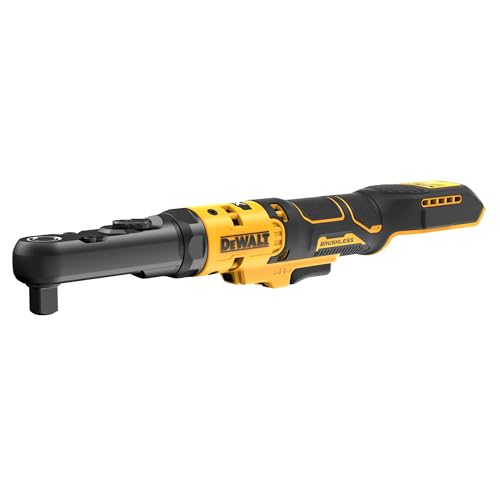
2. DeWalt 20V MAX XR 3/8 in. and 1/2 in. Sealed Head Ratchet — The Torque Leader
Runner-Up
2. DeWalt 20V MAX XR 3/8 in. and 1/2 in. Sealed Head Ratchet — The Torque Leader
Platform: DeWalt 20V MAX
Motor: brushless
Drive sizes: 3/8 in. and 1/2 in., interchangeable anvils
The DeWalt 20V MAX XR ratchet is the strongest tool in this guide by a wide margin. Its brushless motor delivers 75 ft-lb of maximum torque at up to 300 RPM, more than double any other pick, and it does so through a sealed head with interchangeable 3/8 inch and 1/2 inch anvils, so one tool covers the two drive sizes that dominate automotive work. The glass-filled nylon housing is built to shrug off oils and solvents, and the head is sealed against the fluids that kill lesser ratchets in engine bays. The tool weighs 3.1 pounds and is sold bare, with no battery or charger in the box. The listing pinned here is the bare-tool DCF510B, and the kit version with a battery and charger is a separate listing that was not used.
The DeWalt earns its place on torque and versatility. Seventy-five ft-lb is not a marginal lead, it is a different class of capability, and it is the only figure here that lets a cordless ratchet pull a fastener that a hand ratchet would struggle with. The interchangeable anvils are the second reason: a buyer who would otherwise need two ratchets, one for 3/8 inch sockets and one for 1/2 inch, gets both in one tool. The limitations are weight and platform. At 3.1 pounds it is the heaviest tool here, and overhead work will feel it. It is also a bare tool on the 20V MAX platform, so the purchase assumes DeWalt batteries already on the shelf. For a 20V MAX shop that works on vehicles, this is not the compromise pick; it is the platform’s full answer, and the choice between it and the Milwaukee is really a choice between torque and speed.
3. Makita 18V LXT 3/8 in. and 1/4 in. Ratchet — The Versatility Pick
The Makita 18V LXT ratchet takes a different path through the same problem. Instead of chasing the highest torque, it covers the widest range of work: interchangeable 3/8 inch and 1/4 inch anvils, a variable-speed motor that runs from a crawl to 800 RPM, a manual-ratchet mode that lets the tool finish a fastener by hand after the power is off, and an electric brake that stops the drive promptly when the trigger is released. The motor delivers 35 ft-lb of maximum torque, and the tool weighs 2.7 pounds with a battery fitted. The overall length is about 14 and a half inches, the longest in this guide, which is reach rather than bulk. The listing pinned here is the tool-only XRW01Z, and the kit version with a battery and charger is a separate listing that was not used.
Specs
Platform: Makita 18V LXT
Motor: brushless
Drive sizes: 3/8 in. and 1/4 in., interchangeable anvils
Max torque: 35 ft-lb
No-load speed: up to 800 RPM
Manual mode: works as a hand ratchet with power off
Brake: electric brake stops the drive on trigger release
Length: about 14.5 in.
Weight: 2.7 lb with battery fitted (maker’s figure)
Included: ratchet and both anvils; tool only, battery and charger sold separately
The Makita earns its place for the breadth of work it covers. The dual anvils mean one tool handles standard sockets and small fasteners alike, the manual mode means a fastener can be broken loose or snugged without a second tool in hand, and the 800 RPM ceiling is the fastest spin in this guide for running long fasteners down. The trade-offs are torque and length. Thirty-five ft-lb is the lowest figure here, shared with the Milwaukee and the CRAFTSMAN, and the tool is long enough that a buyer should measure the tightest space it must enter before ordering. Buyers inside the LXT system who want one ratchet for everything from trim screws to standard sockets are the audience; buyers who need a hard pull on stubborn fasteners should take the DeWalt instead.
Best for: LXT shops; mixed work where dual drives, manual mode, and top speed in one tool matter most.
Think twice if: your fasteners need breakaway torque; your tightest spaces are shorter than this tool.
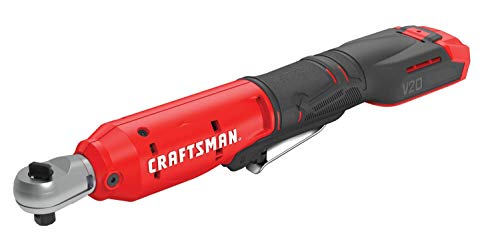
4. CRAFTSMAN V20 3/8 in. Ratchet — The Budget Entry
4. CRAFTSMAN V20 3/8 in. Ratchet — The Budget Entry
The CRAFTSMAN V20 ratchet is the honest minimum of the class: a brushed motor turning a 3/8 inch drive at up to 300 RPM, with 35 ft-lb of maximum torque, a variable-speed trigger, and an LED work light, sold as a bare tool on the V20 platform. It makes no claim to brushless efficiency, sealed heads, or interchangeable anvils, and its specification does not pretend otherwise. What it offers is the core ratcheting capability at the budget tier of this lineup, on a battery platform that covers the rest of a home shop’s drills, drivers, and saws. The listing data behind this pick is the bare-tool CMCF930B, and the kit version with a battery and charger is a separate listing that was not used. One flag for buyers: some coverage of the V20 ratchet family describes a multi-size version with three interchangeable anvils and a higher torque figure, and the listing pinned here is the 3/8 inch tool rated at 35 ft-lb, so confirm the anvil set on the live page before ordering.
The CRAFTSMAN earns its place for the buyer whose ratchet comes out a few times a month: running trim screws, assembling furniture, servicing a mower, turning the fasteners on a project car. For that duty cycle, the missing features are missing features rather than missing necessities, provided the basics are respected, break fasteners loose by hand first, and finish torque-critical work with a torque wrench. The limitations are structural. A brushed motor draws harder for the same work and gives up runtime against every brushless tool here, and 35 ft-lb is the floor of this guide. Buyers who find themselves ratcheting weekly will outgrow it, and the mid-range picks above are where they will land. As a first ratchet on an existing V20 shelf, though, it is a rational purchase rather than a false economy.
5. ACDelco G12 12V 3/8 in. Ratchet Kit — The Complete Package
5. ACDelco G12 12V 3/8 in. Ratchet Kit — The Complete Package
The ACDelco G12 ratchet is the only complete package in this guide, and that is its whole argument. The box holds the 12 volt ratchet, an interchangeable 12 volt lithium-ion battery, a fast charger, and an eight-piece SAE socket set, so a buyer with no cordless platform at all can open the box and start work. The tool itself delivers 45 ft-lb of maximum torque at 170 RPM through a 3/8 inch alloy steel head, with a built-in LED light and a slim, soft-grip body. One flag for buyers: the listing pinned here carries a naming inconsistency, with the title reading one model suffix and the product-information model field reading ARW1209P, so confirm the exact model on the live page before ordering. The kit is the version pinned here, and the tool-only and combo-kit variants are separate listings that were not used.
The ACDelco earns its place for the buyer who owns nothing yet. Forty-five ft-lb is the second-highest torque in this guide, ahead of the three 35 ft-lb tools, and the kit format removes the platform question entirely: no bare-tool surprise, no separate battery purchase, no charger to source. The limitation is speed. One hundred and seventy RPM is the slowest spin here by a wide margin, and on a long fastener the difference against the Milwaukee or the Makita is felt on every turn. The 12 volt system is also a dead end for buyers who later want a full cordless collection, since the G12 line is narrow next to the big four platforms. Buyers who want a ready-to-work ratchet for routine automotive and home repair, and who do not plan to build a platform around it, are the audience; buyers who already own a major platform should buy inside it instead.
Mistakes to Avoid When Using a Cordless Ratchet
The most dangerous ratchet mistake is using it as a breaker bar. A cordless ratchet is built to spin a fastener that is already loose, and forcing it against a seized bolt loads the head mechanism in a way it was not designed for. Break the fastener loose by hand first, then let the ratchet run it out. The second mistake is the mirror image: trusting a cordless ratchet for final torque. No ratchet in this guide sets torque, and a fastener tightened by feel alone is a fastener whose clamp load is a guess; finish torque-critical work with a calibrated torque wrench, every time.
Third is ordering the wrong box. Four of the five picks here are bare tools, and the buyer who orders one without a battery from the same platform owns a tool that will not turn. Confirm the box contents on the live page, not the product title, before ordering. Fourth is the wrong socket habit: running a chrome hand socket on a power tool, or a shallow socket on a fastener that needs depth, and then blaming the ratchet when the socket cracks or the fastener rounds. Use sockets made for power-driven work, seat them fully on the anvil, and replace any socket with a cracked wall. Fifth is ignoring the head: a ratchet head packed with grit and metal dust wears faster and binds sooner, so blow the head out after dirty work and keep the tool out of the parts washer. Sixth is the battery habit that follows every cordless tool, forcing work as the pack fades. A slowing ratchet stalls more easily, and a stalled ratchet invites the operator to lean on it by hand, which is the breaker-bar mistake again; swap the pack instead.
Care, Setup, and Safety Checks
A cordless ratchet asks for little maintenance, and most of it is inspection. Before each session: check that the anvil is seated and the socket retention is sound, since a loose socket is a dropped socket in an engine bay; confirm the forward and reverse selector moves cleanly and locks in position; check the battery latch, because a pack that rocks in the shoe will cut out under load; and run the tool briefly with the head pointed away to confirm the trigger and brake behave normally. Keep the vents clear, because shop dust is abrasive, and blow the tool out after dusty work rather than letting the dust cake inside. Store the tool with the battery removed, and store sockets in the set they came from so the right size is the one in hand.
The recall history of this product class is worth knowing precisely, because the adjacent records are easy to misread and none of them touches the five cordless picks in this guide. No CPSC recall covers cordless ratchets as a class, and none covers any of the five picks or their makers’ ratchet lines. The records that do exist sit one step to the side. In July 2025, the U.S. Consumer Product Safety Commission announced a recall of about 17,680 DeWalt Elite Series flap discs, abrasive accessories with certain late-2024 production date codes, because the disc’s retaining ring could break and release the grinding surface; that recall covers flap disc accessories, not DeWalt ratchets, and it is a reminder to check accessory date codes, not a mark against the XR tool above. Two older recalls cover corded grinders: in May 2016, about 91,000 Bosch 1380 Slim corded 4-1/2 inch grinders were recalled because the tool could overheat, and in December 2017, about 1,100 corded Metabo rat tail grinders were recalled because the switch could lock in the on position. Both are corded models from a decade ago; neither involves any cordless tool sold today. Note also that Metabo HPT, the brand formerly sold as Hitachi, is a separate company from Metabo, and the Metabo recalls say nothing about Metabo HPT tools. A 2017 recall of about 46,000 Rexon-made Craftsman 10 inch portable table saws, sold on folding stands that could collapse, is a table saw record, not a ratchet record, and it says nothing about the V20 ratchet above. Battery packs have their own history: in 2007 the CPSC announced a recall of about one million Milwaukee Power Plus, Chicago Pneumatic, and Extractor 14.4 and 18 volt nickel-cadmium packs, made between 1999 and early 2004, because a damaged cell vent could let a pack burst, and in 2017 Milwaukee added new warnings and instructions for its M18 HD 9.0 battery packs. Those are pack records, not tool records, and they cover battery chemistries and vintages no current ratchet ships with. Buyers shopping used ratchets should run the model against the CPSC database before first use, as with any secondhand power tool.
Frequently Asked Questions
Can a cordless ratchet break loose a rusted bolt?
No, and it should not be asked to. A cordless ratchet is built to spin a fastener quickly once it is loose, and forcing it against a seized bolt loads the head mechanism beyond its design. Break the fastener loose by hand with a breaker bar or a hand ratchet first, then let the cordless ratchet run it out. The DeWalt in this guide makes the most torque at 75 ft-lb, and even that figure is a spinning rating, not a breakaway rating.
Should I buy a bare tool or a kit?
Buy the bare tool if you already own batteries on that platform, and buy the kit if you do not. Four of the five picks here are bare tools, and each needs a battery from its own platform before it will turn. The ACDelco is the only complete kit in this guide, with a battery, a charger, and eight sockets in the box, which makes it the natural pick for a buyer starting from nothing. Confirm the box contents on the live page before ordering, because the headline rarely says which one it is.
What drive size do I need?
A 3/8 inch drive covers most automotive and shop fastener work, and all five picks here are 3/8 inch tools at heart. The DeWalt adds a 1/2 inch anvil for larger sockets, and the Makita adds a 1/4 inch anvil for small fasteners and trim work, so buyers whose socket collection spans sizes should weight those interchangeable anvils heavily. A single-drive ratchet is not a defect, but it is a narrower tool, and the second drive size is the cheapest versatility in this guide.
Can I use a cordless ratchet instead of a torque wrench?
No. A cordless ratchet spins fasteners on and off; it does not measure or limit torque. Every fastener whose specification matters, wheel hardware, engine fasteners, structural bolts, should be finished with a calibrated torque wrench after the ratchet has run it in. The Makita’s manual mode helps here, since a fastener can be snugged by hand before the torque wrench takes over, but the torque wrench is still the tool that sets the number.
Conclusion
The right cordless ratchet is the one that matches your battery shelf first and your torque-versus-speed needs second, because the drive sizes in this class have converged and the platforms have not. The DeWalt 20V MAX XR is the complete package, the highest torque, two drive sizes, and a sealed head, for 20V MAX shops that work on vehicles. The Milwaukee M12 FUEL answers it on speed and size, the fastest spin in this guide on the slimmest platform, for M12 shops that run long fasteners in tight spaces. The Makita is the ratchet’s ratchet, dual drives, manual mode, and the widest speed range, tuned for mixed work on the LXT platform. The CRAFTSMAN covers occasional work on the V20 platform at the budget tier with the fundamentals intact, and the ACDelco is the ready-to-work kit for buyers who own no platform at all. Whichever tool you choose, break fasteners loose by hand first, confirm the box contents before ordering, and finish torque-critical work with a torque wrench. A ratchet rewards respect more reliably than any other tool in the shop.
M
Miller the Driller Editorial Team
We compare specs, warranty terms, long-term owner feedback and street pricing before anything earns a spot. Rankings are never paid.
Affiliate disclosure. As an Amazon Associate we earn from qualifying purchases at no extra cost to you. Prices accurate as of the date shown.
Three wireless routers for small offices compared on device capacity, network separation, wired speed, and coverage, with specs taken from their Amazon listings.
Compare 5 mechanic tool sets for car repairs: a 247-piece DEWALT kit, a 450-piece CRAFTSMAN set, a drawer-box GEARWRENCH set, a 170-piece Crescent set and a 450-piece WORKPRO set.
Four splitting axes and mauls that actually split firewood: a long 36-inch axe for tall users, a shorter 28-inch option, and two 8 lb mauls for knotty rounds.
Learn whether a 20V rechargeable drill battery can be repaired, which faults you can check safely at home, and when replacing the pack is the safer choice.
A specs-based review of the officially licensed Retro-Bit Sega Saturn 2.4 GHz wireless controller: dual receivers, Genesis Mini and Switch support, battery, layout, limits, and FAQs.
Find the best drill battery for Power Wheels ride-on toys for families, with DeWalt, Milwaukee and Ryobi adapters, voltage and safety guidance in this guide.
Find the best hole saw for noching dom pipe: bi-metal saws, deep cups, and the right sizes for clean, tight notches in DOM tube for fabrication shops today.
Find the best diy tile saws for home tiling projects. Compare wet tile saws by blade size, cutting capacity, and features for ceramic and porcelain tile.


 5. ACDelco G12 12V 3/8 in. Ratchet Kit — The Complete Package









