What's inside
As an Amazon Associate I earn from qualifying purchases. This post may contain affiliate links at no extra cost to you.
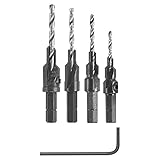
The right countersink set lets a wood screw sit flush without splitting the work or leaving a ragged cone around the head. For most home workshops, the useful choice is a set with a drill bit and adjustable countersink cutter for each common screw size. A fixed-flute countersink set is a simpler, cheaper option if you already drill pilot holes separately.
As an Amazon Associate we earn from qualifying purchases at no extra cost to you.


What we cover
What to look for in a set
Start with the screws you use. Countersinks are sized to match screw-head diameter, not just shank size. A cutter that is too small leaves the head proud; one that is too large creates an oversized crater and weakens the wood around the screw. If possible, test the bit against an actual screw before buying.
For routine woodworking, look for three to five bits covering common screw sizes, a depth stop or adjustable cutter, and a standard round shank that fits your drill chuck. A replaceable pilot drill is useful: pilot bits take the most abuse, and replacing one is cheaper than replacing the whole tool. If you work with hardwood or need repeatable results, consider a set with a stop collar or a separate depth-stop attachment.
Many sets are sold in high-speed steel (HSS), sometimes with a coating. HSS is adequate for occasional work in pine, plywood, and other softwoods. Cobalt or carbide is rarely necessary for ordinary countersinking in wood; sharpness, geometry, and sensible feed pressure matter more. Coatings can reduce friction, but they do not make a dull or poorly sized cutter behave well.
Main set types compared
| Type | Best for | Trade-off |
|---|---|---|
| Adjustable countersink with pilot drill | Drilling a pilot and recess in one setup | More convenient, but the cutter can slip out of adjustment if not tightened firmly |
| Fixed countersink cutter | Occasional shallow recesses in predrilled holes | Simple and inexpensive, but does not drill the pilot hole |
| Stop-collar or depth-stop set | Repeated holes with consistent head depth | More control, though setup takes time and collars can mark delicate surfaces |
| Combination countersink and plug cutter set | Concealing screws with wood plugs | Versatile, but costs more and takes extra steps to fit and trim plugs |
Which category is worth buying?
For a first set, an adjustable multi-size set is the most practical choice. It combines pilot drilling and countersinking, reducing tool changes when driving a row of screws. Check that the set covers the screws you actually own; a large bit count is not useful if the pilot diameters do not match your fasteners. Browse adjustable countersink drill bit sets for wood and compare pilot sizes, cutter adjustment, and included spares rather than relying on the piece count.
If you only countersink a few screws now and then, a basic HSS fixed cutter is often enough. Drill the pilot hole with a separate bit, then use the countersink lightly. You avoid paying for adjustment hardware you may never use, and a fixed cutter has fewer parts to loosen. This is a sensible low-cost choice for shelving, small repairs, and occasional trim work.
For cabinets, furniture, or other work where many heads need to finish at the same depth, buy a set with a depth stop or use a drill stop collar. A stop improves consistency, but it does not replace a test hole: wood hardness, screw-head shape, and drill speed still affect the finish. See wood countersink sets with depth stops if repeatable recesses are a priority.
How to get a clean, flush result
Use the correct pilot size for the screw and material. As a starting point, the pilot should be close to the screw’s shank diameter in hardwood, while softwood often allows a slightly smaller hole. The screw’s threaded portion still needs to bite; an oversized pilot can leave it loose. For a screw passing through one board into another, make a clearance hole in the first board so the threads do not pull the pieces apart.
Set the countersink depth with a test piece from the same material. The screw head should finish flush or just below the surface, not buried deep enough to crush the fibers. Use a slow-to-moderate drill speed and light pressure. Let the cutter remove material rather than forcing it. A cordless drill’s clutch is useful for driving screws, but countersinking is usually easier with the drill in its drilling setting and steady hand pressure.
On a variable-speed drill, start slowly to keep the bit centered. A countersink that wobbles can make an uneven recess, especially in thin stock. Clamp the work when possible. If the cutter chatters or leaves a rough rim, it may be dull, packed with chips, or spinning too fast. Stop, clear the flutes, and try again on scrap. A brief hand turn with the bit can clean up a tiny burr, but it will not fix an oversized or off-center hole.
Common mistakes and limits
Do not assume a countersink automatically prevents splitting. Near an edge, a pilot hole is still important, and a screw driven too close to the end of a board can split it even with a perfect recess. Move the hole inward, predrill, or use a smaller screw when the design allows. In plywood, keep the cutter shallow: thin face veneers can chip or tear out quickly.
A standard countersink makes a conical recess for a flat-head screw. It is not the right cutter for every fastener. Pan-head and washer-head screws generally sit on top of the surface; countersinking them can reduce bearing area and damage the wood. For very clean exposed work, a countersink bit alone may leave a visible rim. A plug cutter can conceal the head, but adds labor and may not match the grain or color exactly.
When buying, prioritize the right sizes and replaceable pilot bits over a large assortment of accessories. Store the cutters dry and remove wood resin after use. If the set will only see occasional softwood work, a basic fixed cutter is enough. If you need to drill, countersink, and repeat the same depth across a project, an adjustable set with a stop is the more useful upgrade.