What's inside
As an Amazon Associate I earn from qualifying purchases. This post may contain affiliate links at no extra cost to you.
The shank is the part of a drill bit held by the chuck. A round shank is smooth and cylindrical; a hex shank has flat sides, usually in a 1/4-inch profile. Both can work in many cordless drills, but they suit different jobs and chuck types. Choose based on the tool you own, the bit you need, and how often you switch between drilling and driving—not on the assumption that hex is always stronger or faster.
As an Amazon Associate we earn from qualifying purchases at no extra cost to you.


What we cover
Quick comparison
| Feature | Hex shank | Round shank |
|---|---|---|
| Best fit | 1/4-inch hex collets and quick-change holders; also many three-jaw chucks | Three-jaw drill chucks |
| Changing bits | Fast in a compatible quick-change holder | Usually requires loosening and tightening the chuck |
| Common use | Small drilling jobs, pilot holes, and frequent switching to driver bits | General-purpose drilling, larger bits, and wider bit selection |
| Main limitation | Not every hex bit fits every holder; small profiles may be unsuitable for high-torque work | Can slip if the chuck is loose or the shank is oily or worn |
How the shanks fit your drill
A cordless drill with a three-jaw chuck can usually grip both round and hex shanks. The jaws close around the bit, so a hex-shank bit does not automatically turn that drill into a quick-change tool. Tighten the chuck firmly; hand-tightening an ordinary keyless chuck is normally enough, but a poorly seated or loose bit can spin in the jaws.
A 1/4-inch hex quick-change holder is different. It accepts compatible hex shanks and locks them in place, often with a sleeve or retaining mechanism. Many impact drivers have this holder instead of a drill chuck. A round-shank bit will not fit it directly. Some quick-change holders accept only 1/4-inch hex shanks, while others are adapters that fit a drill chuck or hold a specific bit style. Check the tool and bit packaging before buying.
When hex shanks are useful
Hex shanks save time when you move repeatedly between drilling pilot holes and driving screws. For example, on a small assembly job, keep a drill bit in the quick-change holder, then swap to a driver bit without opening a chuck. A short, properly seated 1/4-inch hex bit also tends to resist spinning in a compatible holder better than a smooth round shank can in a poorly tightened chuck.
That convenience is especially useful if you own a drill and an impact driver and want bits that can work across both—provided the drill has a standard chuck and the impact driver’s holder matches the bits. An impact driver delivers rapid rotational impacts, so use bits labeled for impact use when drilling or driving with one. A hex shank by itself does not mean a bit is impact-rated.
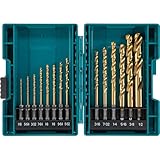
For frequent changes, consider a 1/4-inch hex-shank drill bit set. For occasional holes in wood or soft material, a round-shank bit in the drill you already own may be the cheaper, simpler choice.
When round shanks make sense
Round-shank bits are common in drill-bit sets and come in a broad range of diameters, lengths, and materials. They are a practical default for a standard cordless drill when you need general-purpose bits for wood, metal, or plastic. Larger twist bits and many specialized bits are commonly sold with round shanks, so choosing round does not limit you to small holes or light jobs.
A properly tightened three-jaw chuck can grip a round shank securely for ordinary drilling. If a bit slips, stop the drill, inspect the jaws and shank, clean off oil or debris, reseat the bit, and tighten again. Do not continue drilling with a spinning shank: it can score the bit, heat the chuck, and leave the hole off-center.
If your drill has a three-jaw chuck and you rarely change bits, a basic round-shank twist drill bit set is often the better-value buy. Spending extra for hex shanks will not make holes more accurate or make a blunt bit cut better.
Limits and failure modes to watch for
Shank shape is only one part of bit performance. Diameter, cutting material, flute design, length, and the workpiece matter more to the hole itself. For metal, use a suitable high-speed-steel bit and slower speed with steady pressure. For masonry, use a masonry bit and a hammer drill when the material and tool call for hammer action. Neither an ordinary hex shank nor a round shank makes a standard bit suitable for concrete.
Small 1/4-inch hex shanks are convenient, but they are not the best choice for every large-hole or high-load task. If the bit binds, the shank or bit can twist or break. Reduce pressure, clear chips, and back out periodically when drilling deeper holes. For large hole saws, spade bits, or demanding work, follow the accessory maker’s shank and tool recommendations; a full-size chuck and appropriately rated bit may be a better match.
Also distinguish a hex-shank drill bit from a driver bit. Driver bits are made to engage screw heads, not cut holes. They may fit the same holder, but they cannot replace a drill bit. For drilling and fastening in one session, separate bits—or a combination set with clearly identified drilling and driving accessories—are more useful than choosing a shank by itself.
What to buy for your setup
For a standard cordless drill with a three-jaw chuck, start with round-shank bits if your main goal is economical general drilling. Buy hex-shank bits if rapid changes matter or you also use a compatible quick-change holder. For an impact driver with a 1/4-inch collet, choose compatible hex-shank accessories and check impact-use ratings before applying impact force.
Before ordering, check the largest bit diameter you need, the material you will drill, and whether the bit is intended for a drill chuck or quick-change holder. A well-matched, sharp, securely held round bit is better than a hex bit that does not fit your tool. Conversely, if you change accessories dozens of times a day, the faster swap can justify paying more for hex-shank bits.