What's inside
As an Amazon Associate I earn from qualifying purchases. This post may contain affiliate links at no extra cost to you.
Drilling an angled hole in wood is harder than drilling straight into a flat surface. The bit tends to skate when it first touches the workpiece, then wanders as the flutes cut at an uneven angle. The result can be an oversized entry hole, a splintered surface, or a hole that exits in the wrong place.
The best bit depends on the hole’s diameter, depth, and purpose. For most clean, accurate angled holes, a sharp brad-point bit is the best starting point. Auger bits handle deeper holes, while Forstner bits are better when you need a flat-bottomed hole. A simple drilling guide can matter just as much as the bit.
As an Amazon Associate we earn from qualifying purchases at no extra cost to you.

What we cover
Best drill bit types for angled holes
| Bit type | Best use | Main advantage | Main drawback |
|---|---|---|---|
| Brad-point bit | Clean holes in boards and trim | Center spur resists wandering | Can clog in deep holes |
| Auger bit | Deep holes in framing lumber | Pulls itself through the wood | Can grab and split thin stock |
| Forstner bit | Flat-bottomed holes and large diameters | Clean, controlled cutting | Needs substantial drill torque |
| Standard twist bit | Occasional holes in scrap or softwood | Cheap and widely available | Skates easily at an angle |
| Self-feeding bit | Large holes through structural wood | Fast cutting and strong pulling action | Too aggressive for delicate work |
Brad-point bits: the best general choice
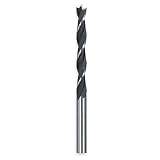
A brad-point wood drill bit set is usually the right purchase for angled holes in furniture parts, cabinet components, shelves, and trim. The sharp center spur locates the hole before the cutting edges engage, reducing the skating common with ordinary twist bits.
Use a bit with a diameter close to the final hole size. For example, a 3/8-inch brad-point bit is preferable to drilling a small pilot hole and then forcing a much larger bit through at an angle. The first method leaves less room for the bit to deflect.
Brad-point bits work especially well in plywood and hardwood when they are sharp. Dull cutting edges create heat and require more pressure, which increases the chance of the bit bending or breaking through the exit side. Back the workpiece with scrap wood if the bit will pass completely through it.
When to choose an auger bit
Choose an auger bit set for wood when the hole is deep, usually more than 2 or 3 inches, or when you are drilling through a joist, post, or heavy framing lumber. The lead screw pulls the bit into the wood, and the wide flutes remove chips efficiently.
That pulling action is useful, but it can also be a problem. An auger can grab suddenly as it breaks through the far side, especially when drilling across the grain. Keep both hands on the drill, reduce speed near the exit, and do not lean your full body weight into the tool.
Augers are not the best choice for thin boards. The lead screw may pull the bit through before the cutting edges have cleared the hole, splitting the workpiece. They also tend to leave a rougher entry than a sharp brad-point bit.
Forstner bits for large or flat-bottomed holes
Forstner bits are useful for angled holes that need a broad, clean opening or a flat bottom. They are common for concealed hinges, cable passages, and recessed hardware. A Forstner bit can cut a cleaner perimeter than a spade bit, but it generally needs more torque and better control.
At an angle, the rim contacts the wood unevenly. Start at a slow speed and use firm, steady pressure. A cordless drill with a side handle is helpful for diameters above 1 inch. Avoid using a small compact drill at maximum load; the motor may stall, and the bit can twist the drill in your hands.
For occasional holes in softwood, a reasonably priced Forstner bit set is fine. Premium bits become worthwhile when drilling hardwood, making many holes, or needing consistent diameters.
Bits that often disappoint
Standard twist bits are convenient, but their pointed geometry is poor for starting angled holes. They can work if you first make a small flat spot or drill a pilot hole perpendicular to the surface, but they are not the most controlled option.
Spade bits are fast and inexpensive for rough holes, especially in framing lumber. However, their flat cutting wings tend to skate at an angle and can tear out a large section around the entry. Use one when appearance does not matter and the hole will be covered by a fitting or grommet.
Self-feeding bits are similarly aggressive. They are suitable for large holes through studs, but excessive pressure can make the bit plunge through suddenly. They are a poor fit for thin panels, finished boards, or holes close to an edge.
How to drill an accurate angled hole
Mark the entry and exit points before drilling. A hole at 30 degrees travels a long distance through the stock, so a small angle error can shift the exit noticeably. On a 3-inch-thick board, changing the angle by only 5 degrees moves the exit by roughly 1/4 inch.
Clamp the workpiece securely. Set the drill to low gear and moderate speed. Start the bit with the drill aligned to the intended angle, using light pressure until the center spur or lead screw is established. Once the bit has cut about 1/8 inch, increase pressure gradually.
For thin material, drill halfway from each side. Measure and mark both faces, then meet in the middle. This prevents the large breakout crater caused when a bit exits unsupported wood. If the hole must be especially accurate, use a scrapwood guide block with a hole drilled at the required angle.
A commercial angled drill guide for woodworking is worthwhile for repeated holes or visible joinery. For one project, a carefully made guide from hardwood or plywood often does the job. Check the guide against a square or protractor before drilling the actual workpiece.
Drill settings and common failures
Use slower speeds for larger bits. As a practical starting point, run a 1/4-inch bit around 1,500 to 2,500 rpm in softwood, a 1/2-inch bit around 800 to 1,500 rpm, and a 1-inch Forstner bit around 300 to 600 rpm. Reduce speed in hardwood and whenever the bit becomes hot.
Stop and clear chips instead of forcing a clogged bit. Excessive pressure usually means the bit is dull, the speed is too high, or the flutes are packed. If the drill begins to twist, release the trigger immediately. Remove the battery before clearing a jammed bit by hand, and wear eye protection because angled drilling can throw chips sideways.
The cheaper option is fine for a few holes in softwood: a sharp brad-point set and a scrapwood backer are often all you need. Spend more on the bit or guide when the hole must be clean, repeatable, deep, or positioned accurately near an edge.