What's inside
As an Amazon Associate I earn from qualifying purchases. This post may contain affiliate links at no extra cost to you.
What we cover
Why melamine chips—and what a bit can fix
Melamine shelving is usually particleboard or MDF with a thin, hard decorative coating. The coating is brittle: a standard twist bit can catch as it breaks through, lifting chips around the hole. The board underneath is softer, so forcing a dull bit or pushing too hard can also tear out the back face.
The bit matters, but so do feed pressure, backing, and hole location. For common shelf-pin holes or hardware holes, a sharp brad-point bit is a good general choice. For larger holes, use a Forstner bit or hole saw suited to the diameter. If you drill only a few small holes, a sharp, inexpensive brad-point bit is often enough; premium bits make more sense for repeated work or a full run of closely spaced holes.
As an Amazon Associate we earn from qualifying purchases at no extra cost to you.
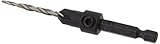


Which bit should you buy?
| Bit type | Best use in melamine | Trade-off |
|---|---|---|
| Brad-point | Small and medium holes, including shelf pins and pilot holes | Centers accurately and cuts a cleaner rim than a general-purpose twist bit; not ideal for very large holes |
| Forstner | Flat-bottomed holes and larger hardware bores | Can leave a clean edge, but needs a steady drill and careful feed; larger sizes work better at lower speed |
| Carbide-tipped hole saw | Large through-holes for cables or fittings | Fast for big holes, but needs backing and can chip the exit face if pushed through carelessly |
| Standard twist | Occasional small holes when already sharp and used with a guide | Usually less clean and less self-centering than a brad point |
For a useful starter set, look for sharp brad-point bits in the sizes you actually need rather than buying a large assortment of unknown quality. A brad-point drill bit set is the practical choice for most shelf work. Check that the set includes the exact diameter required by your shelf pins or fasteners; a bit that is merely close can leave a loose fit.
How to drill a cleaner hole
Mark the hole carefully and clamp the shelf to a stable work surface. Put scrap wood directly under the exit point and clamp it too. Backing supports the fibers as the bit exits, reducing tear-out on the underside. Keep the workpiece flat; a board that shifts or flexes can enlarge the hole or break the surface coating.
For a through-hole, use a sharp bit and moderate, steady pressure. Let the cutting edges do the work rather than leaning hard on the drill. If the bit starts squealing, smoking, or needing more force than expected, stop and check for a dull edge, packed chips, or an unsuitable speed. Excess heat and friction can discolor the laminate or burn the core.
With a brad-point bit, the center spur helps keep the hole on your mark. For a larger hole, a Forstner bit is often easier to control than a large twist bit. A Forstner bit set can be useful if you regularly bore flat-bottomed holes, but it is unnecessary for a few small shelf-pin holes. Use a low or middle drill speed for larger diameters, and clear chips if they pack into the cutters.
Another reliable method is to drill most of the way from one face, then finish from the opposite face using the small exit hole as a guide. This takes more setup, but it can reduce breakout on both faces when backing material is unavailable. It is less convenient for holes that must align precisely across several panels.
Drill settings and useful accessories
Use a regular drill or drill-driver, not hammer mode. Hammering is for masonry and will batter the brittle surface and particleboard core. An impact driver can turn a bit, but its impacts make controlled drilling harder; use a drill for cleaner holes, especially in larger diameters. If using a cordless drill, select the drill setting rather than the screw-driving clutch setting, and keep the tool square to the board.
A simple drill guide helps keep a hand drill perpendicular, especially for a row of shelf-pin holes. A depth stop or tape flag on the bit helps avoid drilling through when you only need a partial-depth hole. For repeatable rows, use a shelf-pin jig and confirm its spacing against your hardware before drilling the whole panel. A shelf-pin drilling jig costs more than a ruler and pencil, but can save time and prevent misaligned holes on multiple shelves.
Common mistakes and fixes
Chipped top edge: The bit may be dull, the feed too aggressive, or the coating unsupported. Replace or sharpen the bit, clamp backing underneath, and ease pressure as the bit approaches the far face. Painter’s tape over the mark can help keep the surface clean, but it does not replace backing or a sharp cutter.
Hole wanders: A twist bit can skate on the smooth surface. Make a small starter dimple without striking hard, use a brad-point bit, or use a guide. Avoid a deep punch mark, which can crack the coating.
Loose shelf pin: Check the specified hole diameter and measure the bit with calipers if fit matters. Do not compensate for an oversized hole with glue unless the pin and shelf design allow it; particleboard does not hold a loose fit reliably.
Burning or rough walls: Stop and clear chips. Reduce speed for large bits, use a sharper cutter, and avoid dwelling in one spot. Melamine’s thin surface can look intact while heat damages the core beneath it.
For a handful of small holes, a sharp brad-point bit, scrap backing, and a steady drill are enough. Buy a jig or larger specialized cutters when the hole pattern, diameter, or volume makes accuracy and repeatability worth the extra cost.