What's inside
As an Amazon Associate I earn from qualifying purchases. This post may contain affiliate links at no extra cost to you.
Thin steel sheet is easy to drill badly. A standard twist bit can make the hole, but it may grab as it breaks through, leave a rough burr, or turn blue from excess heat after only a few holes. The best choice depends mainly on hole size, sheet thickness, and how many holes you need to make.
For most home and workshop jobs, a sharp high-speed steel (HSS) twist bit is the inexpensive answer. A step bit is usually faster and cleaner for larger holes in thin material. Cobalt bits make sense when you are drilling stainless steel or making many holes, but they are not automatically better for ordinary mild-steel sheet.
As an Amazon Associate we earn from qualifying purchases at no extra cost to you.


What we cover
Quick picks
| Job | Best bit type | Why | Main drawback |
|---|---|---|---|
| Small holes up to about 1/4 inch | 135-degree split-point HSS twist bit | Low cost, accurate, available in many sizes | Can dull quickly if run too fast |
| Several sizes or holes from 1/4 to 1-1/4 inches | HSS step bit | One bit covers a range and makes round holes with less grabbing | Each step has a maximum thickness; edges can wear if forced |
| Stainless steel or repeated drilling | Cobalt alloy twist bit | Better heat resistance and longer life | More brittle and more expensive |
| Large holes above roughly 1-1/4 inches | Bi-metal hole saw | Efficient for conduit, pipe, and cable openings | Needs a pilot bit and can catch aggressively |
The best drill bit types for thin steel
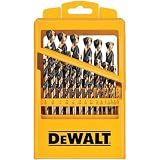
A HSS split-point drill bit set is the best general-purpose purchase. Look for bits labeled HSS, preferably with a 135-degree split point. The split point starts cutting with less wandering than a conventional 118-degree point, especially when you cannot make a center-punch mark. Black oxide or titanium-nitride coatings can improve wear resistance, but coating does not rescue a poor-quality, overheated bit.
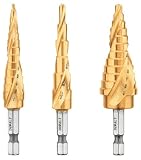
For holes larger than about 1/4 inch, a metal-cutting step drill bit is often the easiest option. It drills a small pilot hole and enlarges it one step at a time. This reduces the tendency of a large twist bit to screw itself into thin sheet. A step bit is also convenient when the exact hole size may change during installation. Check its specifications before buying: many inexpensive step bits are intended for sheet up to 1/8 inch thick, while thicker stock can stop the cutting edge from reaching the next step.
Cobalt bits contain an alloy that tolerates more heat than ordinary HSS. They are useful for stainless steel, harder sheet, or production work where you need repeated holes. They are not a license to drill at high speed. Cobalt is harder but more brittle, so side-loading, dropping the bit, or using it in a crooked hand-held drill can chip the cutting edge. For a few holes in mild steel, a good HSS set is usually the better value.
Use a bi-metal hole saw for large openings. The teeth cut a ring rather than removing the entire center, which is much faster than trying to enlarge a hole with a twist bit. Clamp the sheet securely and use the saw’s pilot bit carefully; once the pilot breaks through, the hole saw can grab if the drill is tilted.
How to drill thin steel without ruining the bit
Mark the location, then center-punch it. A small dimple keeps the tip from skating and is more reliable than tape alone. Support loose sheet with a sacrificial board behind it. This reduces vibration and helps prevent the bit from pulling a ragged slug upward as it exits.
For a hole larger than 3/16 inch, drill a small pilot hole first unless you are using a step bit. A pilot around 1/8 inch is adequate for many sheet-metal jobs. Do not use a tiny pilot if it will be larger than the first cutting step of your step bit; the bit may skip over that step and fail to cut cleanly.
Run a cordless drill in its low-speed range when the bit is larger than about 1/4 inch. Typical starting speeds for mild steel are approximately 1,500 to 2,000 rpm for a 1/8-inch bit, 800 to 1,200 rpm for a 1/4-inch bit, and 300 to 600 rpm for a 1/2-inch bit. These are useful starting points, not rigid rules. If the bit squeals, smokes, turns blue, or produces fine powder instead of curled chips, reduce speed and add pressure or cutting fluid.
Use a few drops of cutting oil on ordinary steel. For stainless steel, use cutting fluid and keep the bit cutting continuously. Stainless work-hardens when a dull bit rubs without cutting; once that hardened spot forms, a smaller amount of pressure will not fix it. Stop, let the work cool, and use a sharp bit at a controlled speed.
Choosing the drill and controlling the work
A regular cordless drill is the right tool for most sheet steel. Use the clutch only if it helps you avoid overdriving a small bit; drilling normally requires the drill’s full trigger range and a firm two-handed grip. A hammer drill’s hammer function should be switched off. Hammering does nothing useful for steel sheet and can damage the bit or make the hole wander.
An impact driver can turn hex-shank bits, but it is a poor first choice for thin sheet. Its impacts increase the chance of cracking a step bit, enlarging the hole, or catching the workpiece. If you already own one, use compatible hex-shank HSS bits at low speed and light pressure, and reserve it for occasional small holes rather than precision work.
Clamp the sheet or secure it with a vise. Never hold a loose piece in your hand while drilling. A spinning sheet can wrap around the bit and cause a severe cut. Wear eye protection, remove the sharp burr with a deburring tool or a larger twist bit turned by hand, and clean away metal chips with a brush rather than your fingers.
What to buy for common projects
For occasional brackets, electrical boxes, and hardware, buy a quality HSS split-point set covering 1/16 to 1/2 inch, plus cutting oil. If you frequently install conduit, cable glands, or plumbing fittings, add a step bit for steel sheet. Choose one with clearly marked sizes and a shank that fits your drill chuck.
Buy cobalt only when the material or workload justifies it. For stainless sheet and dozens of holes, a cobalt metal drill bit set can outlast cheaper bits. For three or four holes in mild steel, replaceable inexpensive HSS bits are usually the more sensible choice. Sharpness, correct speed, firm support, and cutting fluid matter more than an expensive coating.