What's inside
As an Amazon Associate I earn from qualifying purchases. This post may contain affiliate links at no extra cost to you.
Thin zinc-coated steel—galvanized sheet, flashing, ductwork, or light-gauge panels—doesn’t need a specialty drill. A sharp bit, low speed, and steady pressure matter more than a high-powered cordless drill. The main challenge is keeping the bit from skating across the slick coating, then avoiding a ragged hole or a damaged zinc layer around it.
As an Amazon Associate we earn from qualifying purchases at no extra cost to you.


What we cover
Best bit types for thin steel
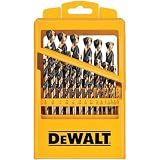
For occasional holes in sheet metal up to about 1/8 inch thick, a sharp high-speed steel (HSS) twist bit is the economical choice. A standard HSS bit works, but a split point—usually 135 degrees—starts more reliably on smooth metal than a conventional 118-degree point. Cobalt HSS bits cost more and hold their edge better when drilling harder steel or making many holes; for a handful of holes in ordinary galvanized sheet, they are usually unnecessary.
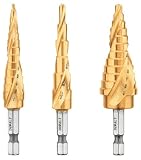
A step bit is useful when you need a clean, round hole larger than roughly 1/4 inch in thin sheet. It enlarges the opening in stages and is less likely than a large twist bit to catch and tear the panel. Its limits are thickness and diameter: check the bit’s rated capacity, and don’t use it on thick stock or when you need a deep hole.
Which bit should you buy?
| Bit type | Best use | Trade-off |
|---|---|---|
| General-purpose HSS twist bit | A few small holes in thin galvanized steel | Lowest cost; dulls sooner and may wander without a pilot or center mark |
| 135-degree split-point HSS bit | More accurate starting and regular sheet-metal work | Costs a little more; still needs moderate speed and pressure |
| Cobalt HSS twist bit | Repeated drilling or tougher steel | Higher price; overkill for occasional thin-sheet holes |
| Step bit | Clean, larger holes in thin panels | Limited by its step range and sheet thickness |
For a basic kit, choose 135-degree split-point HSS drill bits. If the job calls for a larger opening in thin sheet, compare step drill bits for sheet metal. Look for a stated steel-drilling use and a size range that covers your hole; a large assortment is not useful if its common sizes are poor quality.
Drill settings and speed
A standard cordless drill is enough. Set it to low gear if it has two speeds, use the clutch only for driving screws—not drilling—and keep the tool straight. For small bits around 1/8 inch, start near 1,500–2,000 RPM if your drill allows it. For bits around 1/4 inch, roughly 700–1,000 RPM is a sensible starting range. Step bits should also run slowly, commonly around 300–600 RPM in thin sheet. These are practical starting points, not universal ratings: follow the bit maker’s guidance and reduce speed if the bit squeals, smokes, or heats quickly.
High speed and light pressure can polish the surface without cutting. Excessive pressure can bend thin metal, snap a small bit, or make the bit grab as it breaks through. Use firm, controlled pressure; ease off as the point exits. Cutting oil can help during repeated holes, but a small amount is enough. Wipe away residue afterward, especially if the surface will be painted or sealed.
Set up the work to prevent damage
Secure the sheet against a wood backing block or clamp it to a stable support. Unsupported sheet vibrates, buckles, and can wrap around a bit. Keep fingers away from the drilling area, wear eye protection, and remove loose gloves or clothing that could catch. If the panel is already installed, check what lies behind it before drilling: wiring, pipes, and framing can be close to the surface.
Mark the hole, then make a small dimple with a center punch. On very thin material, strike lightly; a hard blow can dent or stretch the sheet. A pilot hole about 1/8 inch can help when using a larger twist bit, but it is not always needed with a sharp split-point bit or a step bit. Drill perpendicular to the panel, and stop once the hole is through rather than pushing the rotating bit into the backing.
Protect the zinc coating
Drilling cuts through the protective zinc layer at the hole edge. Remove sharp burrs with a deburring tool or a few gentle strokes with a file, taking care not to widen the opening. For exterior or damp locations, apply a zinc-rich repair coating to exposed steel according to its instructions. Ordinary paint may cover the edge, but it does not necessarily provide the same corrosion protection.
Do not use a hammer drill’s hammer mode on sheet steel. The impact can distort the panel and make the bit wander; a normal drill setting is the right choice. An impact driver can spin hex-shank bits, but its hammering action is poorly suited to controlled drilling in thin sheet and increases the chance of a rough, oversized hole.
Common problems and fixes
The bit walks: Re-mark the center, add a light punch dimple, or use a split-point bit. Don’t try to steer a spinning bit sideways.
The hole has a torn edge: Clamp the sheet against backing, reduce speed, and ease pressure at breakthrough. For a larger hole, use a step bit instead of forcing a large twist bit through the panel.
The bit squeals or turns blue: Stop and let it cool. It may be dull, running too fast, or cutting without enough pressure. Replace or sharpen a dull bit; more force won’t restore its edge.
The panel dents: Improve support and clamp closer to the hole. Thin sheet can flex even when the drill itself is easy to control.
For just two or three small holes, a basic sharp HSS bit is a reasonable buy. Spend extra on split points for cleaner starts, cobalt for repeated work in tougher steel, or a step bit when hole size and edge quality justify it.