Our Top Picks
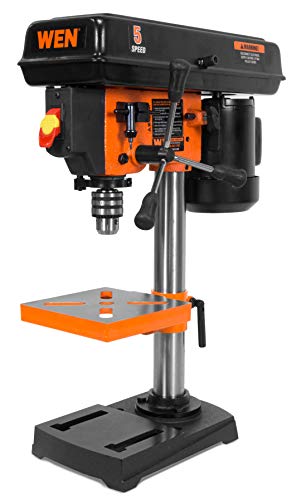 WEN 2.3-Amp 8-Inch 5-Speed Cast Iron Benchtop Drill16.88 x 8.63 x 22.88 inches32 poundsCheck on Amazon
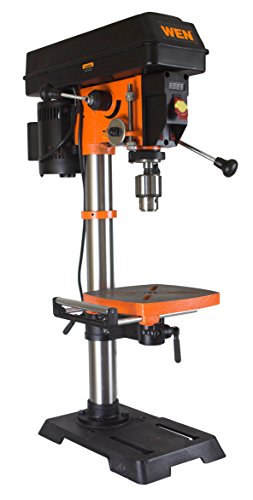


What's inside
As an Amazon Associate I earn from qualifying purchases. This post may contain affiliate links at no extra cost to you.
The best drill press for most home workshops in this group is the WEN 12-Inch Benchtop Drill Press (DP1263V), because it combines a 6.2-amp motor, cast iron construction and a 12-inch swing with variable speed, so it handles woodworking and light metal work without a belt change. A benchtop drill press is a column-mounted drill that lowers a spinning chuck straight down into the work, which is how you get holes that are repeatable and square. If space or budget is tight, the 8-inch WEN 4206T and the SKIL 10-inch model are the compact alternatives.
What we cover
Quick List
- WEN 12-Inch Benchtop Drill Press (DP1263V) – best for the largest swing and variable speed
- WEN 8-Inch 5-Speed Drill Press (4206T) – best for small shops and light-duty work
- SKIL 10-Inch 5-Speed Drill Press (DP9505-00) – best for a mid-size press with laser guidance
- Ironton 8-Inch 1/3 HP Drill Press – best for metalworking-oriented small projects
- VEVOR 10-Inch Swing Drill Press – best for a tilting table at a modest motor rating
- WEN 10-Inch Benchtop Drill Press (DP1062V) – best for a variable-speed press that is smaller than the 12-inch
Which One Is Right for You?
| If you… | Choose |
|---|---|
| need to drill near the center of wide panels and want variable speed | WEN DP1263V 12-Inch |
| want variable speed in a smaller footprint | WEN DP1062V 10-Inch |
| prefer a belt-step press with a laser guide and a work light | SKIL DP9505-00 |
| mostly drill small holes in wood and have little bench space | WEN 4206T 8-Inch |
| plan to drill small metal parts and want a rated horsepower | Ironton 8-Inch 1/3 HP |
| need a 10-inch swing with a tilting table | VEVOR 10-Inch |
Three factors decide most purchases: swing, motor strength and how speeds are changed. Swing tells you how far from the column you can drill, motor amps or horsepower tell you how well the press handles larger bits, and the speed system decides how often you will open the belt cover. If you are unsure, a 10-inch press with at least 5 amps is a comfortable middle ground for a home shop.
All 6 Picks in Detail
1. WEN 12-Inch Benchtop Drill Press (DP1263V) – Best for the Largest Swing and Variable Speed
As an Amazon Associate we earn from qualifying purchases at no extra cost to you.
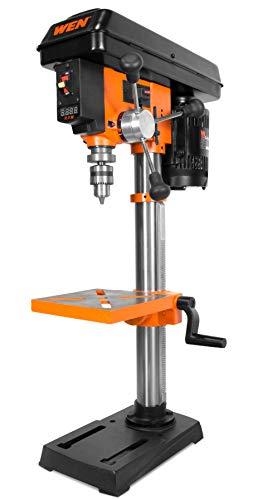
The DP1263V is the biggest press in this set, with a 12-inch swing, a 6.2-amp motor and cast iron construction. It suits woodworkers who drill large panels, hobbyists who switch between Forstner bits and twist bits and anyone who dislikes moving belts. Retailer specifications list a speed range of roughly 580 to 3,100 RPM, a 5/8-inch keyed chuck, about 3-1/8 inches of spindle travel and a 9.5-inch beveling table, so confirm those details on the product page.
- 12-inch swing (about 6 inches from column to chuck center)
- 6.2-amp variable-speed motor
- Cast iron construction
- Laser guide and LED work light
- Chuck, travel and table size: roughly 5/8 inch, 3-1/8 inches and 9.5 inches per retailer specs
Variable speed is a practical benefit. Large bits need low speed, small bits need high speed, and a dial that changes RPM without opening a cover means you actually adjust it for each job.
The press is heavy, roughly in the high-80-pound range according to retailers, so plan a sturdy bench and consider bolting it down. Heavy machines are stable, but you should also lift it with a helper.
Pros
- Large swing and long travel for deeper holes
- Tool-free-style speed changes with a variable dial
Cons
- Heavy and takes a lot of bench space
- Variable-speed mechanisms need periodic upkeep
It is the roomier sibling of the WEN DP1062V, giving you extra swing for a noticeable jump in size.
2. WEN 8-Inch 5-Speed Benchtop Drill Press (4206T) – Best for Small Shops and Light-Duty Work
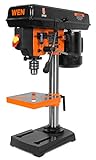
The 4206T is the compact choice: a 2.3-amp motor, an 8-inch swing and a cast iron build in a package that fits on a small bench. It suits hobbyists, model makers and DIYers who drill small holes in wood, plastic and thin metal. Retailer information lists five speeds from about 750 to 3,200 RPM through a belt-and-pulley system, a 1/2-inch keyed chuck, 2 inches of travel and a 6.5-inch table that bevels 45 degrees each way.
- 8-inch swing (4 inches from column to chuck center)
- 2.3-amp motor with five belt-driven speeds
- Cast iron construction
- 1/2-inch keyed chuck (per retailer specs)
- Light enough for a small bench, listed around 32 pounds
Its limits are obvious: only 4 inches from the column, so you cannot reach the middle of a wide board, and a small motor that struggles with large bits.
It is an excellent first press for someone who currently drills by hand. The locking depth stop supports repeatable holes, such as drilling a row of shelf pin holes.
Pros
- Compact and relatively easy to move
- Locking depth stop for repeat holes
Cons
- Small motor limits large-diameter bits
- Short throat and short travel
Compared with the SKIL 10-inch, it is smaller and lighter, but also less capable with bigger bits.
3. SKIL 10-Inch 5-Speed Benchtop Drill Press (DP9505-00) – Best for a Mid-Size Press with Laser Guidance
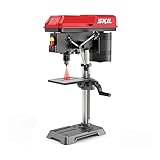
The SKIL DP9505-00 is a 10-inch, 6.2-amp press with five speeds, a laser alignment aid and a work light. It fits homeowners who want more power than an 8-inch press without the footprint of a 12-inch. Retailer specifications list speeds between roughly 610 and 2,800 RPM, a 1/2-inch keyed chuck, 2 inches of spindle travel and a cast iron table that tilts 45 degrees each way, with an overall weight of roughly 48 pounds.
- 10-inch swing (5 inches from column to chuck center)
- 6.2-amp induction motor
- Five belt-step speeds
- Laser alignment and LED light
- 1/2-inch keyed chuck and 2 inches of travel (per retailer specs)
The speeds are changed by moving the belt between pulley steps, which takes a minute but keeps the mechanism simple and durable.
The laser is useful for quick lining up, although for real accuracy you should still use a punch mark and clamp the work. Treat the laser as a guide, and recheck it from time to time.
Pros
- Good power-to-size balance
- Simple belt-step speed system
Cons
- Only 2 inches of spindle travel
- Belt changes interrupt work flow
It is the belt-driven alternative to the WEN DP1062V, which swaps the belt for a variable dial at the same swing.
4. Ironton 8-Inch 1/3 HP Benchtop Drill Press – Best for Small Metalworking Projects

The Ironton press carries an 8-inch swing and a 1/3 horsepower motor, with five speeds. Its listing positions it for metal fabrication and workshop use, which suits hobbyists drilling brackets, small plates and similar parts. Horsepower is an honest rating figure, which makes it easier to compare with other induction motors than a bare amp number. Chuck size, travel, table dimensions and weight are not shown in the listing name, so confirm them on the product page.
- 8-inch swing
- 1/3 HP motor
- Five speeds
- Positioned for metal and general workshop drilling
- Chuck, travel, table size and weight: confirm on listing
With a 1/3 HP motor, drilling steel should be done with sharp bits, cutting oil and moderate pressure. Bits over 3/8 inch will be demanding.
It is a fit for a bench that sees small, steady jobs rather than production work. A small shop that wants a no-nonsense press can find value here.
Pros
- Stated horsepower rating for the motor
- Compact size for small benches
Cons
- Few specifications in the listing name
- Limited reach with an 8-inch swing
Compared with the WEN 4206T, it offers a stated horsepower, while the WEN gives clearer details on chuck and travel.
5. VEVOR 10-Inch Swing Benchtop Drill Press – Best for a Tilting Table at a Modest Motor Rating

The VEVOR press is described as a 3.2-amp, five-speed unit with a 10-inch swing, a cast iron frame and a worktable that tilts from 0 to 45 degrees. It suits hobbyists who want a roomy throat and an angled table for drilling at an angle without spending on a larger motor. The lower amperage means it is best for wood, plastics and thin metals rather than constant heavy drilling.
- 10-inch swing
- 3.2-amp motor with five speeds
- Cast iron frame
- Worktable tilts 0 to 45 degrees
- Chuck size, travel and weight: confirm on listing
The motor rating is roughly half that of the 6.2-amp presses, so it will be slower to cut and more likely to stall with large bits.
Use lower speeds and a lighter feed rate with it, and let the bit do the cutting. For occasional use in a hobby shop, that is acceptable.
Pros
- 10-inch swing in a lighter-motor package
- Tilting table for angled holes
Cons
- Lower motor rating than the 6.2-amp rivals
- Less published detail on the chuck
It shares the swing of the SKIL and WEN 10-inch presses but pairs it with a weaker motor, so it makes sense only if its price or table is the draw.
6. WEN 10-Inch Benchtop Drill Press (DP1062V) – Best for Variable Speed in a Smaller Frame
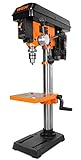
The DP1062V is the 10-inch sibling of the DP1263V, listed with a 6.2-amp variable-speed motor, cast iron construction and a laser guide. It is a good fit for woodworkers who want to change speed on the fly but have limited bench space. The listing name does not give the speed range, chuck size or travel, so confirm them on the product page and do not assume they match the 12-inch model.
- 10-inch swing
- 6.2-amp variable-speed motor
- Cast iron construction
- Laser guide
- Speed range, chuck and travel: confirm on listing
Variable speed is helpful when you move between small twist bits and larger Forstner bits in the same project.
A press like this suits furniture builders, instrument makers and general DIYers who value flexibility. Align the table to the chuck with a square before important work.
Pros
- Variable speed without belt changes
- Strong motor rating for its size
Cons
- Fewer published specifications than the 12-inch
- Variable-speed mechanisms add moving parts to maintain
Compared with the SKIL DP9505-00, it replaces belt steps with a dial, and the SKIL adds a more defined spec sheet.
Specs Compared
| Model | Swing | Motor | Speeds | Chuck | Spindle travel | Table tilt |
|---|---|---|---|---|---|---|
| WEN DP1263V | 12 in | 6.2 A | Variable (about 580-3,100 RPM per retailer specs) | 5/8 in (retailer specs) | 3-1/8 in (retailer specs) | Bevels (confirm angle on listing) |
| WEN 4206T | 8 in | 2.3 A | 5 (about 750-3,200 RPM) | 1/2 in | 2 in | 45 degrees each way |
| SKIL DP9505-00 | 10 in | 6.2 A | 5 (about 610-2,800 RPM) | 1/2 in | 2 in | 45 degrees each way |
| Ironton 8-in | 8 in | 1/3 HP | 5 | confirm on listing | confirm on listing | confirm on listing |
| VEVOR 10-in | 10 in | 3.2 A | 5 | confirm on listing | confirm on listing | 0-45 degrees |
| WEN DP1062V | 10 in | 6.2 A | Variable (range: confirm on listing) | confirm on listing | confirm on listing | confirm on listing |
How We Chose These
This list is built from research on the six presses in the current catalog set, not from bench work. We compared swing, motor rating, speed system, table tilt and the construction details each listing names, then checked those fields against manufacturer pages and retailer specification sheets where they were available. We gave more weight to motor strength, stated cast iron construction and documented speed range than to extras like lasers. Several listings leave out chuck size and travel, and we marked those for confirmation rather than assuming. We also treated swing, motor rating and mechanism type as the three main separators, since they predict what you can drill and how often you will adjust the machine.
What to Look For
Swing and throat distance
Swing is the diameter of the largest circle you can drill the center of, so it equals twice the distance from the column to the chuck. A 10-inch swing means the bit is 5 inches from the column, and an 8-inch swing means 4 inches. That determines the widest board where you can drill the center. If you build cabinets with 12-inch panels, a 10-inch press can reach the middle of a 10-inch board but not a 12-inch one, so match swing to your projects. A worked example: to drill the center of a 14-inch wide tabletop apron, you need a swing of at least 14 inches, which no press here offers, so you would flip the board and drill from both sides or use a guide.
Motor power and speed system
Motor amps indicate how much current the motor draws, and higher numbers generally mean more capability under load. A 2 to 3-amp motor is fine for small bits in wood. For 1/2-inch and larger bits, or sustained metal drilling, 5 to 6-amp motors perform more comfortably. Belt-step systems use pulleys to give fixed speeds such as 600, 1,000, 1,500, 2,000 and 3,000 RPM; moving the belt takes a minute and is dependable. Variable-speed systems adjust with a dial or lever while running, which is convenient but adds parts that can wear. For woodworkers who switch bits frequently, variable speed saves time.
Speed selection and bit size
As a rule of thumb, the larger the bit, the slower the speed. Small twist bits under 1/4 inch can run at 2,000 to 3,000 RPM in wood. Forstner bits of 1 inch or more should run at 500 to 1,000 RPM, and 2-inch bits much slower. For mild steel, a general guideline is around 1,000 to 1,500 RPM for a 1/4-inch bit and 500 to 700 RPM for 1/2 inch, with cutting oil. Always check the bit manufacturer’s guidance. Running too fast burns bits and wood, while running too slow can cause chatter or stall the motor.
Table, chuck and travel
A cast iron table that tilts 45 degrees each way allows angled holes, and slots let you secure a vise or clamps. A 1/2-inch chuck is common on 8 to 10-inch presses; a 5/8-inch chuck gives you more bit options. Spindle travel, the vertical distance the chuck can drop, limits hole depth in a single stroke. Two inches of travel is common, and 3 inches is better for thick stock. A locking depth stop makes repeat holes easy.
Safety and setup
Clamp the workpiece every time, because a spinning bit can grab and whirl a loose piece. Remove the chuck key before starting, avoid gloves and loose sleeves, and tie back long hair. Wear eye protection. Bolt the press to a stable bench or stand, and plug it into a properly grounded outlet. Never force the bit; retract regularly to clear chips. Disconnect the power before changing belts or opening the cover.
Bench, stand and weight
A benchtop press is only as steady as the surface under it. Presses in this class range from around 30 pounds for the smallest 8-inch units to the high 80s for the largest cast iron models, and the heavier machines are usually quieter and steadier at speed. Put the press on a bench made of thick plywood or solid lumber, ideally with the column near a leg or support, and bolt through the base holes with washers. Leave room behind the press for the belt cover to open and room around the table for long stock; a press jammed into a corner is annoying to adjust. If you work with long boards, an outfeed support at table height keeps them from tipping when you drill near an end.
Upkeep and accuracy checks
Every few months, wipe the column with a light oil to keep the head and table moving smoothly, check the belt for glazing or cracks and make sure the chuck is seated firmly on its taper. To check for runout, chuck a straight rod, spin the spindle by hand and watch the end of the rod against a fixed pointer; visible wobble means the chuck, the taper or the bearings need attention. To check that the table is square, clamp a small machinist square against the column and bit, then compare the gap along the length of the bit. If the table does not sit square after tightening, shim it or look for a locking screw that is not fully tightened. Keeping these basics in order often matters more than the difference between two similar models.
Chips, dust and everyday habits
Drilling wood produces fine dust and metal produces sharp chips, so keep a brush nearby instead of clearing the table with your hand, and use a shop vacuum with a hose near the bit when you drill MDF or hardwood. A sacrificial board on the table protects both the table and the underside of the workpiece, and it prevents tear-out where the bit exits. Rotate the board or replace it when it becomes pocked with holes. Finally, keep a few spare belts and a spare chuck key (stored away from the machine, not in it) so a simple failure does not stop a project, and look at the warranty length that each listing states before you buy.
Questions
Is a drill press worth it if I already own a cordless drill?
Yes, if you need repeatable, square holes or you drill large bits. A press holds the bit perpendicular and controls depth, which a hand-held drill cannot do consistently.
What size drill press do I need for a home workshop?
A 10-inch swing with a 5 to 6-amp motor covers most home tasks. An 8-inch press is enough for small items, while a 12-inch is better for wider panels.
Variable speed or belt-step speeds?
Variable speed is faster to change, which helps if you switch bits often. Belt-step presses are simpler and rugged, so they suit users who set a speed and stay there.
Can a benchtop drill press drill metal?
Yes, with proper speed, cutting oil and sharp bits, especially on mild steel and aluminum. Smaller motors will struggle with large bits in steel, so choose a stronger motor if metal is the focus.
Do I need to bolt the press down?
It is recommended. Bolting prevents tipping and vibration, particularly with larger bits and heavy stock. The base on most benchtop presses has holes for this.
What is spindle travel?
It is the distance the chuck can move down in one stroke. If your holes are deeper than the travel, you drill part way, raise the table or reposition the work, then finish the hole.
Update History
- October 20, 2026 – Initial publication; product set drawn from current catalog listings.
- Check the product page for current specifications and availability before buying.
Sources
- Manufacturer product and specification pages for WEN, SKIL and VEVOR
- Retailer listing titles and specification fields for each drill press