What's inside
- What a drill stand can—and cannot—do
- The specifications that matter when choosing
- Best drill-stand type for each situation
- Stroke depth versus working height
- Alignment: the feature that separates useful stands from frustrating ones
- How to convert a hand drill into a press safely
- Ownership realities: what wears first
- Bottom line
- What a drill stand can—and cannot—do
- The specifications that matter when choosing
- Best drill-stand type for each situation
- Stroke depth versus working height
- Alignment: the feature that separates useful stands from frustrating ones
- How to convert a hand drill into a press safely
- Ownership realities: what wears first
- Bottom line
As an Amazon Associate I earn from qualifying purchases. This post may contain affiliate links at no extra cost to you.
To turn a hand drill into a press, mount it in a purpose-built drill stand with a rigid column, adjustable depth stop, and a chuck opening large enough for your drill body; the best choice depends on the holes you make, not simply on the stand’s maximum height.
As an Amazon Associate we earn from qualifying purchases at no extra cost to you.


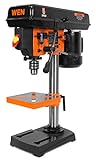
What we cover
- What a drill stand can—and cannot—do
- The specifications that matter when choosing
- Best drill-stand type for each situation
- Stroke depth versus working height
- Alignment: the feature that separates useful stands from frustrating ones
- How to convert a hand drill into a press safely
- Ownership realities: what wears first
- Bottom line
What a drill stand can—and cannot—do
A drill stand clamps a corded or cordless hand drill in a guided carriage. A lever then moves the drill vertically toward the workpiece, giving you more consistent hole location, straighter entry, and better control than holding the tool by hand. In that sense, it can convert a drill into a compact press for woodworking, light metalwork, plastics, and other low-load jobs.
It does not turn a hand drill into a full-size drill press. The drill’s bearings, chuck, motor, speed control, and side-to-side play remain part of the system. A stand is most useful when you need repeatable holes in boards, dowels, hinges, or jigs, but do not have room for a dedicated machine.
The specifications that matter when choosing
| Stand characteristic | Entry-level target | More capable target | Why it matters |
|---|---|---|---|
| Usable stroke | 50–60 mm (2–2⅜ in) | 70–90 mm (2¾–3½ in) | Determines how deeply you can drill in one lever movement |
| Drill chuck capacity | 1.5–10 mm | 1.5–13 mm | Limits the bit diameter and helps match the stand to your drill |
| Column diameter | About 25 mm (1 in) | About 40–45 mm (1½–1¾ in) | A larger column normally resists twisting and flexing better |
| Base footprint | Approximately 150 × 150 mm | Approximately 200 × 200 mm or larger | A bigger base is harder to tip and supports wider workpieces |
| Working height | Up to roughly 200 mm | Up to roughly 250–300 mm | Sets the maximum distance between the base and drill chuck |
| Stand mass | 2–4 kg | 4–8 kg | Weight reduces vibration, but makes storage and transport less convenient |
These are useful buying benchmarks rather than universal specifications. Always check the manufacturer’s compatibility chart: some stands clamp a drill’s neck, while others use a cradle around the motor housing. A drill with an unusually large battery, oversized gearbox, or offset handle may not fit even when its chuck size is suitable.
Best drill-stand type for each situation
| Your situation | Best choice | Reason | Trade-off |
|---|---|---|---|
| Occasional dowels, hinges, and hardware | Basic cast or reinforced polymer stand | Low cost and adequate guided movement | More flex and smaller base |
| Frequent woodworking and repeated holes | Metal stand with rack-and-pinion feed | Better alignment, smoother depth control, and longer service life | Heavier and more expensive |
| Portable work on large panels | Compact stand with a broad, clampable base | Can be secured directly to a bench or workpiece support | Usually has less stroke and working height |
| Large bits or demanding metalwork | Dedicated drill press | More rigid spindle, deeper throat, and purpose-built speed control | Higher cost and permanent bench or floor space |
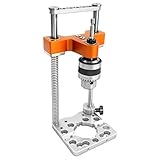
Products such as the Wolfcraft drill stand range illustrate the general portable-stand format: a collar or cradle holds a hand drill, and a lever moves it along a column. Similar stands are sold under several woodworking-tool brands. Compare the actual column, base, carriage, and mounting dimensions rather than choosing by brand name alone.
Stroke depth versus working height
These measurements are often confused. Stroke depth is how far the carriage travels when you pull the lever. Working height is the available distance from the base to the drill’s chuck or bit. A stand can have 80 mm of working height but only 50 mm of stroke, meaning you may need to raise or reposition the workpiece for a deeper hole.
For example, suppose a stand has a 60 mm stroke and you need a 75 mm deep hole in a thick laminated assembly. You cannot produce that depth in one downward movement. You can drill 60 mm, retract the bit, clear chips, and lower the carriage or reposition the work, but the second setup introduces alignment risk. For deep holes, select at least 75–90 mm of usable stroke or use a dedicated drill press.
Alignment: the feature that separates useful stands from frustrating ones
Look for a carriage that surrounds the column rather than riding on a single narrow guide. Metal guide rods, broad bearing surfaces, and a rack-and-pinion feed generally hold alignment better than a thin plastic slide. The base should have a flat underside, clamping slots, or holes for bolting it to a bench.
Check whether the drill mount can be adjusted square to the base. Even a small angular error becomes visible in a deep hole. A practical check is to install a straight bit or rod, lower it close to the base, rotate the drill by hand, and watch for the tip orbiting. Then place a small engineer’s square or reliable combination square beside the rod. If the rod is not perpendicular in both directions, correct the mount before drilling valuable work.
How to convert a hand drill into a press safely
- Confirm compatibility. Match the drill’s body or collar diameter to the stand’s clamp range. Remove the battery before fitting a cordless drill.
- Secure the stand. Bolt it to a bench where possible. If that is not practical, clamp the base and support the workpiece independently. Do not rely on your hand to hold the base down.
- Install the drill and bit. Tighten the chuck evenly and keep the bit’s shank fully seated without bottoming out in the chuck.
- Set the depth stop. Measure from the base to the workpiece surface, then account for the required hole depth. Test on scrap before the finished part.
- Support the work. Use a sacrificial board beneath through-holes. Clamp narrow pieces so they cannot rotate around the bit.
- Select the correct speed. Use slower settings for large bits and many metals, and faster settings for small bits in wood when the bit manufacturer permits it. A stand does not provide the speed range of a dedicated drill press.
- Feed steadily. Lower the lever without forcing it. Withdraw periodically from deep holes to clear chips and reduce heat.
- Disconnect before adjustments. Remove the battery or unplug the drill before changing bits, moving the carriage, clearing a jam, or taking the drill out of the mount.
Keep loose sleeves, hair, and gloves away from a rotating chuck. Do not use a damaged bit, and do not use a stand as a substitute for a guard when drilling abrasive or brittle materials. A trigger lock can cause the drill to keep running during an accident, so use only the operating method recommended by the drill and stand manufacturers.
Ownership realities: what wears first
The first problems are usually not the column itself. Dirt and sawdust can enter the carriage, causing rough travel or play. The clamp screw can loosen, plastic bushings can wear, and the depth-stop threads can become inaccurate. On budget stands, the drill cradle may flex before the column does.
After use, brush or vacuum debris from the column and carriage rather than blowing dust into the mechanism. Wipe exposed metal dry and apply only the lubricant specified by the manufacturer; excess oil attracts abrasive dust. Periodically check the column bolts, base fasteners, clamp screw, and rack-and-pinion engagement. If the carriage rocks when the lever is moved, repair or replace the worn guide parts before relying on the stand for precision work.
Bottom line
A drill stand is a sensible way to convert a hand drill into a press when portability, low cost, and occasional precision matter. Choose a metal, securely mountable stand with at least 60 mm of stroke for general woodworking, a 13 mm-compatible mount if your drill and bits require it, and the largest rigid column your workspace can accommodate. If you routinely drill deep holes, use large cutters, or need consistently square holes in hard material, the extra rigidity and spindle control of a dedicated drill press will justify the space.