What's inside
As an Amazon Associate I earn from qualifying purchases. This post may contain affiliate links at no extra cost to you.
For a standard M10 x 1.5 coarse thread, use an 8.5 mm drill bit; for M10 x 1.25 fine thread use 8.8 mm, and for M10 x 1.0 extra-fine use 9.0 mm. Those sizes give roughly 75 to 77 percent thread engagement, the industry standard balance between strength and easy tapping. If you only have inch bits, a letter Q (0.332 in) is the closest substitute for the M10 x 1.5 tap drill. The rest of this guide covers the full chart, how to work out the size for any pitch, which bits and taps to buy, and how to tap the hole without breaking anything.
As an Amazon Associate we earn from qualifying purchases at no extra cost to you.


What we cover
M10 tap drill chart
The pitch is the distance between threads in millimeters. If your tap is marked just “M10”, it is almost certainly the 1.5 mm coarse pitch.
| Thread | Pitch | Cut tap drill | Approx. thread % | Form (roll) tap drill | Typical use |
|---|---|---|---|---|---|
| M10 x 1.5 (coarse) | 1.5 mm | 8.5 mm | ~77% | ~9.3 mm | General bolts, machinery, brackets |
| M10 x 1.25 (fine) | 1.25 mm | 8.8 mm | ~74% | ~9.4 mm | Automotive, some brake and suspension parts |
| M10 x 1.0 (extra fine) | 1.0 mm | 9.0 mm | ~77% | ~9.5 mm | Some automotive fittings, sensors, banjo bolts |
| M10 x 0.75 | 0.75 mm | 9.25 mm | ~77% | ~9.65 mm | Specialty fine threads |
Form (roll) taps do not cut chips; they push metal into shape, so they need a larger hole. Use the form-tap column only if your tap is labeled as a forming or fluteless tap.
How to work out the tap drill for any metric thread
The quick rule is: tap drill = major diameter minus pitch. For M10 x 1.5, that is 10 – 1.5 = 8.5 mm. It works for every standard metric cut tap and gives about 75 to 77 percent thread.
If you need to check the thread percentage for a different bit, use: thread % = 76.98 x (major diameter – drill diameter) / pitch. For example, an 8.6 mm drill in M10 x 1.5 gives 76.98 x 1.4 / 1.5 = about 72 percent, which is easier to tap in stainless steel and still strong enough for most jobs.
Inch drill substitutes
If your drill index is fractional or letter-sized, these are the closest matches. Higher percentages make stronger threads but are much harder to tap; anything above about 80 percent risks breaking the tap in steel.
| Metric thread | Inch bit | Diameter | Approx. thread % | Verdict |
|---|---|---|---|---|
| M10 x 1.5 | Letter Q | 0.332 in (8.43 mm) | ~80% | Closest, fine in aluminum and mild steel |
| M10 x 1.5 | Letter R | 0.339 in (8.61 mm) | ~71% | Easier tapping in stainless and tough steel |
| M10 x 1.5 | 21/64 in | 0.328 in (8.33 mm) | ~86% | Too tight for steel; avoid |
| M10 x 1.25 | 11/32 in | 0.344 in (8.73 mm) | ~78% | Good substitute |
| M10 x 1.25 | Letter S | 0.348 in (8.84 mm) | ~71% | Good substitute |
| M10 x 1.0 | Letter T | 0.358 in (9.09 mm) | ~70% | Acceptable |
Do not confuse a 10 mm tap with a #10 tap
A “#10” tap is an inch Unified thread, about 4.8 mm in diameter, and needs a far smaller bit: a #25 drill (0.1495 in) for 10-24 UNC and a #21 drill (0.159 in) for 10-32 UNF. If your bolt measures around 3/16 in across, you have a #10 thread, not M10.
Clearance holes for M10 bolts
If the bolt passes through one part and threads into another, the top part needs a clearance hole, not a tap drill.
| Fit | Hole size | When to use |
|---|---|---|
| Close | 10.5 mm | Accurate alignment, dowel-like location |
| Normal | 11 mm | Most general assemblies |
| Loose | 12 mm | Allowing adjustment or poor alignment |
Which drill bits and taps to buy
Drill bits
- Cobalt (M35 or M42) jobber bit, 8.5 mm: the best all-round choice for steel and stainless. Irwin, DeWalt and Milwaukee all sell cobalt bits in metric sizes, either individually or in metric sets.
- HSS bit: fine for aluminum, brass and mild steel in small quantities.
- A metric set from 1 to 10 mm in 0.5 mm steps covers tap drills for M3 through M10 coarse; 8.8 mm and 9.0 mm usually need to be bought separately.
- A center drill or spotting drill to start the hole exactly where you want it.
Taps
| Tap type | Best for | Typical price (M10) |
|---|---|---|
| Taper / plug / bottoming hand tap set | Hand tapping; bottoming finishes blind holes | $15-$40 per set |
| Spiral point (gun) tap | Through holes; pushes chips ahead, strong | $10-$30 |
| Spiral flute tap | Blind holes; pulls chips out | $12-$35 |
| Forming (roll) tap | Aluminum, mild steel, production; no chips | $15-$40 |
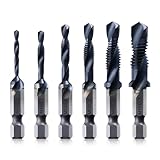
| Combination drill-tap bit (hex shank) | Thin sheet metal with a drill/driver | $8-$20 |
Irwin Hanson tap and die sets are a common starting point for home workshops, while OSG and other industrial brands are the go-to for machine tapping and harder materials.
Step-by-step: drilling and tapping an M10 x 1.5 hole
- Mark and center punch the location, then spot it with a center drill so the 8.5 mm bit does not wander.
- Pilot drill with a 4 to 5 mm bit in steel; it makes the larger bit cut straighter and with less force.
- Drill 8.5 mm at moderate speed with cutting oil. For a blind hole, drill deeper than the full thread length you need by the length of the tap’s tapered lead plus a little chip room, roughly 5 to 8 mm extra for an M10 plug tap.
- Chamfer the hole slightly larger than 10 mm so the first thread does not burr up.
- Start the tap square using a tap guide or the drill press chuck (turned by hand, power off).
- Tap with oil, turning about half a turn forward and a quarter back to break chips with straight-flute hand taps; spiral taps can usually run continuously.
- Finish blind holes with a bottoming tap and blow chips out between taps.
Common mistakes
- Using a too-small hole because the bit size was rounded down; this is the number one cause of broken taps.
- Tapping crooked, which produces a bolt that leans and threads that strip early.
- Running dry in steel; cutting oil reduces torque and improves the finish.
- Hitting the bottom of a blind hole with the tap; mark the depth on the tap with tape.
Wear safety glasses, clamp the work securely, and never hold small parts by hand when drilling 8.5 mm holes in metal.