What's inside
As an Amazon Associate I earn from qualifying purchases. This post may contain affiliate links at no extra cost to you.
A light shelf is still a lever. A few books or a small plant near the front edge can pull harder on the fasteners than the shelf’s empty weight suggests. The right anchor depends on the shelf’s total loaded weight, how far it projects from the wall, and whether you can hit a stud—not just the diameter of the screw.
As an Amazon Associate we earn from qualifying purchases at no extra cost to you.



What we cover
Start with the wall and the load
Check the shelf maker’s weight rating and include the shelf itself, brackets, and everything you plan to set on it. Treat that as a working load, not a reason to load every anchor to its advertised maximum. Anchor ratings vary by drywall thickness, installation quality, and direction of pull. A shelf bracket can pry an anchor outward, which is more demanding than simply hanging a picture flat against the wall.
Use a stud finder and confirm likely stud locations with a small pilot hole or by checking for a change in resistance. Standard framing is often 16 inches on center, but it is not guaranteed. If you can fasten a bracket into a stud, do it; a wood screw into framing is generally more dependable than a drywall anchor. For a bracket that spans a stud and drywall, use a suitable screw in the stud and an anchor only for the other attachment point.
For a shelf that will hold heavy books, dishes, or anything breakable, seek studs or use a mounting system designed for that load. Anchors are not a substitute for adequate brackets or a shelf with a sensible projection.
Which anchor type fits a light shelf?
| Anchor type | Best use | Trade-off |
|---|---|---|
| Plastic expansion plug | Very light loads and small screws | Cheap and simple, but has limited resistance to a bracket pulling away from drywall |
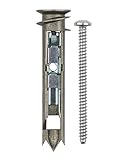
| Self-drilling threaded anchor | Light shelves when the bracket holes accept its screw size | Fast to install, but can strip or damage drywall if overdriven |
| Hollow-wall toggle or strap toggle | Higher loads where no stud is available | Spreads force behind the board, but needs a larger hole and enough cavity depth |
| Molly bolt | Permanent mounting in suitable hollow walls | Can be strong when set correctly, but installation is less forgiving and removal leaves a larger hole |
For a genuinely light shelf—say, a small display shelf holding a few lightweight items—a quality self-drilling anchor may be adequate if the bracket maker allows that fastener and the wall is sound. Compare self-drilling drywall anchors by their stated screw size and wall-thickness range, not by a high load number printed on the package.
For more margin in hollow drywall, a toggle-style fastener is usually the better choice. Its rear plate or wings bear against a wider area of the back of the board. A strap toggle anchor kit is convenient where you can make the required hole and have access to the cavity. Check the package for minimum wall thickness and required hole diameter before buying.
Choose by the shelf you’ll actually use
Use plastic plugs only for low-consequence, very light duty; they are the budget choice, not the best default for a projecting shelf. A self-drilling anchor is a reasonable low-cost option for a small shelf with a short projection and a modest load. It is less suitable if the shelf will be bumped, loaded unevenly, or used to support several pounds near its front edge.
If the shelf is expected to carry a meaningful load and there is no stud behind the bracket, favor a correctly sized toggle or other hollow-wall fastener with a published rating for the actual wall material. Do not assume that two anchors double the safe capacity: bracket geometry and uneven loading can put most of the force on one fastener. If the shelf instructions specify a fastener type or minimum number of attachments, follow those instructions.
Drywall thickness matters. Many homes use 1/2-inch board, but 5/8-inch board and multiple layers are also common. A toggle that is too short may not open fully; one that is too long may have excessive movement. Check the fastener’s grip range and make sure there is clear space behind the hole for the toggle to open. Avoid drilling where wiring or plumbing may be present.
Install without weakening the wall
Mark the bracket holes level, then verify that the anchor body and screw fit the bracket. Drill the hole size specified on the package. A cordless drill with a sharp bit is enough for ordinary drywall; a hammer drill is meant for masonry and can make a ragged, oversized hole in gypsum board. Use a standard drill setting, moderate speed, and light pressure.
For a self-drilling anchor, turn it in straight until its flange sits flush. Stop if it spins, crushes the paper face, or sinks below the surface: the hole may be oversized or the drywall damaged. For a toggle, install it according to its directions, set the rear plate fully, and tighten the screw snugly without crushing the board. Do not use an impact driver for final tightening. Its sudden torque can strip an anchor or break the drywall before you feel the problem.
Hang the empty shelf and check for movement before loading it. If a bracket rocks, the screw turns without tightening, or the drywall cracks or dimples, remove the load and fix the attachment rather than tightening harder. A larger anchor may not solve damaged board; move the hole, use a suitable toggle in sound drywall, or attach to framing.
A practical buying checklist
Before purchasing, note the bracket-hole diameter, screw diameter and length, drywall thickness, cavity clearance, and the shelf’s intended loaded weight. Buy an anchor system that matches all five. A small assortment can be useful for household jobs, but do not mix an anchor with a random screw unless the manufacturer says the sizes are compatible. For a single light shelf, the cheapest suitable fastener is fine; spend more for a toggle when the load, projection, or consequences of a fall justify the added holding area.